


Experimental study on high-temperature creep-fatigue sequential coupling performance of Q345 steel for bridge
-
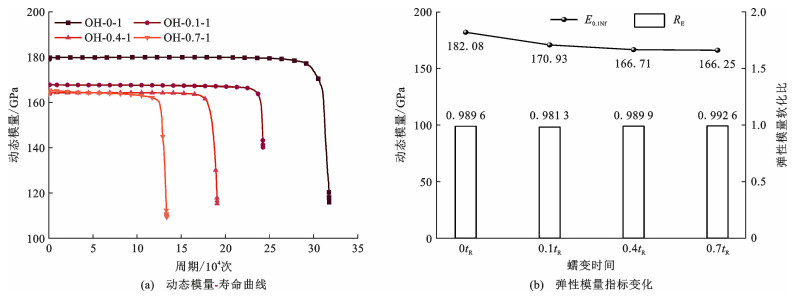
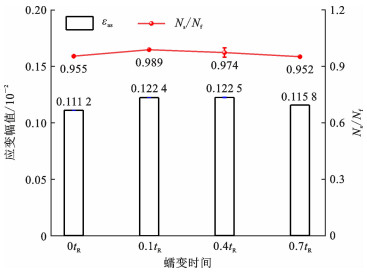
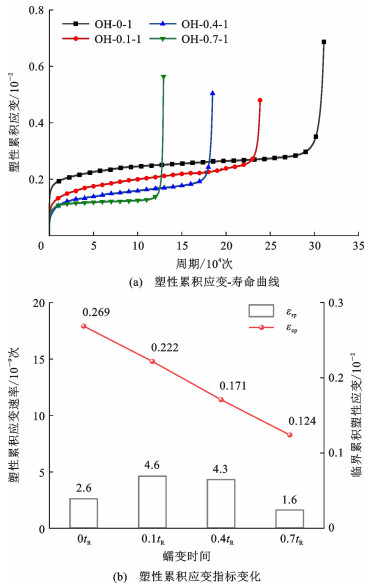
摘要: 针对火灾后桥梁钢结构疲劳性能评估的实际需求,以桥梁工程广泛应用的Q345低碳合金钢为研究对象,设计了4类7组共15个圆棒标准狗骨状试件,系统探究了持力状态下不同蠕变损伤时间对钢材冷却后残余变形及疲劳性能的影响规律。研究结果表明:随着高温蠕变时间由0增加至0.7倍蠕变断裂时间,高温蠕变-疲劳时序耦合试件的平均疲劳寿命减少,从32.2万次降低至11.5万次,降低了64.4%;高温蠕变-疲劳耦合作用使断口转为杯锥状并缩小疲劳扩展区,这主要源于氧化脱碳与蠕变损伤导致的材料承载能力下降,从而加速了疲劳破坏;不同高温蠕变时间对试件的疲劳动态弹性模量影响较小,弹性模量软化比接近1.0,初始动态弹性模量最大仅减少了8.7%;临界累积塑性应变随着蠕变时间增加而显著降低,最大降幅达55.6%,而塑性应变累积速率基本不变。随着蠕变时间的增加,高温蠕变损伤降低了时序疲劳的累积塑性变形容限,使材料在更小的塑性应变水平下加速软化与失效。本研究可为火灾受损桥梁钢结构的疲劳性能评估与剩余寿命预测提供试验依据与理论参考。Abstract: To meet the practical demand for fatigue performance assessment of bridge steel structures after fire, Q345 low-carbon alloy steel, which is widely used in bridge engineering, was selected as the research object. A total of 15 standard cylindrical dog-bone specimens were designed in 4 categories and 7 groups. The influence law of different creep damage durations under sustained loading on the residual deformation and fatigue performance of the steel after cooling was systematically investigated. The results show that as the high-temperature creep time increases from 0 to 0.7 times the creep rupture time, the average fatigue life of the sequential creep-fatigue coupling specimens decreases from 3.22×10⁵ cycles to 1.15×10⁵ cycles, representing a reduction of 64.4%. The sequential creep-fatigue coupling effect transforms the fracture morphology into a cup-and-cone shape and shrinks the fatigue propagation zone. This is mainly due to the reduction in material load-bearing capacity caused by oxidation decarburization and creep damage, which accelerates fatigue failure. Different high-temperature creep times have little effect on the dynamic elastic modulus of the specimens. The softening ratio of the elastic modulus is close to 1.0, and the initial dynamic elastic modulus decreases by only 8.7% at maximum. The critical cumulative plastic strain decreases significantly with increasing creep time, with a maximum reduction of 55.6%, while the plastic strain accumulation rate remains basically unchanged. As the creep time increases, the high-temperature creep damage reduces the cumulative plastic deformation tolerance of the sequential fatigue process, causing the material to accelerate softening and fail at lower plastic strain levels. This study can provide an experimental basis and theoretical reference for the fatigue performance assessment and residual life prediction of fire-damaged bridge steel structures.
-

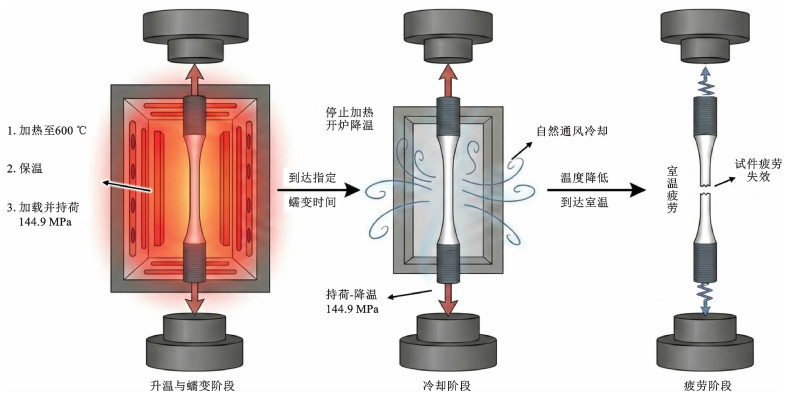
图 4 高温蠕变-疲劳时序耦合试验流程
Figure 4. High-temperature creep-fatigue sequential coupling test process

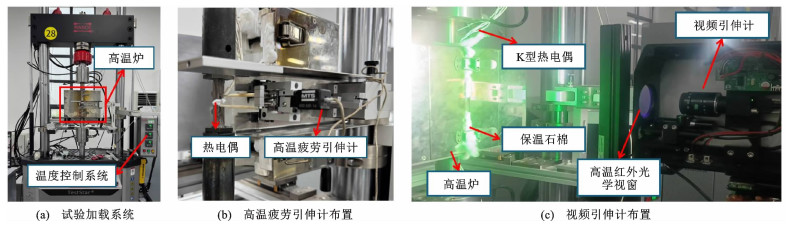
图 5 高温蠕变-疲劳时序耦合试验系统和测点布置
Figure 5. System and measurement points layout of high-temperature creep-fatigue sequential coupling test

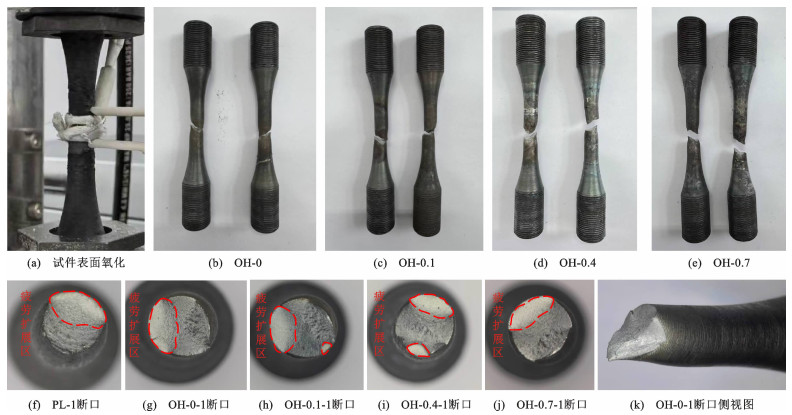
图 6 高温蠕变-疲劳时序耦合试件破坏模式
Figure 6. Failure pattern of high-temperature creep-fatigue sequential coupling specimens

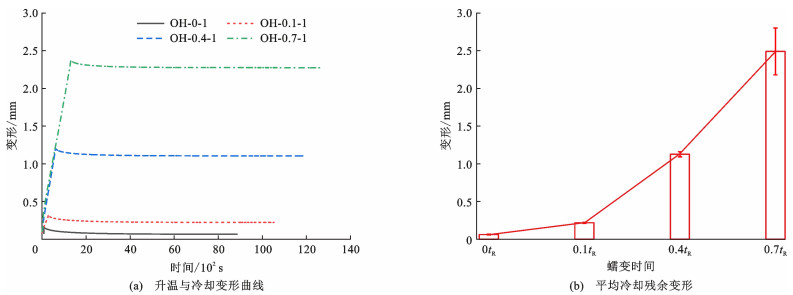
图 7 高温蠕变-疲劳时序耦合试件冷却残余变形
Figure 7. Cooling residual deformation of high-temperature creep-fatigue sequential coupling specimens
表 1 Q345低碳合金钢主要化学成分质量分数和碳当量
Table 1. Mass fraction of main chemical elements and CEV in Q345 low-carbon alloy steel
化学成分质量分数/% C Si Mn P S Ni Als Cr Cu CEV 0.160 0.330 1.480 0.015 0.006 0.010 0.032 0.060 0.020 0.420  下载: 导出CSV
表 2 基本力学性能试验结果
Table 2. Test results for basic mechanical properties
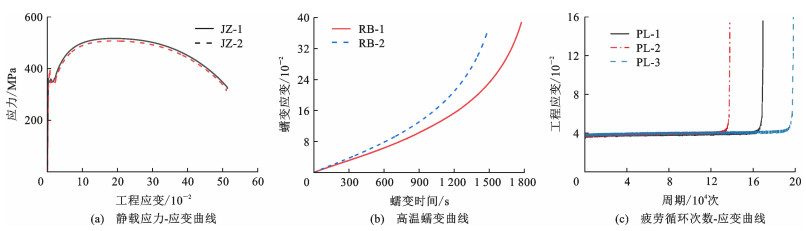
试件编号 力学性能 试件编号 高温蠕变性能 试件编号 疲劳性能 屈服强度/MPa 极限强度/MPa 弹性模量/MPa 蠕变断裂时间/s 疲劳寿命/次 JZ-1 346.27 516.83 213 636 RB-1 1 769.52 PL-1 169 872 JZ-2 344.37 507.09 213 840 RB-2 1 544.02 PL-2 138 340 平均值 345.32 511.96 213 738 平均值 1 656.77 PL-3 196 686 平均值 168 299
下载: 导出CSV
表 3 时序耦合试验类型与参数设计
Table 3. Sequential coupling test categories and parameter design
试件编号 疲劳上限/MPa 疲劳应力比 疲劳频率/Hz 蠕变持荷应力/MPa 蠕变时间 试件数量/个 OH-0 460 0.1 10 144.9 0tR 2 OH-0.1 0.1tR 2 OH-0.4 0.4tR 2 OH-0.7 0.7tR 2
下载: 导出CSV
表 4 试验主要结果
Table 4. Results of the test
试件编号 δ/mm εa(0.5Nf)/10-2 EN(0.5Nf)/MPa Rε RE Ni/次 Nf/次 PL(平均) - 0.235 0 177 981.09 1.012 9 0.988 9 167 440 168 299 OH-0-1 0.059 1 0.222 4 179 908.33 1.008 0 0.988 0 311 000 318 323 OH-0-2 0.066 6 0.221 6 180 466.93 1.003 4 0.991 2 318 200 325 020 OH-0.1-1 0.223 4 0.244 3 167 939.90 1.005 5 0.983 5 241 700 243 420 OH-0.1-2 0.213 1 0.244 8 167 525.80 1.007 2 0.979 0 267 900 269 674 OH-0.4-1 1.104 6 0.245 2 164 004.21 1.007 2 0.993 9 185 800 191 472 OH-0.4-2 1.153 1 0.245 6 165 925.84 1.009 9 0.985 8 175 154 175 766 OH-0.7-1 2.274 6 0.230 4 165 963.38 1.010 1 0.998 0 129 500 134 066 OH-0.7-2 2.714 8 0.231 3 164 081.33 1.015 6 0.987 2 91 800 95 166
下载: 导出CSV
-
[1] LIU Z, LOU G B, HOU J, et al. Designing a two-level steel cable-stayed bridge against fires[J]. Structural Engineering International, 2023, 33(4): 569-575. doi: 10.1080/10168664.2023.2171331 [2] 张嬿妮, 张帅, 刘学, 等. 热表面作用下锂电池电解液着火特性研究[J]. 西安科技大学学报, 2025, 45(3): 461-470.ZHANG Yan-ni, ZHANG Shuai, LIU Xue, et al. Characterization of lithium battery electrolyte ignition under hot surface action[J]. Journal of Xi'an University of Science and Technology, 2025, 45(3): 461-470. [3] 张岗, 赵晓翠, 宋超杰, 等. 桥梁火灾科学与安全保障技术综述[J]. 交通运输工程学报, 2023, 23(6): 94-113. doi: 10.19818/j.cnki.1671-1637.2023.06.004ZHANG Gang, ZHAO Xiao-cui, SONG Chao-jie, et al. Review on bridge fire science and safety guarantee technology[J]. Journal of Traffic and Transportation Engineering, 2023, 23(6): 94-113. doi: 10.19818/j.cnki.1671-1637.2023.06.004 [4] 王春生, 张静雯, 谭晨欣, 等. 长寿命耐候钢桥全寿命周期经济性评估模型[J]. 交通运输工程学报, 2024, 24(3): 69-81. doi: 10.19818/j.cnki.1671-1637.2024.03.004WANG Chun-sheng, ZHANG Jing-wen, TAN Chen-xin, et al. Life-cycle economic evaluation model of long lasting weathering steel bridges[J]. Journal of Traffic and Transportation Engineering, 2024, 24(3): 69-81. doi: 10.19818/j.cnki.1671-1637.2024.03.004 [5] 崔冰, 陈鲲. 常规跨径钢箱梁桥工业化设计及经济性分析[J]. 中外公路, 2025, 45(1): 225-234.CUI Bing, CHEN Kun. Industrial design and economic analysis of steel box girder bridge with conventional span[J]. Journal of China & Foreign Highway, 2025, 45(1): 225-234. [6] PAGÁN-MARTÍNEZ J J, PAYA-ZAFORTEZA I, HOSPITALER-PÉREZ A. Post-fire assessment of composite steel-concrete box-girder bridges: Lessons from a recent incident[J]. Journal of Constructional Steel Research, 2024, 214: 108425. doi: 10.1016/j.jcsr.2023.108425 [7] 张岗, 丁宇航, 熊鑫, 等. 公轨合用钢桁架桥梁抗火研究进展[J]. 交通运输工程学报, 2026, 26(1): 31-45. doi: 10.19818/j.cnki.1671-1637.2026.01.002ZHANG Gang, DING Yu-hang, XIONG Xin, et al. Research review on fire resistance of highway and railway steel truss bridge[J]. Journal of Traffic and Transportation Engineering, 2026, 26(1): 31-45. doi: 10.19818/j.cnki.1671-1637.2026.01.002 [8] 余玉洁, 张翔, 王霄翔. 高温后结构钢材单调拉伸和循环荷载试验研究[J]. 建筑钢结构进展, 2024, 26(2): 13-23.YU Yu-jie, ZHANG Xiang, WANG Xiao-xiang. Monotonic and cyclic loading tests on the structural steel after an exposure to high temperature[J]. Progress in Steel Building Structures, 2024, 26(2): 13-23. [9] 邓林宇. 基于监测数据与多尺度模拟的大跨度悬索桥钢桥面板疲劳性能研究[D]. 南昌: 华东交通大学, 2023.DENG Lin-yu. Fatigue performance of large span suspension bridges based on monitoring data and Muti-scale simulation study of fatigue performance of steel bridge panels[D]. Nanchang: East China Jiaotong University, 2023. [10] 王春生, 翟慕赛, 王雨竹. 钢桥疲劳研究进展[J]. 交通运输工程学报, 2024, 24(1): 9-42. doi: 10.19818/j.cnki.1671-1637.2024.01.002WANG Chun-sheng, ZHAI Mu-sai, WANG Yu-zhu. Research progresses on fatigue in steel bridges[J]. Journal of Traffic and Transportation Engineering, 2024, 24(1): 9-42. doi: 10.19818/j.cnki.1671-1637.2024.01.002 [11] SINAIE S, HEIDARPOUR A, ZHAO X L. Mechanical properties of cyclically-damaged structural mild steel at elevated temperatures[J]. Construction and Building Materials, 2014, 52: 465-472. doi: 10.1016/j.conbuildmat.2013.11.042 [12] LOU T, WANG W. Mechanical properties of mild steel under combined effects of pre-damage and elevated temperatures in post-earthquake fire scenarios[J]. Journal of Constructional Steel Research, 2022, 189: 107102. doi: 10.1016/j.jcsr.2021.107102 [13] ZHANG C T, CUI L W, WANG Z S. Effects of cyclic loading and high-temperature cooling on mechanical properties of Q450 weathering steel[J]. Journal of Constructional Steel Research, 2025, 224: 109084. doi: 10.1016/j.jcsr.2024.109084 [14] GUO Y, FANG C, ZHENG Y. Post-fire hysteretic and low-cycle fatigue behaviors of Q345 carbon steel[J]. Journal of Constructional Steel Research, 2021, 187: 106991. doi: 10.1016/j.jcsr.2021.106991 [15] JIANG B H, QU Y Q, WANG M J, et al. Mechanical properties of Q355 hot-rolled steel during the entire fire process[J]. Journal of Constructional Steel Research, 2024, 215: 108565. doi: 10.1016/j.jcsr.2024.108565 [16] CHEN W, YE J H, JIN L, et al. High-temperature material degradation of Q345 cold-formed steel during full-range compartment fires[J]. Journal of Constructional Steel Research, 2020, 175: 106366. doi: 10.1016/j.jcsr.2020.106366 [17] HU Z H, DING K Q, ZHOU J F, et al. Early fatigue damage evolution and crack recognition in low-cycle metal fatigue testing based on acoustic emission monitoring[J]. International Journal of Fatigue, 2025, 201: 109182. doi: 10.1016/j.ijfatigue.2025.109182 [18] ZHU F, ZHANG Y, ZHANG C T. Experimental study on mechanical properties of Q345 steel after high temperature cooling[J]. World Journal of Engineering and Technology, 2020, 8(3): 257-265. doi: 10.4236/wjet.2020.83021 [19] WU F, LIU Y, ZHANG H Y, et al. Macro- and micro-mechanical perspectives on creep-fatigue interaction in Type 316L stainless steel[J]. Journal of the Mechanics and Physics of Solids, 2026, 206: 106353. doi: 10.1016/j.jmps.2025.106353 [20] SAADOON A M, AL GHARAWI M, AL-MOSAWE A. Effect of elevated temperature on microstructure and mechanical properties of hot-rolled steel[J]. Engineering, Technology & Applied Science Research, 2024, 14(6): 18756-18766. [21] IM Y C, KIM D Y, LIM S W, et al. Fatigue life prediction for carbon-SMC and carbon-FRP by considering elastic modulus degradation[J]. Journal of Composites Science, 2021, 5(2): 54. doi: 10.3390/jcs5020054 [22] WITHERS P J. Residual stress and its role in failure[J]. Reports on Progress in Physics, 2007, 70(12): 2211-2264. doi: 10.1088/0034-4885/70/12/R04 [23] CHEONG K S, STEVENS K J, SUZUKI Y, et al. The effects of microstructure on creep behaviour: A study through synchrotron X-ray tomography[J]. Materials Science and Engineering: A, 2009, 513/514: 222-227. doi: 10.1016/j.msea.2009.02.021 [24] LI Y J, YUAN Y T, WANG D X, et al. Low cycle fatigue behavior of wire arc additive manufactured and solution annealed 308 L stainless steel[J]. Additive Manufacturing, 2022, 52: 102688. doi: 10.1016/j.addma.2022.102688 [25] DUTTA K, RAY K K. Ratcheting strain in interstitial free steel[J]. Materials Science and Engineering: A, 2013, 575: 127-135. doi: 10.1016/j.msea.2013.02.052 [26] ZHANG T Y, WANG X W, JI Y N, et al. P92 steel creep-fatigue interaction responses under hybrid stress-strain controlled loading and a life prediction model[J]. International Journal of Fatigue, 2020, 140: 105837. doi: 10.1016/j.ijfatigue.2020.105837 -

计量
- 文章访问数: 16
- HTML全文浏览量: 10
- PDF下载量: 4
- 被引次数: 0
