


Performance evaluation of post-earthquake material reception in airport hubs considering dynamic receiving efficiency
-
摘要: 为科学评估震后机场枢纽的应急物资接收能力,针对传统静态评估方法在时变性和系统动态响应方面的不足,提出了机场物资接收效率指数(MREI),结合工程系统韧性理论与动态效率,构建了全周期机场震后应急物资接收能力评估框架;基于MREI量化实际与理想物资接收累积量的时变偏差,实现震后机场物资接收能力的动态评估,实时反映设备损伤、动态调度及资源交互对接收效率的影响;构建了多智能体模型,通过模拟设备损伤、动态调度及资源交互对物资接收的影响,实现MREI的量化计算;模型集成了贝叶斯网络以量化子系统功能,并采用蒙特卡洛方法模拟地震不确定性。案例分析表明:借助MREI,可有效揭示地面峰值加速度、机型比例及进场间隔时间对接收能力的影响规律;机场震后物资接收能力随强度增加逐渐降低,且4E机场普遍优于4D机场;当4E机场大型机占比超0.7、4D机场超0.4时,各自接收能力均显著衰减;4E机场在2 000 t理想物资接收需求下,存在最优进场间隔区间(16~19 min),可使MREI维持在0.8以上,且物资接收总用时较最小间隔(3 min)缩短了23%。MREI弥补了传统吞吐量、备降航班等静态指标的不足,可为震后应急决策提供“损伤评估-功能计算-动态模拟-策略优化”一体化量化工具,其动态评估能力亦可为交通枢纽韧性研究提供有益的方法支撑。Abstract: To scientifically evaluate the emergency material reception capacity of airport hubs after earthquakes, the material receiving efficiency index (MREI) was proposed in response to the shortcomings of traditional static evaluation methods in terms of time-varying characteristics and system dynamic response. Combined with engineering system resilience theory and dynamic efficiency, a full-cycle evaluation framework for post-earthquake airport emergency material reception capacity was established. The dynamic evaluation of post-earthquake airport material reception capacity was realized by quantifying the time-varying deviation between actual and ideal cumulative material received based on MREI. The impact of equipment damage, dynamic scheduling, and resource interaction on receiving efficiency was reflected in real time. A multi-agent model was constructed to enable the quantitative calculation of MREI by simulating the impact of equipment damage, dynamic scheduling, and resource interaction on material reception. The model integrates a Bayesian network to quantify the functional status of subsystems, and adopts the Monte Carlo method to simulate seismic uncertainty. The case analysis shows that based on MREI, the impact law of peak ground acceleration, aircraft type ratio, and arrival interval on reception capacity can be effectively revealed. Post-earthquake airport material reception capacity decreases gradually with higher strength, and 4E airports are generally superior to 4D ones. When the proportion of large aircraft exceeds 0.7 (for 4E airports) and 0.4 (for 4D airports), the reception capacity attenuates significantly. For 4E airports with an ideal material reception demand of 2 000 t, there exists an optimal arrival interval range (16 - 19 min). This range allows MREI to be maintained above 0.8, and shortens the total material reception time by 23% compared with the minimum interval (3 min). MREI overcomes the limitations of traditional static indexes such as throughput and the number of flight diversions, and provides an integrated quantitative tool of "damage assessment-function calculation-dynamic simulation-strategy optimization" for post-earthquake emergency decision-making. Its dynamic evaluation capability also offers valuable methodological support for research on transportation hub resilience.
-

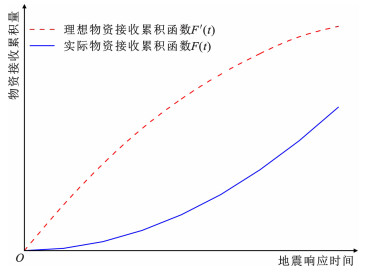
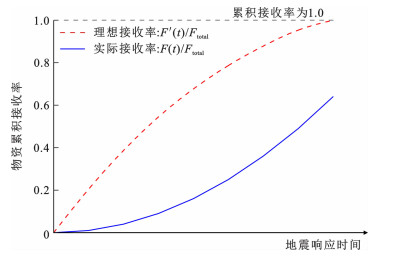
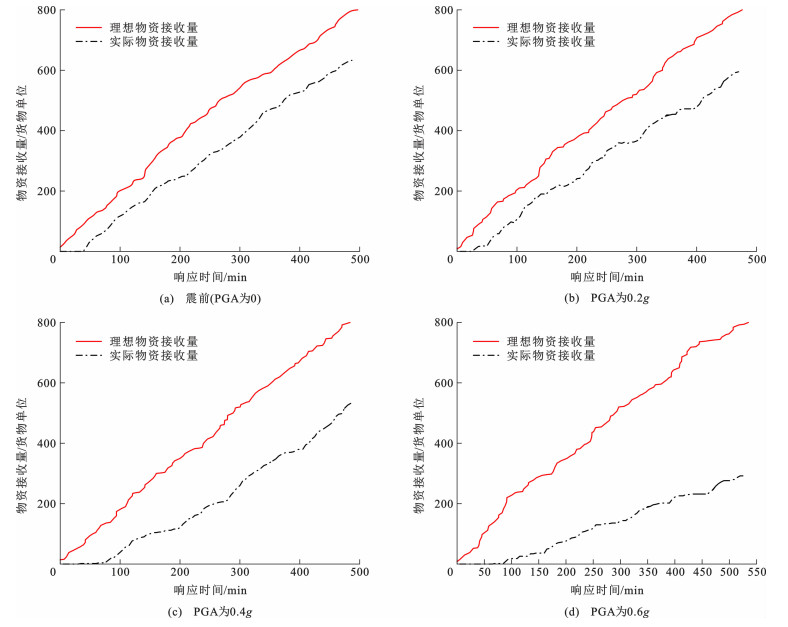
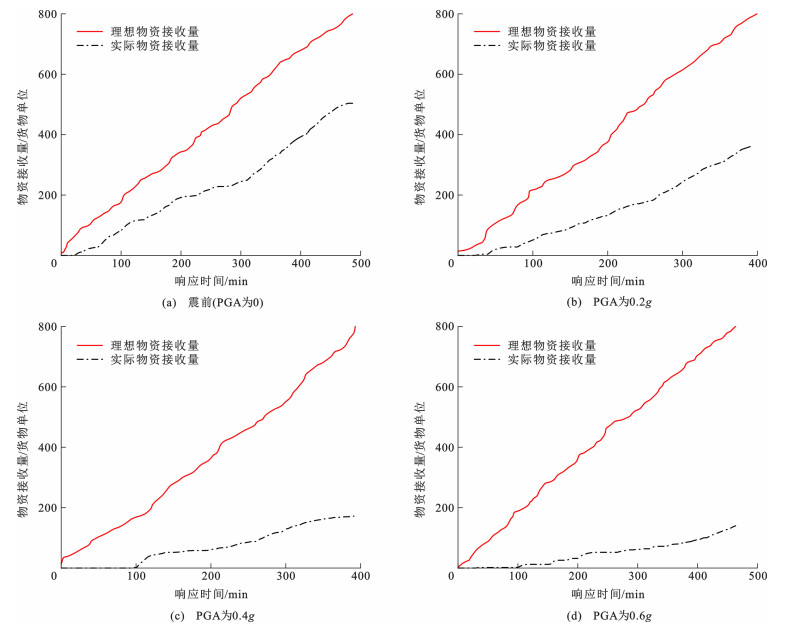
图 4 基于时间维度的机场理想与实际物资累计接收率曲线
Figure 4. Ideal and actual cumulative material reception rate curves for the airport based on the time dimension

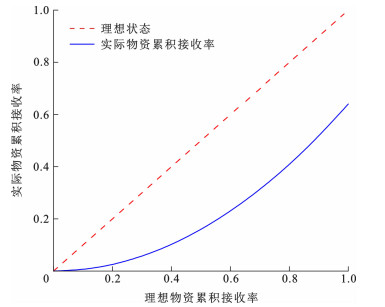
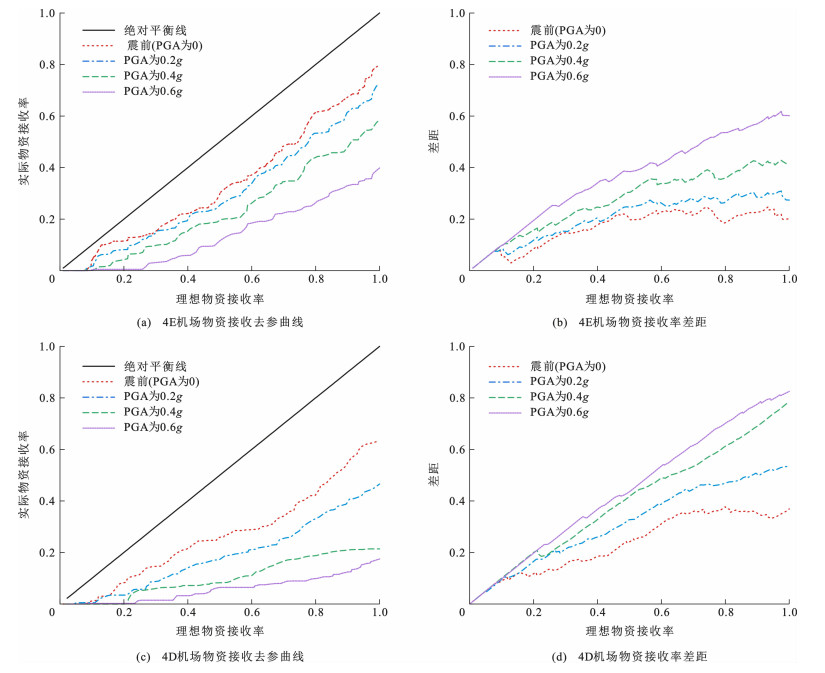
图 5 坐标转换后的机场RMREI简化计算示意
Figure 5. Simplified diagram for calculating airport RMREI after coordinate transformation

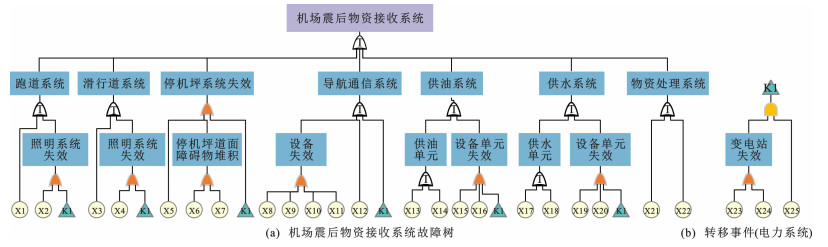
图 6 机场震后物资接收系统T-S故障树模型
Figure 6. T-S fault tree model of airport post-earthquake material receiving system

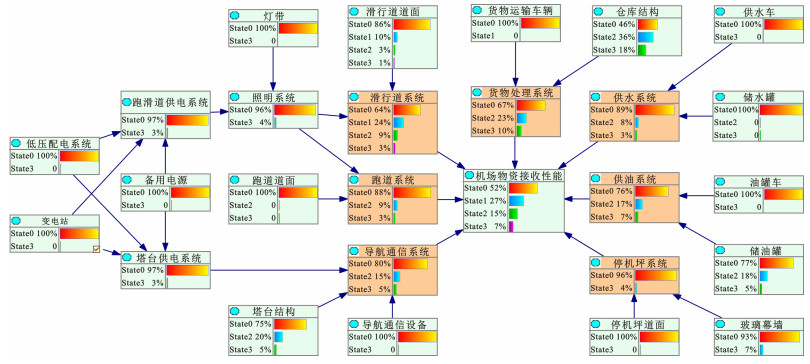
图 7 机场震后物资接收能力贝叶斯网络(PGA为0.2g)
Figure 7. Bayesian network of airport post-earthquake material receiving capacity (PGA is 0.2g)

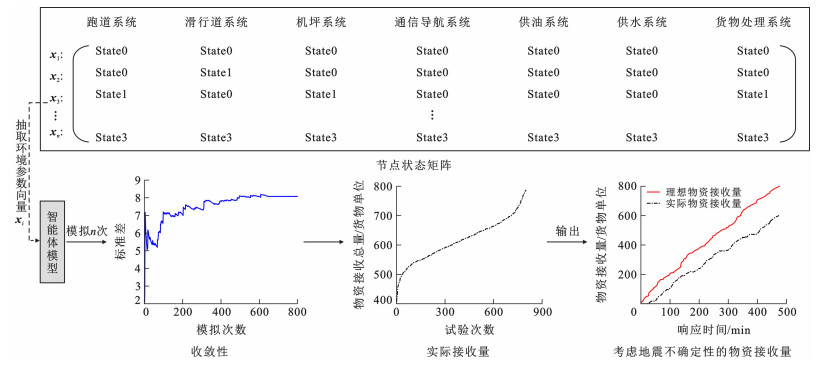
图 9 考虑地震不确定性数据处理流程
Figure 9. Data processing workflow considering earthquake uncertainty

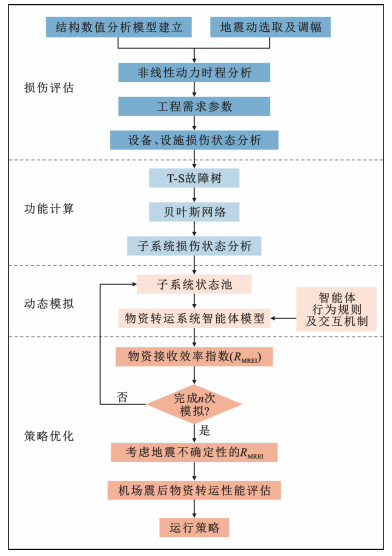
图 10 机场震后物资接收能力评估流程
Figure 10. Assessment process of airport post-earthquake material reception capacity

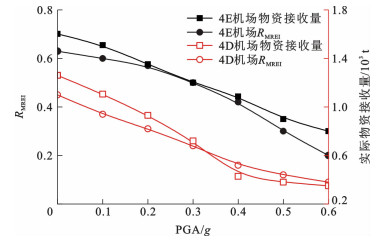
图 14 机场RMREI与实际物资接收量随PGA的变化
Figure 14. Variations in airport RMREI and actual received material quantity with PGA

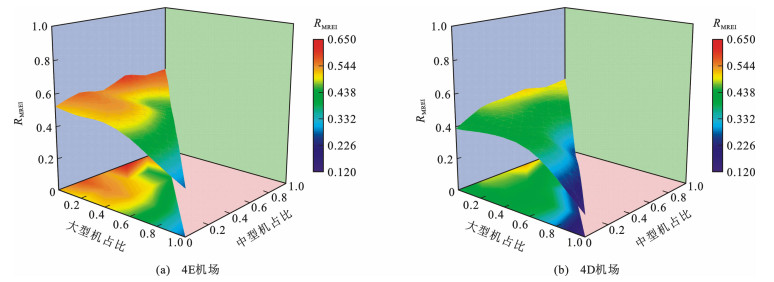
图 15 考虑机型比例的机场RMREI曲面
Figure 15. Airport RMREI surface considering aircraft type proportion
表 1 底事件对应序号
Table 1. Serial number corresponding to the basic event
编号 底事件 编号 底事件 编号 底事件 X1 跑道道面裂缝、隆起 X10 全向信标损坏 X19 水泵损坏 X2 跑道灯带损坏 X11 测距仪损坏 X20 供水车损坏 X3 滑行道道面裂缝、隆起 X12 塔台结构损伤 X21 仓库结构损伤 X4 滑行道灯带损坏 X13 储油罐损坏 X22 货运车损坏 X5 机坪道面损坏 X14 外部供油管网损坏 X23 高压配电网损坏 X6 航站楼结构倒塌 X15 油泵损坏 X24 低压配电网损坏 X7 航站楼玻璃幕墙倒塌 X16 供油车损坏 X25 备用电源损坏 X8 无线电设备损坏 X17 储水罐损坏 K1 供电系统失效 X9 仪表着陆系统损坏 X18 市政供水管网损坏  下载: 导出CSV
表 2 跑道系统条件概率
Table 2. CP of runway system
底事件状态 跑道系统条件概率 跑道道面 跑道照明系统 P(0) P(2) P(3) 0 0 0.894 421 041 0.081 140 046 0.024 438 912 0 3 0.432 828 874 0.307 714 747 0.259 456 379 2 0 0.353 325 877 0.496 985 090 0.149 689 033 2 3 0.046 909 580 0.517 092 574 0.435 997 846 3 0 0.245 410 476 0.345 192 230 0.409 397 295 3 3 0.020 567 071 0.226 714 449 0.752 718 480
下载: 导出CSV
表 3 子系统功能状态
Table 3. Subsystem functional states
子系统 功能状态 属性 跑道系统 State0 跑道系统正常运行 State2 此时跑道系统中等损坏,需要短期抢修,12 h后飞机可进离场 State3 此时跑道系统严重损坏,需长期修复,假设修复周期为7 d,7 d后恢复进离场功能 滑行道系统 State0 滑行道系统正常运行 State1 滑行道道面出现轻微裂缝等问题,飞机通过时需要减速前进 State2 滑行道道面出现中度损坏等问题,限小型、中型飞机通过 State3 滑行道道面严重损坏,导致此段滑行道无法使用,需绕路滑行 通信导航系统 State0 通信导航系统正常运行 State2 通信导航系统内相关设备或塔台轻微损坏,轻微影响通信导航效率,此时需限流进离场 State3 通信导航系统的关键设备无法使用或塔台倒塌,通信导航系统无法正常工作 停机坪系统 State0 机坪系统正常,机位可停靠 State3 机坪路面严重损伤,或地面出现建筑倒塌的瓦砾,导致机位无法使用 供油系统 State0 供油系统正常运行,供油速度为1 020 L·min-1 State2 此时供油系统中的关键储油设施损坏,但供油车运行正常,可进行部分供油工作。设置供油速度为600 L·min-1 State3 供油系统中储油设施和部分供油车损坏,但依旧可以进行小部分供油工作。设置供油速度为200 L·min-1 供水系统 State0 供水系统正常运行,供水速度为60 L·min-1 State2 此时供水系统中的关键储水设施损坏,但供水车运行正常,可进行部分供水工作。设置供水速度为40 L·min-1 State3 供水系统中储水设施和部分供水车损坏,但依旧可以进行小部分供水工作。设置供水速度为20 L·min-1 货物处理系统 State0 货物处理系统正常运行,货物处理上限为2 500 t,且当物资处理量达到处理上限的400%时,停止飞机进港[5] State2 仓库结构部分损坏,导致货物处理上限降低为1 500 t State3 仓库结构完全损坏,需要在露天条件下进行货物处理,此时货物处理的上限为500 t
下载: 导出CSV
表 4 飞机智能体属性
Table 4. Aircraft agent attributes
智能体类型 代表机型 载货量/货物单位 燃油需求量/L 需水量/L 最短起降距离/m 地面最大滑行速度/(km·h-1) D类大型货机 波音767-300F 14 14 000 300 3 000 30 C类中型货机 波音737-700C 8 3 500 200 约1 400 30 B类轻型货机 DHC-6 2 700 100 约600 30
下载: 导出CSV
表 5 地服车辆智能体属性
Table 5. Ground service vehicle agent attributes
智能体类型 工作速率 容量 最大行驶速度/(km·h-1) 升降平台车 0.2个货物单位·min-1 25 客梯车 12人·min-1 25 供油车 1 020 L·min-1 22 000 L 25 供水车 20 L·min-1 6 000 L 25 货物拖车 2个货物单位 25
下载: 导出CSV
表 6 传统指标与RMREI对比
Table 6. Comparison of traditional indicators and RMREI
指标名称 定义与计算方式 核心功能 数据特征 吞吐量 震后24 h实际物资接收量 反映物资接收规模 静态总量统计 备降航班数 因机场损坏被迫备降其他机场的航班总数 体现机场运行可靠性 离散事件统计 RMREI 全周期实际物资接收率曲线与理想物资接收率曲线的时变偏差积分 整合设备损伤、调度策略、物资交互的综合影响 连续时间序列动态评估
下载: 导出CSV
-
[1] POLATER A. Airports' role as logistics centers in humanitarian supply chains: A surge capacity management perspective[J]. Journal of Air Transport Management, 2020, 83: 101765. doi: 10.1016/j.jairtraman.2020.101765 [2] CETIN K O, SOYLEMEZ B, GUZEL H, et al. Soil lique-faction sites following the February 6, 2023, Kahraman-maraş-Türkiye earthquake sequence[J]. Bulletin of Earth-quake Engineering, 2025, 23(3): 921-944. doi: 10.1007/s10518-024-01875-3 [3] VEATCH M, GOENTZEL J. Feeding the bottleneck: Air-port congestion during relief operations[J]. Journal of Humanitarian Logistics and Supply Chain Management, 2018, 8(4): 430-446. doi: 10.1108/JHLSCM-01-2018-0006 [4] 赵栋. 基于网络鲁棒性和多目标优化模型的高速公路应急物流中心选址研究[D]. 石家庄: 石家庄铁道大学, 2024.ZHAO Dong. Study on the site selection of expressway emergency logistics center based on network robustness analysis[D]. Shijiazhuang: Shijiazhuang Tiedao University, 2024. [5] COMES T, WARNIER M, FEIL W, et al. Critical airport infrastructure disaster resilience: A framework and simu-lation model for rapid adaptation[J]. Journal of Management in Engineering, 2020, 36(5): 04020059. doi: 10.1061/(ASCE)ME.1943-5479.0000798 [6] BAO D W, ZHANG X L. Measurement methods and influ-encing mechanisms for the resilience of large airports under emergency events[J]. Transportmetrica A: Transport Scien-ce, 2018, 14(10): 855-880. doi: 10.1080/23249935.2018.1448016 [7] 王兴隆, 赵俊妮, 王进. 恶劣天气下机场离场航班运行韧性评估及恢复[J]. 北京航空航天大学学报, 2024, 50(1): 110-121.WANG Xing-long, ZHAO Jun-ni, WANG Jin. Resilience assessment and recovery of airport departure flights under severe weather[J]. Journal of Beijing University of Aero-nautics and Astronautics, 2024, 50(1): 110-121. [8] ZHOU L, CHEN Z H. Measuring the performance of airport resilience to severe weather events[J]. Transportation Research Part D: Transport and Environment, 2020, 83: 102362. doi: 10.1016/j.trd.2020.102362 [9] HUANG C N, LIOU J J H, LO H W, et al. Building an assessment model for measuring airport resilience[J]. Journal of Air Transport Management, 2021, 95: 102101. doi: 10.1016/j.jairtraman.2021.102101 [10] WANG X L, CHEN Z Y, LI K N. Quantifying the resilience performance of airport flight operation to severe weather[J]. Aerospace, 2022, 9(7): 344. doi: 10.3390/aerospace9070344 [11] 陈仔燕. 恶劣天气下机场航班运行韧性评估及预测[D]. 天津: 中国民航大学, 2022.CHEN Zi-yan. Evaluation and prediction of airport flights operational system resilience under severe weather[D]. Tianjin: Civil Aviation University of China, 2022. [12] ZÁMKOVÁ M, PROKOP M, STOLÍN R. A review of flight delay causes at Spanish airports based on statistical analysis of categorical data[J]. Central European Symposium on Thermophysics 2019(Cest), 2019, 2133: 400009. [13] GOŁDA P, ZAWISZA T, IZDEBSKI M. Evaluation of effici-ency and reliability of airport processes using simulation tools[J]. Eksploatacja I Niezawodnosc - Maintenance and Reli-ability, 2021, 23(4): 659-669. doi: 10.17531/ein.2021.4.8 [14] HANAOKA S, INDO Y, HIRATA T, et al. Lessons and challenges in airport operation during a disaster: Case studies on Iwate Hanamaki Airport, Yamagata Airport, and Fuku-shima Airport during the great east Japan earthquake[J]. Journal of JSCE, 2013, 1(1): 286-297. doi: 10.2208/journalofjsce.1.1_286 [15] DAMGACIOGLU H, CELIK N, GULLER A. A route-based network simulation framework for airport ground system disruptions[J]. Computers & Industrial Engineering, 2018, 124: 449-461. [16] FERNANDES H F, MVLLER C. Optimization of the waiting time and makespan in aircraft departures: A real time non-iterative sequencing model[J]. Journal of Air Transport Management, 2019, 79: 101686. doi: 10.1016/j.jairtraman.2019.101686 [17] HATA Y, ICHII K, NOZU A. Seismic damage assessment of an airport runway based on non-linear FEM analysis with special reference to crack occurrence[M]//SEIICHI M, TATSUYA I, NOBUYUKI Y. Advances in Transportation Geotechnics 2. London: CRC Press, 2012: 207-212. [18] TSUBOKAWA Y, KAWAMURA N, MIZUKAMI J, et al. Study on bearing capacity of airport pavement damaged due to the 2011 Tohoku region Pacific coast earthquake[J]. Journal of JSCE, 2017, 5(1): 58-67. doi: 10.2208/journalofjsce.5.1_58 [19] TSUBOKAWA Y, MIZUKAMI J, HATA I, et al. Report on damages of pavement at Sendai Airport due to Tohoku region Pacific coast earthquake[J]. Journal of Japan Society of Civil Engineers, Ser E1 (Pavement Engineering), 2012, 68(3): 123-129. [20] SAHADEVAN D, AL ALI H, NOTMAN D, et al. Opti-mising airport ground resource allocation for multiple aircraft using machine learning-based arrival time prediction[J]. Aerospace, 2023, 10(6): 509. doi: 10.3390/aerospace10060509 [21] PARK J, SEAGER T P, RAO P S C, et al. Integrating risk and resilience approaches to catastrophe management in engi-neering systems[J]. Risk Analysis, 2013, 33(3): 356-367. doi: 10.1111/j.1539-6924.2012.01885.x [22] CIMELLARO G P, REINHORN A M, BRUNEAU M. Frame-work for analytical quantification of disaster resilience[J]. Engineering Structures, 2010, 32(11): 3639-3649. doi: 10.1016/j.engstruct.2010.08.008 [23] WANG C, WANG L D, CHEN H, et al. Fault diagnosis of train network control management system based on dynamic fault tree and Bayesian network[J]. IEEE Access, 2021, 9: 2618-2632. doi: 10.1109/ACCESS.2020.3046681 [24] DE BIAGI V, CHIAIA B, FIORENTINI L, et al. Seismic vulnerability assessment of fuel storage tanks in Italy[J]. Journal of Pressure Vessel Technology, 2019, 141: 010905. doi: 10.1115/1.4040313 [25] SONG H, ZHANG H Y, CHAN C W. Fuzzy fault tree analysis based on T-S model with application to INS/GPS navigation system[J]. Soft Computing, 2009, 13(1): 31-40. doi: 10.1007/s00500-008-0290-3 [26] R∅ED W, MOSLEH A, VINNEM J E, et al. On the use of the hybrid causal logic method in offshore risk analysis[J]. Reliability Engineering & System Safety, 2009, 94(2): 445-455. [27] ZHAO Z, LU X W, GUO Y, et al. Seismic fragility assess-ment of base-isolated steel water storage tank[J]. Shock and Vibration, 2020, 2020: 8835943. [28] 温佳年, 危丽燕, 张望欣, 等. 考虑电力设施失效的区域路网桥梁震后修复决策方法[J]. 交通运输工程学报, 2025, 25(6): 61-74. doi: 10.19818/j.cnki.1671-1637.2025.06.006 WEN Jia-nian, WEI Li-yan, ZHANG Wang-xin, et al. A post-earthquake repair decision method for bridges in regional road networks considering power facility failures[J]. Journal of Traffic and Transportation Engineering, 2025, 25(6): 61-74. doi: 10.19818/j.cnki.1671-1637.2025.06.006 [29] VAFAEI M, ALIH S C. Seismic vulnerability of air traffic control towers[J]. Natural Hazards, 2018, 90(2): 803-822. doi: 10.1007/s11069-017-3072-3 [30] 尚庆学, 韩镝, 孙国良, 等. 基于振动台试验的通信机柜地震易损性分析[J]. 哈尔滨工业大学学报, 2022, 54(5): 57-63.SHANG Qing-xue, HAN Di, SUN Guo-liang, et al. Seismic fragility analysis of telecommunication cabinets based on shaking table tests[J]. Journal of Harbin Institute of Tech-nology, 2022, 54(5): 57-63. [31] SHI Z L, DONG Z Q, LI G, et al. Quantitative evaluation method for post-earthquake functionality loss of pedestrian flow pathways within a complex building using evacuation and rescue simulation[J]. Engineering Structures, 2024, 317: 118604. doi: 10.1016/j.engstruct.2024.118604 [32] YANG S, ZHANG Y, LU X Z, et al. Multi-agent deep rein-forcement learning based decision support model for resilient community post-hazard recovery[J]. Reliability Engineering & System Safety, 2024, 242: 109754. [33] HOOSHANGI N, ALESHEIKH A. Developing an agent-based simulation system for post-earthquake operations in uncer-tainty conditions: A proposed method for collaboration among agents[J]. ISPRS International Journal of Geo-Information, 2018, 7(1): 27. doi: 10.3390/ijgi7010027 [34] LESLIE D. Multi-agent systems: Algorithmic, game-theoretic, and logical foundations[J]. The Journal of the Operational Research Society, 2010, 61(6): 1066. -

计量
- 文章访问数: 15
- HTML全文浏览量: 9
- PDF下载量: 5
- 被引次数: 0
