


Adaptive offloading model for remote driving takeover task based on cloud-edge collaboration
Article Text (Baidu Translation)
-
摘要: 建立了基于云边协同的自适应任务卸载模型,分析了远程驾驶接管过程中因网络波动与算力不足引起的高时延与连接不稳定问题;定义了实时控制类、计算密集型与交互服务类3类任务,并设定了紧急与一般两级优先级体系,以精确区分不同任务对时延和可靠性的差异化需求;构建了融合云端中心、边缘节点与车载终端的协同计算环境,提出了基于任务优先级动态分配计算节点、结合实时网络带宽与边缘负载自适应调整资源权重的分层卸载规则,并研究了基于备用节点的断点续传机制,以增强系统在不稳定环境下的鲁棒性;采用动态规划算法构建了以全局最小时延为优化目标的决策模型,设定了相应的奖励函数以量化评估不同卸载策略的有效性;基于任务数据量、处理器频率等11项参数构建了专门的数据集,并设计了对比试验,系统研究了模型在动态负载与不同资源状态下的性能表现。研究结果表明:在边缘负载动态变化的场景下,所提自适应卸载策略获得的奖励值相较于传统固定阈值边缘计算方法提升13.2%;在引入云端协同计算后,系统整体奖励值相较于仅使用边缘计算的方案提升23.6%;特别在边缘节点负载超过60%时,该策略能够有效降低任务阻塞率达45%。Abstract: An adaptive task offloading model based on cloud-edge collaboration was established, and the problems of high latency and unstable connection during remote driving takeover caused by network fluctuation and insufficient computing power were deeply analyzed. Three types of tasks, namely real-time control, computation-intensive, and interactive service tasks, were defined, and a two-level priority system of urgent and general levels was set to accurately distinguish the differentiated requirements of different tasks for latency and reliability. A collaborative computing environment integrating cloud center, edge node, and onboard terminal was constructed; a hierarchical offloading rule dynamically allocating computing nodes based on task priority and adaptively adjusting resource weights combined with real-time network bandwidth and edge load was proposed; a breakpoint resume mechanism based on backup nodes was studied to enhance the robustness of the system in unstable environments. A decision model with global minimum latency as the optimization objective was constructed using a dynamic programming algorithm, and a corresponding reward function was set to quantitatively evaluate the effectiveness of different offloading strategies. A dedicated dataset was constructed based on 11 parameters such as task data volume and processor frequency, and comparative experiments were designed to systematically study the performance of the model under dynamic load and different resource states. The research results indicate that under the scenario of dynamically changing edge load, the reward value obtained by the proposed adaptive offloading strategy is increased by 13.2% compared to the traditional fixed-threshold edge computing method; after introducing cloud collaborative computing, the overall reward value of the system is increased by 23.6% compared to the edge-only computing scheme; especially when the edge node load exceeds 60%, the proposed strategy can effectively reduce the task blocking rate by 45%.
-

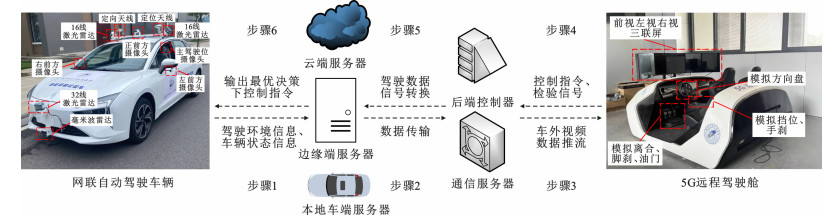
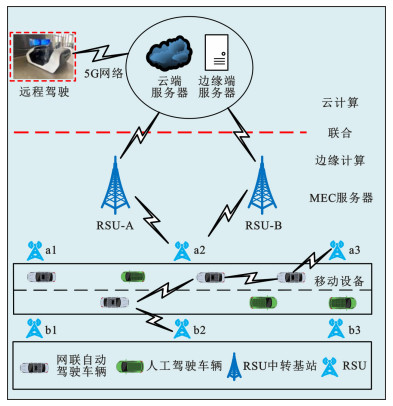
图 1 云边协同计算车路云通信示意
Figure 1. Schematic of cloud-edge cooperative computing vehicle-road-cloud communication
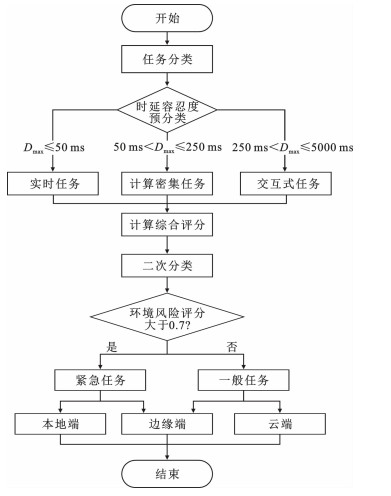
表 1 任务分类
Table 1. Classification of tasks
任务类型 计算复杂度 计算资源占用 时延容忍度 任务优先处理端 实时任务 低 低 低 本地、边缘 计算密集任务 高 高 中 边缘、云 交互式任务 中 高 高 边缘、云  下载: 导出CSV
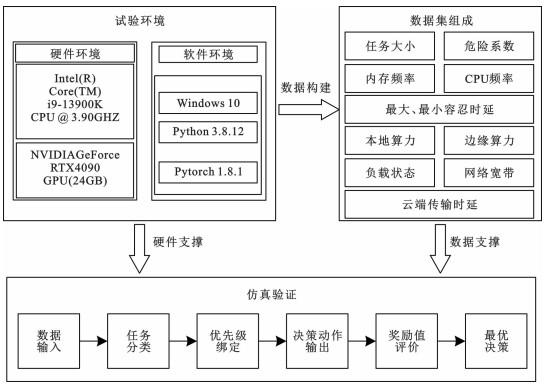
表 2 数据集参数说明
Table 2. Dataset parameter description
参数类别 符号 取值范围/类型 任务特性 Si/Mb [20, 100] Fi/MHz [30, 100] Mi/MHz [30, 100] 网络条件 B/Mb·s-1 [300, 500] 资源状态 C1/TOPS [10, 50] C2/TOPS [50, 100] C3/TOPS [0, +∞] L/% [20, 80] $ \widetilde{D}_3 / \mathrm{ms}$ 由C1、C2、B和传输距离计算得到,传输距离设定为[1, 2 000] m
下载: 导出CSV
-
[1] 秦严严, 罗钦中, 贺正冰. 网联自动驾驶车辆混合交通流专用道管控方法[J]. 交通运输工程学报, 2023, 23(3): 221-231. doi: 10.19818/j.cnki.1671-1637.2023.03.017 QIN Yan-yan, LUO Qin-zhong, HE Zheng-bing. Manage-ment and control method of dedicated lanes for mixed traffic flows with connected and automated vehicles[J]. Journal of Traffic and Transportation Engineering, 2023, 23(3): 221-231. doi: 10.19818/j.cnki.1671-1637.2023.03.017 [2] 上官伟, 李鑫, 柴琳果, 等. 车路协同环境下混合交通群体智能仿真与测试研究综述[J]. 交通运输工程学报, 2022, 22(3): 19-40. doi: 10.19818/j.cnki.1671-1637.2022.03.002 SHANGGUAN Wei, LI Xin, CHAI Lin-guo, et al. Resear-ch review on simulation and test of mixed traffic swarm in vehicle-infrastructure cooperative environment[J]. Journal of Traffic and Transportation Engineering, 2022, 22(3): 19-40. doi: 10.19818/j.cnki.1671-1637.2022.03.002 [3] 张毅, 裴华鑫, 姚丹亚. 车路协同环境下车辆群体协同决策研究综述[J]. 交通运输工程学报, 2022, 22(3): 1-18. doi: 10.19818/j.cnki.1671-1637.2022.03.001 ZHANG Yi, PEI Hua-xin, YAO Dan-ya. Research review on cooperative decision-making for vehicle swarms in vehicle-infrastructure cooperative environment[J]. Journal of Traffic and Transportation Engineering, 2022, 22(3): 1-18. doi: 10.19818/j.cnki.1671-1637.2022.03.001 [4] ZHAO H Z, WU H, LU N N, et al. Lane changing in a vehicle-to-everything environment: Research on a vehicle lane-changing model in the tunnel area by considering the influence of brightness and noise under a vehicle-to-everything environment[J]. IEEE Intelligent Transportation Systems Magazine, 2023, 15(2): 225-237. doi: 10.1109/MITS.2022.3197462 [5] 赵红专, 张继康, 潘佳雯, 等. 基于改进视觉算法的自动驾驶风险预判模型[J]. 交通运输系统工程与信息, 2024, 24(5): 79-90, 139.ZHAO Hong-zhuan, ZHANG Ji-kang, PAN Jia-wen, et al. Automatic driving risk prediction model based on improved vision algorithm[J]. Journal of Transportation Systems Engineering and Information Technology, 2024, 24(5): 79-90, 139. [6] HOU C, ZHAO Q C. Optimal task-offloading control for edge computing system with tasks offloaded and computed in sequence[J]. IEEE Transactions on Automation Science and Engineering, 2023, 20(2): 1378-1392. doi: 10.1109/TASE.2022.3176745 [7] 王新胜, 卞震. 基于贝叶斯模型的驾驶行为识别与预测[J]. 通信学报, 2018, 39(3): 108-117.WANG Xin-sheng, BIAN Zhen. Driving behavior recognition and prediction based on Bayesian model[J]. Journal on Communications, 2018, 39(3): 108-117. [8] SATRIA D, PARK D, JO M. Recovery for overloaded mobile edge computing[J]. Future Generation Computer Systems, 2017, 70: 138-147. doi: 10.1016/j.future.2016.06.024 [9] DUAN J R, REN K, ZHOU W, et al. A service migration method for resource competition in mobile edge computing[C]//IEEE. 2021 IEEE International Performance, Computing, and Communications Conference (IPCCC). New York: IEEE, 2021: 1-8. [10] JITANI A, MAHAJAN A, ZHU Z W, et al. Structure-aware reinforcement learning for node-overload protection in mobile edge computing[J]. IEEE Transactions on Cognitive Communications and Networking, 2022, 8(4): 1881-1897. doi: 10.1109/TCCN.2022.3195503 [11] 李晨, 严新平, 刘佳仑, 等. 船舶远程驾驶控制系统设计与应用[J]. 交通运输工程学报, 2024, 24(5): 333-347. doi: 10.19818/j.cnki.1671-1637.2024.05.021 LI Chen, YAN Xin-ping, LIU Jia-lun, et al. Design and application of ship remote-driving control system[J]. Journal of Traffic and Transportation Engineering, 2024, 24(5): 333-347. doi: 10.19818/j.cnki.1671-1637.2024.05.021 [12] 张继康. 基于自动驾驶风险预判的远程驾驶接管和云边协同可靠性提升方法研究[D]. 桂林: 桂林电子科技大学, 2024.ZHANG Ji-kang. Remote driving takeover and cloud-edge cooperative reliability improvement method based on auto-nomous driving risk prediction[D]. Guilin: Guilin University of Electronic Technology, 2024. [13] 郭延永, 刘佩, 袁泉, 等. 网联自动驾驶车辆道路交通安全研究综述[J]. 交通运输工程学报, 2023, 23(5): 19-38. doi: 10.19818/j.cnki.1671-1637.2023.05.002 GUO Yan-yong, LIU Pei, YUAN Quan, et al. Review on research of road traffic safety of connected and automated vehicles[J]. Journal of Traffic and Transportation Engi-neering, 2023, 23(5): 19-38. doi: 10.19818/j.cnki.1671-1637.2023.05.002 [14] MACH P, BECVAR Z. Mobile edge computing: A survey on architecture and computation offloading[J]. IEEE Commu-nications Surveys & Tutorials, 2017, 19(3): 1628-1656. [15] 陈玉平, 刘波, 林伟伟, 等. 云边协同综述[J]. 计算机科学, 2021, 48(3): 259-268.CHEN Yu-ping, LIU Bo, LIN Wei-wei, et al. Survey of cloud-edge collaboration[J]. Computer Science, 2021, 48(3): 259-268. [16] XU X L, ZHANG X, LIU X H, et al. Adaptive computation offloading with edge for 5G-envisioned Internet of connected vehicles[J]. IEEE Transactions on Intelligent Transportation Systems, 2021, 22(8): 5213-5222. doi: 10.1109/TITS.2020.2982186 [17] DAI H J, ZENG X Y, YU Z L, et al. A scheduling algo-rithm for autonomous driving tasks on mobile edge computing servers[J]. Journal of Systems Architecture, 2019, 94: 14-23. doi: 10.1016/j.sysarc.2019.02.004 [18] KUANG Z F, MA Z H, LI Z, et al. Cooperative computa-tion offloading and resource allocation for delay minimization in mobile edge computing[J]. Journal of Systems Architec-ture, 2021, 118: 102167. doi: 10.1016/j.sysarc.2021.102167 [19] CHEN X H, CAI Y L, LI L Y, et al. Energy-efficient resource allocation for latency-sensitive mobile edge computing[J]. IEEE Transactions on Vehicular Technology, 2020, 69(2): 2246-2262. doi: 10.1109/TVT.2019.2962542 [20] WEI Z, YU X B, ZOU L. Multi-resource computing offload strategy for energy consumption optimization in mobile edge computing[J]. Processes, 2022, 10(9): 1762. doi: 10.3390/pr10091762 [21] HUANG P, DENG M J, KANG Z L, et al. Self-adaptive learning of task offloading in mobile edge computing systems[J]. Entropy, 2021, 23(9): 1146. doi: 10.3390/e23091146 [22] XU F, XIE Y, SUN Y Y, et al. Two-stage computing off-loading algorithm in cloud-edge collaborative scenarios based on game theory[J]. Computers and Electrical Engineering, 2022, 97: 107624. doi: 10.1016/j.compeleceng.2021.107624 [23] 唐宁昆, 王高才. 云边协同环境下一种面向任务的多智能体强化学习任务卸载方案[J]. 小型微型计算机系统, 2025, 46(4): 863-875.TANG Ning-kun, WANG Gao-cai. Task-oriented multi-agent reinforcement learning task offloading scheme for cloud-edge computing[J]. Journal of Chinese Computer Systems, 2025, 46(4): 863-875. [24] ZHAO J H, LI Q P, GONG Y, et al. Computation off-loading and resource allocation for cloud assisted mobile edge computing in vehicular networks[J]. IEEE Transactions on Vehicular Technology, 2019, 68(8): 7944-7956. doi: 10.1109/TVT.2019.2917890 [25] LAI S W, ZHAO R, TANG S P, et al. Intelligent secure mobile edge computing for beyond 5G wireless networks[J]. Physical Communication, 2021, 45: 101283. doi: 10.1016/j.phycom.2021.101283 [26] BUTT U A, AMIN R, MEHMOOD M, et al. Cloud secu-rity threats and solutions: A survey[J]. Wireless Personal Communications, 2023, 128(1): 387-413. doi: 10.1007/s11277-022-09960-z -

图(6) / 表(2)
计量
- 文章访问数: 6
- HTML全文浏览量: 7
- PDF下载量: 2
- 被引次数: 0
