


Road pothole segmentation network based on multi-scale feature fusion and channel feature adaptation
-
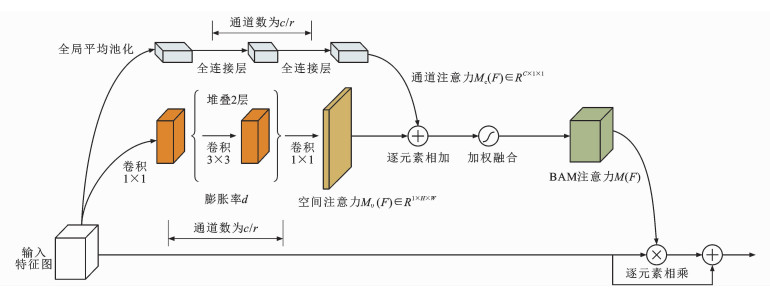
摘要: 为准确感知道路坑洞并提高模型泛化分割能力,提出了一种基于空洞空间金字塔融合及特征适应的道路坑洞分割网络(potholes-FBConvNet)。将卷积网络模型(ConvNext)作为主干结构,进行不同网络深度的多尺度特征提取;将统一感知解析网络架构(UPerNet)作为颈部融合网络,充分利用主干网络所提取的多级特征表示,在颈部网络中引入空洞空间金字塔融合模块,进一步增强网络捕获多尺度上下文特征信息能力;在颈部及解码头部之间嵌入特征适应模块,在颈部融合特征解码之前对通道及空间特征进行自适应校准,有效提升网络分割性能;分别收集并精细化标注2 097张道路坑洞(普通破损坑洞1 065张,完全破损坑洞507张,重度破损坑洞525张)分割数据库,并依次进行对比及消融试验以验证网络性能。试验结果表明:提出的potholes-FBConvNet模型交并比、相似系数、精确率及召回率在普通破损坑洞上可达85.43%、92.14%、92.96%及91.33%,在完全破损坑洞上可达87.76%、93.48%、92.33%及94.67%,在重度破损坑洞上可达90.76%、95.15%、95.41%及94.90%;相比16种基于Transformer及卷积Conv的典型对比模型,提出的分割网络具备最优泛化分割能力及鲁棒性。Abstract: To accurately identify road potholes and the improve model generalization segmentation ability, a road pothole segmentation network (potholes-FBConvNet) based on astrous spatial pyramid fusion (ASPF) and feature adaptation was proposed. The convolutional neural network model (ConvNext) was used as the main structure for multi-scale feature extraction at different network depths. The unified perception and resolution network architecture (UPerNet) was used as the neck fusion network. The multi-level feature representations extracted through the main network were fully utilized, and the ASPF module was introduced into the neck network to further enhance its ability to capture multi-scale contextual feature information. A feature adaptation module was embedded between the neck and decoding head to perform adaptive calibration on the channel and spatial features before neck fusion feature decoding. In this way, the network segmentation performance was effectively improved. A total of 2 097 road pothole segmentation databases were separately collected and meticulously annotated (1 065 generally damaged potholes, 507 completely damaged potholes, 525 severely damaged potholes), and comparative and ablation experiments were conducted in sequence to verify network performance. The experimental results show that, the proposed potholes-FBConvNet model achieves an intersection over union (IoU), similarity coefficient, precision, and recall of 85.43%, 92.14%, 92.96%, and 91.33% on generally damaged potholes. On completely damaged potholes, it reaches 87.76%, 93.48%, 92.33%, and 94.67%. On severely damaged potholes, it reaches 90.76%, 95.15%, 95.41%, and 94.90%. Compared with 16 typical comparison models based on Transformer and Conv, the proposed segmentation network has the optimal generalization segmentation ability and robustness.
-

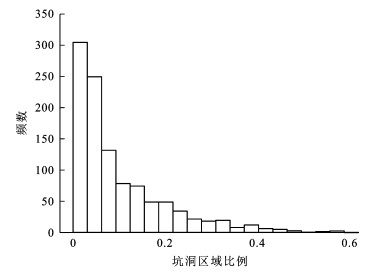
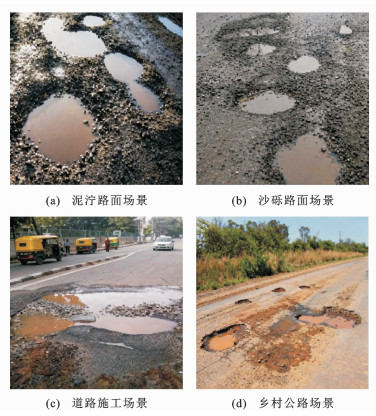
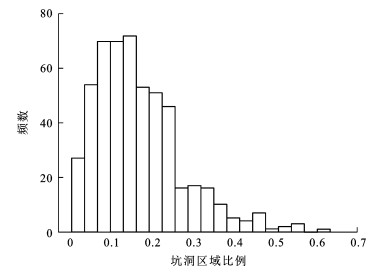
图 6 普通破损坑洞分割区域比例分布
Figure 6. Proportion distribution of ordinary damaged potholes segmentation area

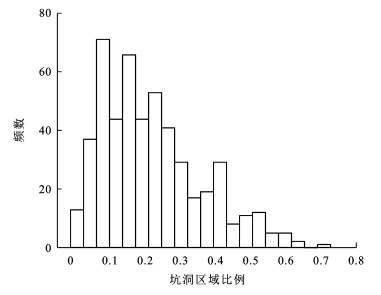
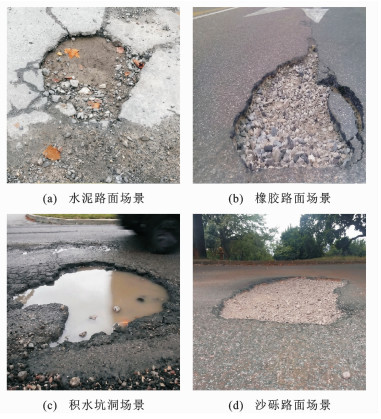
图 8 完全破损坑洞分割区域比例分布
Figure 8. Proportion distribution of completely damaged potholes segmentation area

图 10 重度破损坑洞分割区域比例分布
Figure 10. Proportion distribution of severely damaged potholes segmentation area

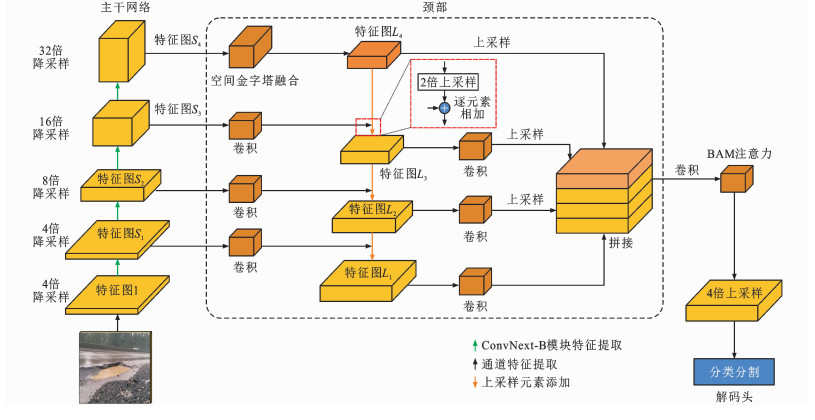
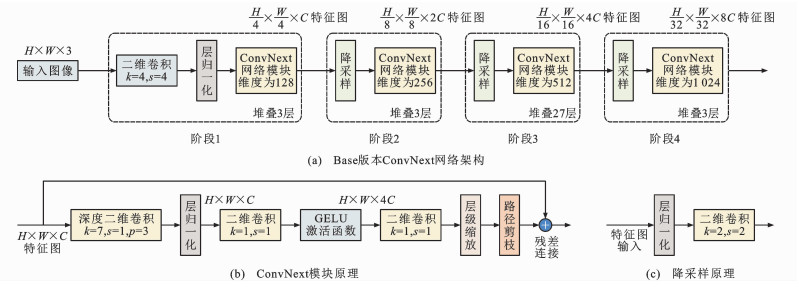
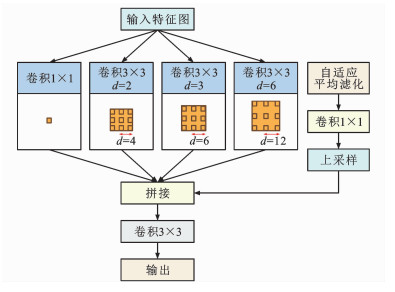
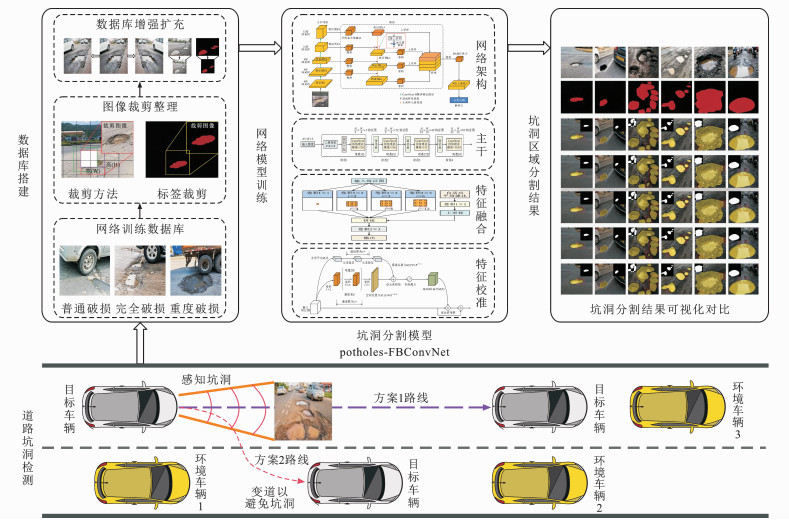
图 11 potholes-FBConvNet坑洞分割网络
Figure 11. Potholes segmentation network of potholes-FBConvNet

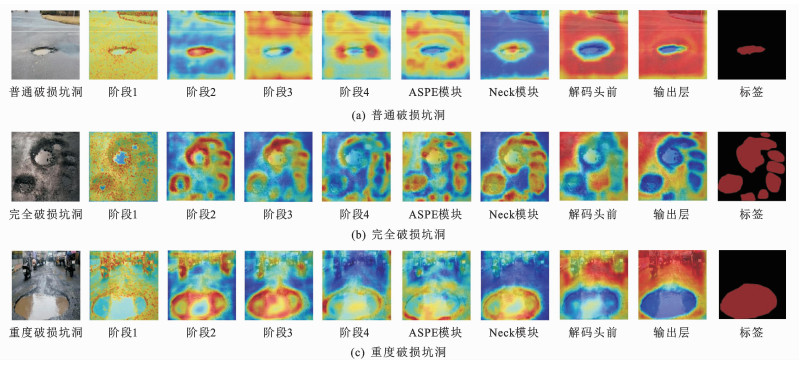
图 15 potholes-FBConvNet在不同类型坑洞的特征图可视化结果
Figure 15. Visualization results of feature maps of different types of potholes using potholes-FBConvNet

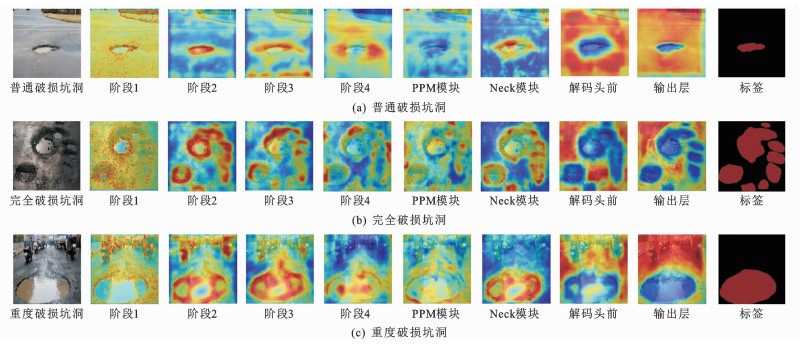
图 16 基础模型在不同类型坑洞的特征图可视化结果
Figure 16. Visualization results of feature maps of different types of potholes using basic model
表 2 普通破损坑洞对比试验
Table 2. Comparison experiments of ordinary damaged potholes
模型 IoU/% D/% P/% R/% IoUt/% Dt/% Pt/% Rt/% Param/106 FLOPs/109 检测速度/(帧·s-1) 基于
TransformerSegformer-MiT-B0[27] 82.77 90.57 91.14 90.00 81.29 89.68 91.55 87.88 3.72 5.59 113.30 Twins-S[28] 83.77 91.17 92.78 89.61 83.46 90.98 93.43 88.66 53.97 197.97 32.73 Swin-T[29] 81.94 90.08 91.36 88.83 81.22 89.64 92.52 86.93 59.83 207.11 34.31 DPT[30] 83.03 90.73 93.06 88.51 81.98 90.10 92.88 87.48 109.67 148.19 28.95 ViT[31] 82.61 90.48 92.26 88.76 81.71 89.93 92.54 87.46 144.06 346.15 18.35 基于
Conv网络MobileNetV3[32] 76.36 86.59 90.67 82.87 76.23 86.51 88.93 84.22 3.28 7.39 118.79 Fast-SCNN[33] 78.40 87.89 90.33 85.58 76.74 86.84 90.93 83.10 1.45 0.80 197.32 STDC[34] 76.71 86.82 89.66 84.15 73.87 84.97 85.41 84.54 8.57 7.41 166.47 PoolFormer-S12[35] 64.89 78.71 80.54 76.96 59.62 74.70 70.80 79.06 15.64 26.96 100.61 U-Net[36] 69.95 82.32 88.88 76.66 63.38 77.58 89.85 68.27 29.06 178.03 31.71 BISNetV2[37] 77.00 87.01 90.33 83.92 78.97 88.25 90.03 86.53 14.76 10.81 158.21 DeepLabV3[38] 81.54 89.83 92.28 87.50 80.29 89.07 91.79 86.51 68.10 236.99 33.69 PoinrRend[39] 81.80 89.99 93.23 86.97 79.79 88.76 91.44 86.23 28.70 43.10 61.66 K-Net[40] 82.48 90.40 93.28 87.69 80.79 89.37 91.81 87.06 81.31 239.85 31.80 ISANet[41] 81.34 89.71 91.82 87.10 80.36 89.11 91.38 86.95 37.69 132.21 44.32 ANN[42] 80.46 89.17 91.55 86.92 80.14 88.98 91.97 86.17 46.22 162.45 36.76 ConvNext-B 84.94 91.86 92.14 91.58 82.86 90.63 90.42 90.83 121.99 255.92 27.02 改进网络 85.43 92.14 92.96 91.33 83.19 90.82 91.51 90.14 134.65 259.84 26.77 提升效果 0.49 0.28 0.82 -0.25 0.33 0.19 1.10 -0.69 12.66 3.92 -0.25 注:带t下标变量代表测试集上的评估结果,后续表格均以此规则表示;提升效果指改进网络相对ConvNext-B的各参数变化幅度。  下载: 导出CSV
表 3 完全破损坑洞对比试验
Table 3. Comparison experiments of completely damaged potholes
% 模型 IoU D P R IoUt Dt Pt Rt 基于
TransformerSegformer-MiT-B0 85.87 92.40 91.75 93.06 83.28 90.88 92.27 89.53 Twins-S 86.94 93.01 92.58 93.45 85.54 92.20 92.72 91.49 Swin-T 86.22 92.60 92.18 93.03 82.90 90.65 91.12 90.18 DPT 87.00 93.05 92.81 93.28 85.57 92.22 93.84 90.67 ViT 86.56 92.79 92.32 93.27 85.37 92.11 92.94 91.29 基于
Conv网络MobileNetV3 76.61 86.76 86.45 87.07 76.68 83.90 89.91 83.90 Fast-SCNN 80.84 89.40 91.35 87.54 77.44 87.28 88.71 85.90 STDC 81.33 89.70 89.53 89.88 76.82 86.89 87.88 85.93 PoolFormer-S12 65.47 79.13 79.97 78.30 62.19 76.69 76.65 76.72 U-Net 71.28 83.23 88.58 78.48 67.12 80.32 85.80 75.50 BISNetV2 77.66 87.43 89.68 85.28 75.38 85.96 90.96 81.70 DeepLabV3 83.25 90.86 90.60 91.11 81.63 89.89 92.87 87.09 PoinrRend 82.11 90.17 91.20 89.17 81.13 89.58 91.97 87.31 K-Net 84.04 91.33 91.76 90.91 81.42 89.76 91.74 87.86 ISANet 82.88 90.64 91.44 89.85 80.15 88.98 90.96 87.09 ANN 83.81 91.19 91.71 90.68 80.26 89.05 90.89 87.27 ConvNext-B 86.95 93.02 92.18 93.87 84.62 91.67 92.51 90.85 改进网络 87.76 93.48 92.33 94.67 85.06 91.92 92.79 91.08 提升效果 0.81 0.46 0.15 0.80 0.44 0.25 0.28 0.23
下载: 导出CSV
表 4 重度破损坑洞对比试验
Table 4. Comparison experiments of severely damage potholes
% 模型 IoU D P R IoUt Dt Pt Rt 基于
TransformerSegformer-MiT-B0 88.82 94.08 94.09 94.07 89.54 94.48 96.53 92.52 Twins-S 89.96 94.72 95.12 94.31 90.34 94.78 95.60 94.36 Swin-T 89.98 94.72 95.27 94.19 89.98 94.67 96.31 93.09 DPT 89.10 94.24 94.95 93.54 89.89 94.68 95.60 93.77 ViT 88.73 94.03 95.03 93.05 89.43 94.42 96.25 92.65 基于
Conv网络MobileNetV3 83.87 91.23 91.19 91.27 84.58 91.64 92.23 91.07 Fast-SCNN 83.88 91.23 93.75 88.84 83.86 91.22 94.70 88.00 STDC 85.45 92.15 94.09 90.29 86.11 92.54 94.43 90.72 PoolFormer-S12 70.48 82.68 85.45 80.09 70.53 82.72 85.80 79.85 U-Net 76.03 86.38 88.35 84.50 72.81 84.27 93.06 76.99 BISNetV2 84.42 91.55 93.38 89.79 85.62 92.25 92.58 91.93 DeepLabV3 88.62 93.97 95.35 92.63 89.36 94.38 95.81 92.99 PoinrRend 86.64 92.84 94.96 90.82 87.29 93.22 95.34 91.18 K-Net 88.10 93.67 95.15 92.24 88.36 93.82 96.32 91.45 ISANet 87.55 93.36 94.67 92.09 87.60 93.39 94.22 92.57 ANN 88.07 93.65 95.32 92.05 87.91 93.57 95.27 91.92 ConvNext-B 90.22 94.86 95.31 94.41 89.68 94.56 96.26 92.92 改进网络 90.76 95.15 95.41 94.90 90.29 94.90 95.85 93.96 提升效果 0.54 0.29 0.10 0.49 0.61 0.34 -0.41 1.04
下载: 导出CSV
表 5 普通破损坑洞消融试验
Table 5. Ablation experiments of ordinary damaged potholes
模型 IoU/% D/% P/% R/% IoUt/% Dt/% Pt/% Rt/% Param/106 FLOPs/109 检测速度/(帧·s-1) 基准模型B 84.94 91.86 92.14 91.58 82.86 90.63 90.42 90.83 121.99 255.92 27.02 B+BAM 85.03 91.91 93.19 90.66 83.13 90.79 91.81 89.78 122.07 256.57 26.71 B+ASPF 85.18 92.00 92.90 91.12 83.86 91.22 91.19 90.28 134.57 259.19 27.14 改进网络 85.43 92.14 92.96 91.33 83.19 90.82 91.51 90.14 134.65 259.84 26.77
下载: 导出CSV
表 6 完全破损坑洞消融试验
Table 6. Ablation experiments of completely damage potholes
% 模型 IoU D P R IoUt Dt Pt Rt 基准模型B 86.95 93.02 92.18 93.87 84.62 91.67 92.51 90.85 B+BAM 87.52 93.34 93.11 93.57 84.44 91.57 92.85 90.32 B+ASPF 87.31 93.22 92.75 93.70 84.96 91.87 92.19 91.54 改进网络 87.76 93.48 92.33 94.67 85.06 91.92 92.79 91.08
下载: 导出CSV
表 7 重度破损坑洞消融试验
Table 7. Ablation experiments of severely damage potholes
% 模型 IoU D P R IoUt Dt Pt Rt 基准模型B 90.22 94.86 95.31 94.41 89.68 94.56 96.26 92.92 B+BAM 90.43 94.97 95.41 94.54 89.37 94.38 95.32 93.47 B+ASPF 90.56 95.04 95.23 94.86 90.00 94.74 95.60 93.90 改进网络 90.76 95.15 95.41 94.90 90.29 94.90 95.85 93.96
下载: 导出CSV
表 8 各典型算法坑洞分割效果可视化对比
Table 8. Visual comparison of potholes segmentation effects of various typical algorithms

-
[1] 姚楚羡, 蔡皓楠, 张远波, 等. 基于轻量化车载设备的道路病害检测方法[J]. 测绘通报, 2024(5): 147-150.YAO Chu-xian, CAI Hao-nan, ZHANG Yuan-bo, et al. Road damage detection method based on lightweight vehicle equipment[J]. Bulletin of Surveying and Mapping, 2024(5): 147-150. [2] 崔新壮, 黄丹, 刘磊, 等. 沥青路面病害力学研究进展[J]. 山东大学学报(工学版), 2016, 46(5): 68-87.CUI Xin-zhuang, HUANG Dan, LIU Lei, et al. A review of mechanics of asphalt pavement disease[J]. Journal of Shandong University (Engineering Science), 2016, 46(5): 68-87. [3] 管进超, 丁玲, 杨旭, 等. 多维图像融合驱动的复杂场景路表破损识别[J]. 交通运输工程学报, 2024, 24(3): 154-170. doi: 10.19818/j.cnki.1671-1637.2024.03.010 GUAN Jin-chao, DING Ling, YANG Xu, et al. Pavement surface distress detection in complex scenarios driven by multi-dimensional image fusion[J]. Journal of Traffic and Transportation Engineering, 2024, 24(3): 154-170. doi: 10.19818/j.cnki.1671-1637.2024.03.010 [4] 《中国公路学报》编辑部. 中国路面工程学术研究综述·2024[J]. 中国公路学报, 2024, 37(3): 1-81.Editorial Department of China Journal of Highway and Transport. Review on China's pavement engineering research: 2024[J]. China Journal of Highway and Transport, 2024, 37(3): 1-81. [5] 《中国公路学报》编辑部. 中国路面工程学术研究综述·2020[J]. 中国公路学报, 2020, 33(10): 1-66.Editorial Department of China Journal of Highway and Transport. Review on China's pavement engineering research · 2020[J]. China Journal of Highway and Transport, 2020, 33(10): 1-66. [6] GAO M X, WANG X, ZHU S L, et al. Detection and segmentation of cement concrete pavement pothole based on image processing technology[J]. Mathematical Problems in Engineering, 2020(1): 1360832. [7] ABBAS I H, ISMAEL M Q, Automated pavement distress detection using image processing techniques[J]. Engineering, Technology and Applied Science Research, 2021, 11(5): 7702-7708. doi: 10.48084/etasr.4450 [8] KIM S, SEO D, JEON S. Improvement of tiny object segmentation accuracy in aerial images for asphalt pavement pothole detection[J]. Sensors, 2023, 23(13): 5851. doi: 10.3390/s23135851 [9] YE W L, JIANG W, TONG Z, et al. Convolutional neural network for pothole detection in asphalt pavement[J]. Road Materials and Pavement Design, 2021, 22(1): 42-58. doi: 10.1080/14680629.2019.1615533 [10] WANG A D, LANG H, CHEN Z, et al. The two-step method of pavement pothole and raveling detection and segmentation based on deep learning[J]. IEEE Transactions on Intelligent Transportation Systems, 2024, 25(6): 5402-5417. doi: 10.1109/TITS.2023.3340340 [11] LAKMAL H K I S, DISSANAYAKE M B. Pothole detection with image segmentation for advanced driver assisted systems[C]// IEEE. 2020 IEEE International Women in Engineering (WIE) Conference on Electrical and Computer Engineering (WIECON-ECE). New York: IEEE, 2021: 308-311. [12] 袁朝春, 王俊娴, 何友国, 等. 基于路面坑洞检测的智能汽车主动避障控制[J]. 江苏大学学报(自然科学版), 2022, 43(5): 504-511, 518.YUAN Chao-chun, WANG Jun-xian, HE You-guo, et al. Active obstacle avoidance control of intelligent vehicle based on pothole detection[J]. Journal of Jiangsu University (Natural Science Edition), 2022, 43(5): 504-511, 518. [13] 宣以国, 余成波, 蒋启超, 等. 基于改进YOLOv7的道路裂缝和坑洞检测算法[J]. 科学技术与工程, 2024, 24(17): 7205-7213.XUAN Yi-guo, YU Cheng-bo, JIANG Qi-chao, et al. Improved YOLOv7 road crack and pothole detection algorithm[J]. Science Technology and Engineering, 2024, 24(17): 7205-7213. [14] 王鑫, 李琦. 基于深度学习的路面缺陷自动检测系统[J]. 光电子·激光, 2022, 33(11): 1165-1172.WANG Xin, LI Qi. Automatic detection of pavement defects based on deep learning[J]. Journal of Optoelectronics· Laser, 2022, 33(11): 1165-1172. [15] 胡晓伟, 闫奕昕, 王大为, 等. 基于YOLOM算法的路面病害轻量化检测方法[J]. 中国公路学报, 2024, 37(12): 381-391.HU Xiao-wei, YAN Yi-xin, WANG Da-wei, et al. Lightweight pavement disease detection based on YOLOM algorithm[J]. China Journal of Highway and Transport, 2024, 37(12): 381-391. [16] 罗向龙, 王彦博, 蒲亚亚, 等. 多病害并发复杂场景下的道路病害检测RGT-YOLOv7模型[J]. 湖南大学学报(自然科学版), 2024, 51(12): 107-118.LUO Xiang-long, WANG Yan-bo, PU Ya-ya, et al. Road disease detection RGT-YOLOv7 model under multiple diseases complicated scenarios[J]. Journal of Hunan University (Natural Sciences), 2024, 51(12): 107-118. [17] 郭道俊, 周幸宇, 许崇帮, 等. 基于DeepLabV3+网络改进的快速隧道病害分割方法[J]. 公路交通科技, 2023, 40(8): 127-135.GUO Dao-jun, ZHOU Xing-yu, XU Chong-bang, et al. Improved fast tunnel disease segmentation method based on DeepLabV3+ network[J]. Journal of Highway and Transportation Research and Development, 2023, 40(8): 127-135. [18] 任泳洁, 吴立朋. 融合注意力机制和新型卷积神经网络的市政道路病害识别[J]. 科学技术与工程, 2024, 24(20): 8663-8672.REN Yong-jie, WU Li-peng. Municipal road disease recognition based on attention mechanism and novel convolutional neural network[J]. Science Technology and Engineering, 2024, 24(20): 8663-8672. [19] LI D R, DUAN Z D, HU X Y, et al. Automated classification and detection of multiple pavement distress images based on deep learning[J]. Journal of Traffic and Transportation Engineering (English Edition), 2023, 10(2): 276-290. doi: 10.1016/j.jtte.2021.04.008 [20] GUAN T, CAI J Y, WANG Y, et al. Pavement pothole detection system based on deep learning and binocular vision[J]. Journal of Traffic and Transportation Engineering (English Edition), 2025, 12(4): 1100-1123. doi: 10.1016/j.jtte.2024.08.001 [21] LIU Z, MAO H Z, WU C Y, et al. A ConvNet for the 2020s[C]// IEEE. 2022 IEEE/CVF Conference on Computer Vision and Pattern Recognition (CVPR). New York: IEEE, 2022: 11966-11976. [22] VASWANI A, SHAZEER N, PARMAR N, et al. Attention is all you need[PP/OL]. V7. ArXiv (2023-08-02). https://arxiv.org/abs/1706.03762 .[23] HE K M, ZHANG X Y, REN S Q, et al. Deep residual learning for image recognition[C]//IEEE. 2016 IEEE Conference on Computer Vision and Pattern Recognition (CVPR). New York: IEEE, 2016: 770-778. [24] XIAO TT, LIU Y C, ZHOU B L, et al. Unified perceptual parsing for scene understanding[C]//Springer. Computer Vision-ECCV 2018. Munich: Springer, 2018: 432-448. [25] CHEN L C, PAPANDREOU G, SCHROFF F, et al. Rethinking atrous convolution for semantic image segmentation[PP/OL]. V3. ArXiv (2017-12-05). https://arxiv.org/abs/1706.05587 .[26] PARK J, WOO S, LEE J Y, et al. BAM: Bottleneck attention module[PP/OL]. V2. ArXiv (2018-07-18). https://arxiv.org/abs/1807.06514 .[27] XIE E Z, WANG W H, YU Z D, et al. SegFormer: Simple and efficient design for semantic segmentation with Transformers[PP/OL]. V3. ArXiv (2021-10-28). https://arxiv.org/abs/2105.15203 .[28] CHU XX, TIAN Z, WANG Y Q, et al. Twins: Revisiting the design of spatial attention in vision transformers[PP/OL]. V4. ArXiv (2021-09-30). https://arxiv.org/abs/2104.13840 .[29] LIU Z, LIN Y T, CAO Y, et al. Swin Transformer: Hierarchical vision transformer using shifted windows[C]// IEEE. 2021 IEEE/CVF International Conference on Computer Vision (ICCV). New York: IEEE, 2022: 9992-10002. [30] RANFTL R, BOCHKOVSKIY A, KOLTUN V. Vision Transformers for dense prediction[C]//IEEE. 2021 IEEE/CVF International Conference on Computer Vision (ICCV). New York: IEEE, 2022: 12159-12168. [31] DOSOVITSKIY A, BEYER L, KOLESNIKOV A, et al. An image is worth 16×16 words: Transformers for image recognition at scale[PP/OL]. V2. ArXiv (2021-06-03). https://arxiv.org/abs/2010.11929 .[32] HOWARD A, SANDLER M, CHEN B, et al. Searching for MobileNetV3[C]//IEEE. 2019 IEEE/CVF International Conference on Computer Vision (ICCV). New York: IEEE, 2019: 1314-1324. [33] POUDEL R P K, LIWICKI S, CIPOLLA R. Fast-SCNN: Fast semantic segmentation network[PP/OL]. V1. ArXiv (2019-02-12). https://arxiv.org/abs/1902.04502 .[34] FAN M Y, LAI S Q, HUANG J S, et al. Rethinking BiSeNet for real-time semantic segmentation[C]//IEEE. 2021 IEEE/CVF Conference on Computer Vision and Pattern Recognition (CVPR). New York: IEEE, 2021: 9711-9720. [35] YU W H, LUO M, ZHOU P, et al. MetaFormer is actually what you need for vision[C]//IEEE. 2022 IEEE/CVF Conference on Computer Vision and Pattern Recognition (CVPR). New York: IEEE, 2022: 10809-10819. [36] RONNEBERGER O, FISCHER P, BROX T. U-Net: Convolutional networks for biomedical image segmentation[C]// Springer. Medical Image Computing and Computer-assisted Intervention-MICCAI 2015. Munich: Springer, 2015: 234-241. [37] YU C Q, GAO C X, WANG J B, et al. BiSeNet V2: Bilateral network with guided aggregation for real-time semantic segmentation[J]. International Journal of Computer Vision, 2021, 129(11): 3051-3068. doi: 10.1007/s11263-021-01515-2 [38] CHEN L C, ZHU Y K, PAPANDREOU G, et al. Encoder-decoder with atrous separable convolution for semantic image segmentation[C]//Springer. Computer Vision-ECCV 2018. Munich: Springer, 2018: 833-851. [39] KIRILLOV A, WU Y X, HE K M, et al. PointRend: Image segmentation as rendering[C]//IEEE. 2020 IEEE/CVF Conference on Computer Vision and Pattern Recognition (CVPR). New York: IEEE, 2020: 9796-9805. [40] ZHANG W W, PANG J M, CHEN K, et al. K-net: Towards unified image segmentation[PP/OL]. V2. ArXiv (2021-11-01). https://arxiv.org/abs/2106.14855 .[41] JIN Z C, LIU B, CHU Q, et al. ISNet: Integrate image-level and semantic-level context for semantic segmentation[C]// IEEE. 2021 IEEE/CVF International Conference on Computer Vision (ICCV). New York: IEEE, 2022: 7169-7178. [42] ZHU Z, XU M D, BAI S, et al. Asymmetric non-local neural networks for semantic segmentation[C]//IEEE. 2019 IEEE/CVF International Conference on Computer Vision (ICCV). New York: IEEE, 2019: 593-602. [43] 朱彦洁, 王瑜晨, 熊文, 等. 基于桥检领域-任务迁移的检测报告信息提取少样本模型[J]. 交通运输工程学报, 2025, 25(1): 248-262.ZHU Yan-jie, WANG Yu-chen, XIONG Wen, et al. Few-shot model for extracting inspection report information based on bridge inspection domain-task transfer[J]. Journal of Traffic and Transportation Engineering, 2025, 25(1): 248-262. -

计量
- 文章访问数: 10
- HTML全文浏览量: 6
- PDF下载量: 3
- 被引次数: 0
