


Collaborative optimization model of fleet dynamic scheduling and supporting facility layout considering SAEV charging demand
-
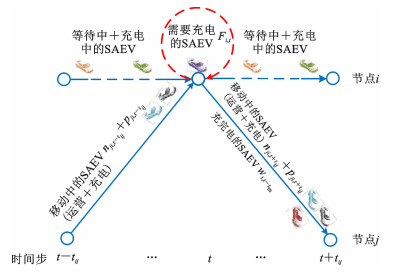
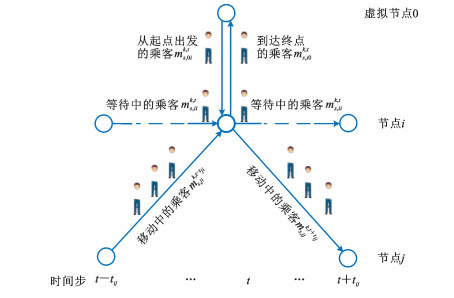
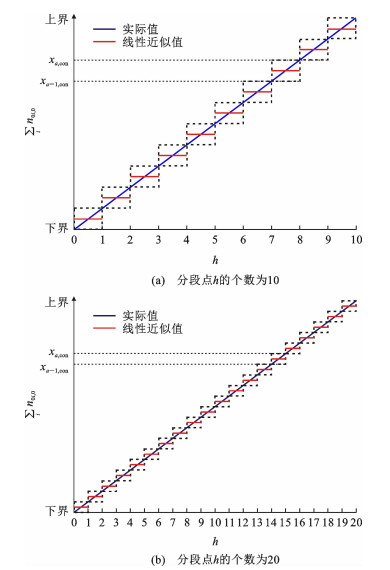
摘要: 为实现共享自动驾驶电动汽车(SAEV)的车队调度与配套设施布局协同优化,构建了SAEV车队规模、车队行驶总距离、乘客总出行时间以及充电停车设施建设成本最小化的多目标非线性规划模型;该模型基于时间扩展网络描述乘客动态OD出行需求、SAEV车队的动态调度策略以及乘客流的时空位移变化,并利用网络中节点、边的容量限制,分别刻画了交通小区内充电停车设施和连接道路上的拥堵效应;区别于传统模型,该模型考虑了SAEV车队的充电需求、充电/营业SAEV车流与乘客流的动态守恒关系、拼车乘客数量限制以及配套设施容量限制等约束;为提高模型求解效率,采用线性近似与线性等价技术将模型重构为混合整数线性规划模型,并采用Epsilon约束法求解多目标模型的帕累托最优解;采用成都市路网出行数据对模型有效性进行了验证,并针对不同拼车乘客数量、车队充电需求比例进行了情景对比分析。研究结果表明:当拼车乘客数量从1人增加至4人,车队行驶总距离减少77.87%,车队规模减小88.56%,配套设施建设成本减少96.80%,但乘客总出行时间增加125.46%,表明运营商应选取合适的拼车策略以保证乘客出行效率;当SAEV车队充电需求比例从30%降低至5%,车队行驶总距离降低10.77%,运营商车队规模降低3.69%,配套设施建设成本与乘客出行总时间保持不变,表明提升SAEV续航性能在提高车队运输效率、降低SAEV车队运营成本方面具有较大潜力。
-
关键词:
- 交通工程 /
- 共享自动驾驶电动汽车 /
- 混合整数非线性规划模型 /
- 车队运营调度 /
- 线性化技术 /
- 设施布局
Abstract: To achieve the collaborative optimization of fleet scheduling and supporting facility layout of shared autonomous electric vehicle (SAEV), a multi-objective nonlinear programming model was established, with the objectives of minimizing the SAEV fleet size, total vehicle travel distance, total passenger travel time, and construction cost of charging and parking facilities. Based on a time-expanded network, the dynamic OD travel demand of passengers, the dynamic scheduling strategy of the SAEV fleet, and the spatiotemporal displacement of passenger flows were described. Furthermore, the capacity constraints of nodes and arcs in the network were utilized to characterize the congestion effects of charging and parking facilities in traffic zones and connecting roads, respectively. Distinguished from traditional models, several constraints were considered, including the charging demand of the SAEV fleet, dynamic conservation relations of charging and operating SAEV flows and passenger flows, ridesharing passenger number limit, and capacity limits of supporting facilities. To improve the solution efficiency of the model, linear approximation and linear equivalence techniques were employed to reconstruct the model into a mixed-integer linear programming model, and the Epsilon-constraint method was used to solve the Pareto-optimal solutions of the multi-objective model. The validity of the model was verified using the travel data of the road network in Chengdu, and a scenario comparison analysis was conducted for different numbers of ridesharing passengers and ratios of fleet charging demand. Research results show that when the number of ridesharing passengers increases from one to four, the total vehicle travel distance decreases by 77.87%; the fleet size decreases by 88.56%, and the construction cost of supporting facilities decreases by 96.80%, but the total passenger travel time increases by 125.46%, which indicates that operators should select an appropriate ridesharing strategy to ensure passenger travel efficiency. When the proportion of SAEV charging demand decreases from 30% to 5%, the total vehicle travel distance decreases by 10.77%, the operator fleet size decreases by 3.69%, and the construction cost of supporting facilities and total passenger travel time remain unchanged, which indicates that improving the SAEV endurance performance has great potential in improving the transport efficiency of SAEV fleet and reducing the operation cost of SAEV fleet. -

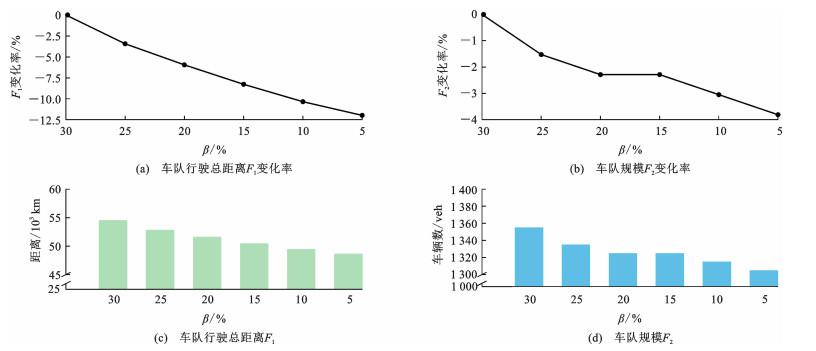
图 10 充电需求比例系数灵敏度分析结果
Figure 10. Sensitivity analysis results of charging demand proportion coefficient
表 1 各聚类区域土地价值假设值
Table 1. Assumed land values in cluster areas
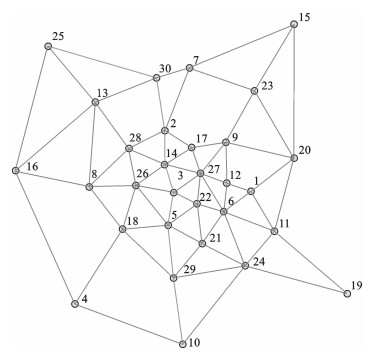
千元 区域 价值 区域 价值 区域 价值 1 12.342 11 11.806 21 14.663 2 15.453 12 18.546 22 19.389 3 18.642 13 6.530 23 6.947 4 7.094 14 18.505 24 9.417 5 15.614 15 6.516 25 6.513 6 18.561 16 5.284 26 13.496 7 11.285 17 16.947 27 18.591 8 9.712 18 12.015 28 11.924 9 17.399 19 5.722 29 11.338 10 6.646 20 7.190 30 8.036  下载: 导出CSV
表 2 其他参数
Table 2. Additional parameters
参数 μij, max/veh γi, min/座 γi, max/座 ki, max/veh m β/% 取值 80 1 10 80 10 30
下载: 导出CSV
表 3 不同拼车人数试验结果
Table 3. Test results of different ridesharing numbers
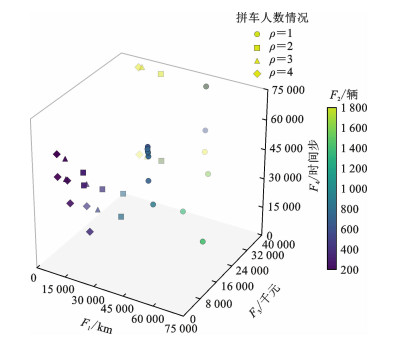
ρ/人 F1/km F2/veh F3/千元 F4/时间步 1 54 545.14 1 355 19 199.02 26 960.00 2 23 722.51 475 9 906.69 38 152.77 3 16 337.45 205 614.37 49 804.22 4 12 072.17 155 614.37 60 782.70
下载: 导出CSV
表 4 不同充电需求比例下的各目标函数值
Table 4. Values of each objective functions under different charging demand proportions
β/% F1/km F2/veh F3/千元 F4/时间步 30 54 545.14 1 355 19 199.02 26 960 25 52 859.86 1 335 19 199.02 26 960 20 51 625.56 1 325 19 199.02 26 960 15 50 486.65 1 325 19 199.02 26 960 10 49 469.58 1 315 19 199.02 26 960 5 48 669.76 1 305 19 199.02 26 960
下载: 导出CSV
-
[1] MACHADO C A S, DE SALLES HUE N P M, BERSSANETI F T, et al. An overview of shared mobility[J]. Sustainability, 2018, 10(12): 4342. doi: 10.3390/su10124342 [2] 李同飞, 赵梦晴, 熊杰, 等. 面向网联自动驾驶混行场景的车道通行能力与路阻函数研究[J]. 交通运输工程学报, 2025, 25(6): 146-156. doi: 10.19818/j.cnki.1671-1637.2025.06.013 LI Tong-fei, ZHAO Meng-qing, XIONG Jie, et al. Lane capacity and cost function for the mixed traffic scenario with connected and autonomous vehicles[J]. Journal of Traffic and Transportation Engineering, 2025, 25(6): 146-156. doi: 10.19818/j.cnki.1671-1637.2025.06.013 [3] COKYASAR T, LARSON J. Optimal assignment for the single-household shared autonomous vehicle problem[J]. Transportation Research Part B: Methodological, 2020, 141: 98-115. doi: 10.1016/j.trb.2020.09.003 [4] MILITÃO A M, TIRACHINI A. Optimal fleet size for a shared demand-responsive transport system with human-driven vs automated vehicles: A total cost minimization approach[J]. Transportation Research Part A: Policy and Practice, 2021, 151: 52-80. doi: 10.1016/j.tra.2021.07.004 [5] SINGH S, SAINI B S. Autonomous cars: Recent developments, challenges, and possible solutions[J]. IOP Conference Series: Materials Science and Engineering, 2021, 1022(1): 012028. doi: 10.1088/1757-899X/1022/1/012028 [6] 霍月英, 张越, 李晓娟, 等. 接驳地铁的共享自动驾驶汽车动态合乘匹配研究[J]. 中国公路学报, 2024, 37(6): 288-301.HUO Yue-ying, ZHANG Yue, LI Xiao-juan, et al. Dynamic ridesharing matching of shared autonomous vehicles as connection to metro[J]. China Journal of Highway and Transport, 2024, 37 (6): 288-301. [7] YAO Z H, JIANG H R, CHENG Y, et al. Integrated schedule and trajectory optimization for connected automated vehicles in a conflict zone[J]. IEEE Transactions on Intelligent Transportation Systems, 2022, 23(3): 1841-1851. doi: 10.1109/TITS.2020.3027731 [8] LI H, WANG Z W, CHEN S W, et al. Integrated optimization of planning and operation of a shared automated electric vehicle system considering the trip selection and opportunity cost[J]. Electronic Research Archive, 2024, 32(1): 41-71. doi: 10.3934/era.2024003 [9] NARAYANAN S, CHANIOTAKIS E, ANTONIOU C. Shared autonomous vehicle services: A comprehensive review[J]. Transportation Research Part C: Emerging Technologies, 2020, 111: 255-293. doi: 10.1016/j.trc.2019.12.008 [10] VOSOOGHI R, PUCHINGER J, BISCHOFF J, et al. Shared autonomous electric vehicle service performance: Assessing the impact of charging infrastructure[J]. Transportation Research Part D: Transport and Environment, 2020, 81: 102283. doi: 10.1016/j.trd.2020.102283 [11] ZHANG S Y, YU J J Q. Online joint ride-sharing and dynamic vehicle-to-grid coordination for connected electric vehicle system[J]. IEEE Transactions on Transportation Electrification, 2024, 10(1): 1194-1206. doi: 10.1109/TTE.2023.3284423 [12] YANG S, WU J J, SUN H J, et al. Trip planning for a mobility-as-a-service system: Integrating metros and shared autonomous vehicles[J]. Transportation Research Part E: Logistics and Transportation Review, 2023, 176: 103217. doi: 10.1016/j.tre.2023.103217 [13] LIU Z Y, LI R M, DAI J C. Effects and feasibility of shared mobility with shared autonomous vehicles: An investigation based on data-driven modeling approach[J]. Transportation Research Part A: Policy and Practice, 2022, 156: 206-226. doi: 10.1016/j.tra.2022.01.001 [14] MARUYAMA R, SEO T. Dynamic user optimal model for shared autonomous vehicles system: Development and systematic comparison with social optimal model[C]//IEEE. 2022 IEEE 25th International Conference on Intelligent Transportation Systems (ITSC). New York: IEEE, 2022: 749-754. [15] ZHAO L H, MALIKOPOULOS A A. Enhanced mobility with connectivity and automation: A review of shared autonomous vehicle systems[J]. IEEE Intelligent Transportation Systems Magazine, 2022, 14(1): 87-102. doi: 10.1109/MITS.2019.2953526 [16] LEVIN M W. Congestion-aware system optimal route choice for shared autonomous vehicles[J]. Transportation Research Part C: Emerging Technologies, 2017, 82: 229-247. doi: 10.1016/j.trc.2017.06.020 [17] DEAN M D, GURUMURTHY K M, DE SOUZA F, et al. Synergies between repositioning and charging strategies for shared autonomous electric vehicle fleets[J]. Transportation Research Part D: Transport and Environment, 2022, 108: 103314. doi: 10.1016/j.trd.2022.103314 [18] FENG C, MEI Z Y. Optimization of shared autonomous vehicles routing problem: From the view of parking[J]. Sustainability, 2023, 15(16): 12303. doi: 10.3390/su151612303 [19] 胡路, 徐尉耀, 李皓. 考虑混合车位的自动驾驶电动共享汽车系统配置与运营联合优化[J]. 中国公路学报, 2024, 37(4): 37-47.HU Lu, XU Wei-yao, LI Hao. Joint optimization of mixed parking spaces and dynamic pricing for a shared autonomous electric vehicle system[J]. China Journal of Highway and Transport, 2024, 37 (4): 37-47. [20] PAPARELLA F, HOFMAN T, SALAZAR M. Electric autonomous mobility-on-demand: Jointly optimal vehicle design and fleet operation[J]. IEEE Transactions on Intelligent Transportation Systems, 2024, 25(11): 17054-17065. doi: 10.1109/TITS.2024.3428569 [21] FAGNANT D J, KOCKELMAN K M. Dynamic ride-sharing and fleet sizing for a system of shared autonomous vehicles in Austin, Texas[J]. Transportation, 2018, 45(1): 143-158. doi: 10.1007/s11116-016-9729-z [22] IACOBUCCI R, MCLELLAN B, TEZUKA T. Optimization of shared autonomous electric vehicles operations with charge scheduling and vehicle-to-grid[J]. Transportation Research Part C: Emerging Technologies, 2019, 100: 34-52. doi: 10.1016/j.trc.2019.01.011 [23] VAN DEN BERGH O, WEEKX S, DE CAUWER C, et al. Locating charging infrastructure for shared autonomous electric vehicles and for vehicle-to-grid strategy: A systematic review and research agenda from an energy and mobility perspective[J]. World Electric Vehicle Journal, 2023, 14(3): 56. doi: 10.3390/wevj14030056 [24] 马骏驰, 张源, 段宗涛, 等. 考虑充电需求的电动汽车行为策略研究综述[J]. 交通运输工程学报, 2024, 24(6): 66-79.MA Jun-chi, ZHANG Yuan, DUAN Zong-tao, et al. Research review on behavior strategies of electric vehicles considering charging demands[J]. Journal of Traffic and Transportation Engineering, 2024, 24(6): 66-79. [25] CHEN T D, KOCKELMAN K M, HANNA J P. Operations of a shared, autonomous, electric vehicle fleet: Implications of vehicle & charging infrastructure decisions[J]. Transportation Research Part A: Policy and Practice, 2016, 94: 243-254. doi: 10.1016/j.tra.2016.08.020 [26] 杨佳逸, 梅振宇, 唐崴, 等. 基于前馈控制的高密度停车场自主泊车动态分配模型[J]. 交通运输工程学报, 2025, 25(6): 219-228. doi: 10.19818/j.cnki.1671-1637.2025.06.018 YANG Jia-yi, MEI Zhen-yu, TANG Wei, et al. A proactive control-based dynamic allocation model for high-density autonomous parking lots[J]. Journal of Traffic and Transportation Engineering, 2025, 25(6): 219-228. doi: 10.19818/j.cnki.1671-1637.2025.06.018 [27] TIAN J J, JIA H F, WANG G F, et al. Integrated optimization of charging infrastructure, fleet size and vehicle operation in shared autonomous electric vehicle system considering vehicle-to-grid[J]. Renewable Energy, 2024, 229: 120760. doi: 10.1016/j.renene.2024.120760 [28] LOKHANDWALA M, CAI H. Siting charging stations for electric vehicle adoption in shared autonomous fleets[J]. Transportation Research Part D: Transport and Environment, 2020, 80: 102231. doi: 10.1016/j.trd.2020.102231 [29] YU X L, CHEN J X, KUMAR P, et al. An integrated optimisation framework for locating depots in shared autonomous vehicle systems[J]. Transportmetrica A: Transport Science, 2024, 20(2): 2152299. doi: 10.1080/23249935.2022.2152299 [30] SEO T, ASAKURA Y. Multi-objective linear optimization problem for strategic planning of shared autonomous vehicle operation and infrastructure design[J]. IEEE Transactions on Intelligent Transportation Systems, 2022, 23(4): 3816-3828. doi: 10.1109/TITS.2021.3071512 [31] SANTOS G G D, BIROLINI S, DE ALMEIDA CORREIA G H. A space-time-energy flow-based integer programming model to design and operate a regional shared automated electric vehicle (SAEV) system and corresponding charging network[J]. Transportation Research Part C: Emerging Technologies, 2023, 147: 103997. doi: 10.1016/j.trc.2022.103997 [32] YANG H, MENG Q. Departure time, route choice and congestion toll in a queuing network with elastic demand[J]. Transportation Research Part B: Methodological, 1998, 32(4): 247-260. doi: 10.1016/S0191-2615(97)00041-6 [33] 周苏洋, 关奥博, 顾伟, 等. 工业综合能源系统的多工序统一建模与规划[J]. 电力系统自动化, 2025, 49(3): 31-41.ZHOU Su-yang, GUAN Ao-bo, GU Wei, et al. Unified Modeling and Planning of Industrial Integrated Energy System with Multiple Processes[J]. Automation of Electric Power Systems, 2025, 49(3): 31-41. [34] HENAO A, MARSHALL W E. The impact of ride-hailing on vehicle miles traveled[J]. Transportation, 2019, 46(6): 2173-2194. doi: 10.1007/s11116-018-9923-2 -

计量
- 文章访问数: 14
- HTML全文浏览量: 9
- PDF下载量: 4
- 被引次数: 0
