| Citation: | QI Jing-jing, LI Wei-xuan, JIANG Li-zhong, CAO Hua, LYU Wei-rong, LU Bei-rong, HUANG Zhi. Mechanical performance of steel-concrete double composite continuous beams with constrained shear connectors[J]. Journal of Traffic and Transportation Engineering, 2026, 26(5): 57-70. doi: 10.19818/j.cnki.1671-1637.2026.042

|
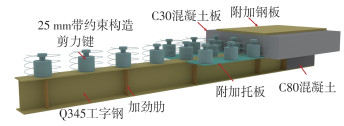
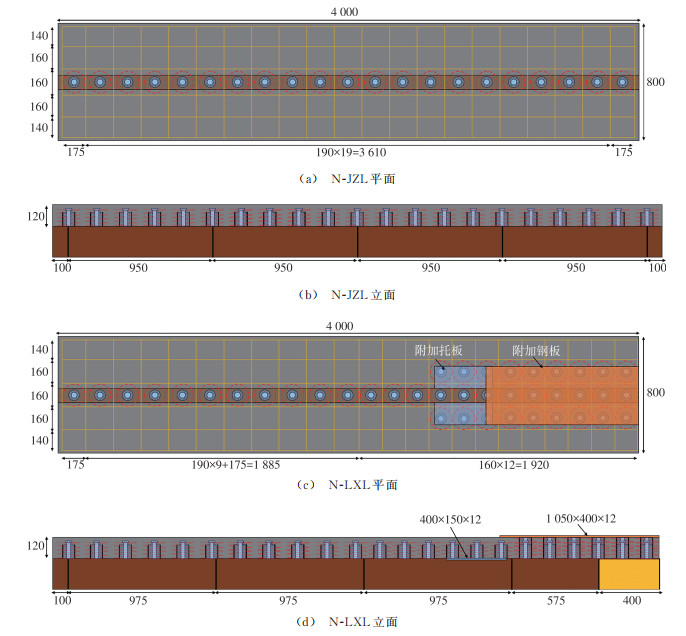
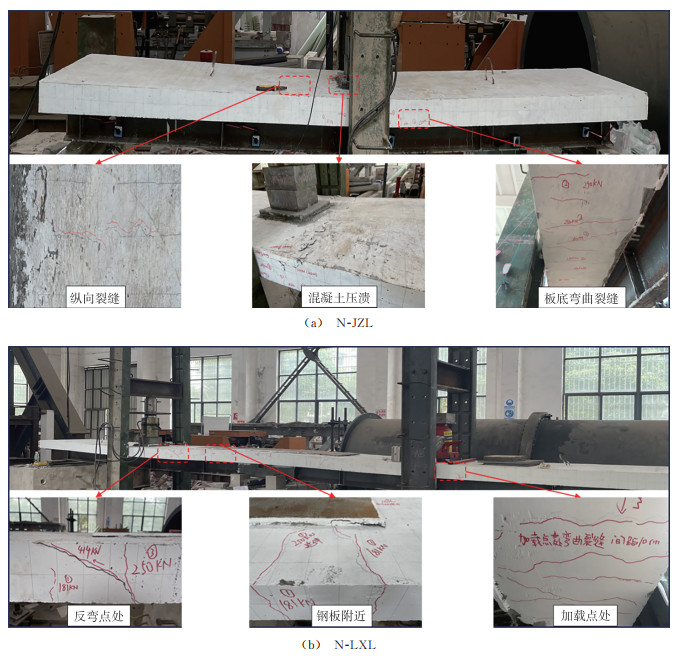
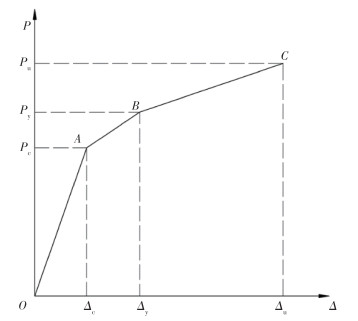
To enhance the material utilization efficiency in the negative moment regions of steel-concrete composite beams, a double composite beam with constrained shear connectors was proposed. Flexural tests were carried out on one simply supported beam and one continuous beam. Analysis was performed on the failure mode, load-bearing capacity, interface slip, and strain distribution characteristics of the steel-concrete composite beam with constrained shear connectors. Based on finite element simulation, the interfacial mechanical mechanism and plastic hinge formation mechanism of the steel-concrete double composite beam were revealed. The stiffness degradation law was further explored for the steel-concrete double composite beam by establishing a characteristic-point-based mid-span load-deflection curve model. The research results show that the failure mode of the steel-concrete double composite beam is tensile-shear failure with inclined cracks at the inflection point. Cracks in the concrete at the bottom of the slab in the negative moment region are fine and few in number. Compared with conventional steel-concrete continuous composite beams, the double composite beam exhibits increases of 49% in load-bearing capacity and 67% in stiffness. Stiffness degradation of the double composite beam exhibits a three-stage characteristic: stable stiffness in the elastic stage, moderate stiffness degradation in the elastoplastic stage, and significant stiffness degradation in the ultimate plastic stage. The theoretical model is suitable for evaluating the deformation capacity and overall stiffness degradation law of the double composite beam. Numerical results indicate that the flexural stiffness of the intermediate support section of the double composite beam is 1.66 times that of the mid-span section. During loading, the plastic hinge forms earlier in the mid-span than at the support. The shear connectors on the additional steel plate bear 34% of the interfacial shear force in the negative moment region, thereby enhancing the interfacial shear stiffness. Under a large deformation, the working state coefficient of the additional steel plate interface reaches 0.49, indicating significantly improved utilization efficiency. The double composite structure fully leverages the complementary characteristics of high tensile strength of steel and high compressive strength of concrete, improves the crack resistance of the bridge deck in the negative moment region of the steel-concrete composite beam, and fundamentally resolves the engineering challenge of concrete slab cracking and low material utilization efficiency in the negative moment region of steel-concrete composite beams.

| [1] |
NIE Jian-guo, YU Zhi-wu. Research and practice of composite steel-concrete beams in China[J]. China Civil Engineering Journal, 1999, 32(2): 3-8.
|
| [2] |
ZHONG Shan-tong. Research and application of steel-concrete composite structures in our country[J]. Steel Construction, 2000, 15(4): 41-46.
|
| [3] |
FAN Jian-sheng, NIE Jian-guo. Progress in research and application of composite steel-concrete bridges[J]. Progress in Steel Building Structures, 2006, 8(5): 35-39.
|
| [4] |
HE Jun, WANG Zi-tong, HE Yao-bei, et al. Research review on demountable shear connectors for prefabricated steel-concrete composite beams[J]. Journal of Traffic and Transportation Engineering, 2025, 25(5): 180-207. doi: 10.19818/j.cnki.1671-1637.2025.05.013
|
| [5] |
SU Qing-tian, YANG Guo-tao, WU Chong. Experiments on concrete cracking of steel-concrete composite box girder[J]. China Journal of Highway and Transport, 2012, 25(5): 74-81.
|
| [6] |
ZHAO Qiu, YE Jun-yu, ZHANG Hao. Research on bending capacity of new steel-concrete composite girders in negative moment region[J]. Journal of Traffic and Transportation Engineering, 2025, 25(5): 356-367. doi: 10.19818/j.cnki.1671-1637.2025.05.023
|
| [7] |
ZHANG Yu-ping, TAN Li, LI Chuan-xi, et al. Transverse negative bending performance of steel-UHPC composite bridge deck with PBL shear keys[J]. Journal of Chang'an University (Natural Science Edition), 2025, 45(2): 111-125.
|
| [8] |
ZHANG Hong. Research on anti-cracking design and shear key durability of steel-concrete composite beams in negative moment region[D]. Chengdu: Southwest Jiaotong University, 2021.
|
| [9] |
NIE Jian-guo, TAO Mu-xuan, NIE Xin, et al. New technique and application of uplift-restricted and slip-permitted connection[J]. China Civil Engineering Journal, 2015, 48(4): 7-14, 58.
|
| [10] |
LI Cong, NIE Jian-guo, ZHOU Xin-yi, et al. Anti-cracking design for hogging moment regions of steel-concrete continuous composite beam bridges[J]. Journal of Building Structures, 2022, 43(3): 172-178.
|
| [11] |
ZOU Yang, PENG Hong-bo, ZHANG Zhong-ya, et al. Experimental study on shear performance of PBL shear connector in negative moment region[J]. China Civil Engineering Journal, 2023, 56(10): 52-66.
|
| [12] |
LI Xiao, HU Zhi-jian, HE Yan. Anti-cracking property of UHPC-NC structure in the negative moment zone of PC beam bridge[J]. Journal of South China University of Technology (Natural Science Edition), 2022, 50(11): 35-43.
|
| [13] |
CAI Shu-kun. Experimental research and theoretical analysis of steel and ultrahigh performance concrete(UHPC) composite beam under hogging moment[D]. Changsha: Hunan University, 2020.
|
| [14] |
WU Fang-wen, ZUO Jian, FAN Zhou, et al. Investigation on mechanical properties of steel-ECC/UHPC composite girders in negative moment regions[J]. Journal of Traffic and Transportation Engineering, 2024, 24(1): 218-231. doi: 10.19818/j.cnki.1671-1637.2024.01.014
|
| [15] |
WANG Y H, YU J, LIU J P, et al. Experimental study on assembled monolithic steel-prestressed concrete composite beam in negative moment[J]. Journal of Constructional Steel Research, 2020, 167: 105667. doi: 10.1016/j.jcsr.2019.06.004
|
| [16] |
LIU Shuai. Study on stress performance and crack resistance method of negative moment region of steel-concrete composite bridge[D]. Shenyang: Shenyang Jianzhu University, 2022.
|
| [17] |
DAI Chang-yuan, SU Qing-tian, FENG Xiao-mao, et al. Crack width calculation method of fiber reinforced concrete composite bridge deck[J]. Journal of Tongji University (Natural Science), 2020, 48(6): 788-795.
|
| [18] |
KALIBHAT M G, UPADHYAY A. Numerical modeling of continuous steel concrete composite girders considering cracking of concrete[J]. Structures, 2020, 27: 1313-1323. doi: 10.1016/j.istruc.2020.07.031
|
| [19] |
AN Jing-feng, LIU Li-wei, GUO Zhao-yuan, et al. Factors affecting cracking and crack control measures of steel-concrete composite girder bridge[J]. Journal of Nanjing Tech University (Natural Science Edition), 2020, 42(3): 389-398.
|
| [20] |
LEI Sheng-xiang, ZHANG Yan-qing, LIU Yong, et al. Review of study on the out-of-plane mechanical performance of steel-concrete-steel sandwich composite members[J]. Building Structure, 2022, 52(13): 32-42, 20.
|
| [21] |
ZHAO Wei-yi, WANG Lin, GUO Quan-quan, et al. Research advances of impact resistance of steel-concrete composite structures[J]. Steel Construction (Chinese & English), 2020, 35(3): 26-36.
|
| [22] |
YOUSEFI M, HASHEM KHATIBI S. Experimental and numerical study of the flexural behavior of steel-concrete-steel sandwich beams with corrugated-strip shear connectors[J]. Engineering Structures, 2021, 242: 112559. doi: 10.1016/j.engstruct.2021.112559
|
| [23] |
WANG T, YAN J B. Developments of steel-concrete-steel sandwich composite structures with novel EC connectors: Members[J]. Journal of Constructional Steel Research, 2020, 175: 106335. doi: 10.1016/j.jcsr.2020.106335
|
| [24] |
QI Jing-jing, CAO Hua, BU Ming-hua, et al. Research on mechanical behavior of stud shear connector with constraint measure[J]. Building Structure, 2021, 51(18): 32-39.
|
| [25] |
QI Jing-jing, WU Ji-dong, JIANG Li-zhong, et al. Interface shear behavior of stud shear connectors composite plate with constrained measure[J]. Journal of Railway Science and Engineering, 2023, 20(7): 2629-2642.
|
| [26] |
LIU Zhong-wu. Experimental and theoretical study on seismic performance of steel-concrete simply supported composite beams[D]. Changsha: Central South University, 2004.
|
| [27] |
CAO Hua. Experimental research and theoretical analysis on seismic performance of steel-concrete continuous composite beams[D]. Changsha: Central South University, 2005.
|
| [28] |
XIE Zu-wei. Study on interface shear performance of stud connectors with constrained configuration[D]. Xiangtan: Hunan University of Science and Technology, 2022.
|
| [29] |
CHEN Pan. Study on mechanical behavior of stud shear connectors with constrained configuration[D]. Xiangtan: Hunan University of Science and Technology, 2019.
|
Website copyright Journal of Traffic and Transportation Engineering Editorial Department陕ICP备05001904号-1
Address :Editorial Department of Journal of Traffic and Transportation Engineering, Chang'an University, Middle Section of South 2nd Ring Road, Xi'an, China(710064) Tel:029-82334388 Email:jygc@chd.edu.cn
All visit:Today's visit:
Supported by:
Beijing Renhe Information Technology Co. Ltd




 DownLoad: