


Research review of dry process rubberized asphalt mixtures: materials, mechanism, design, and performance
-
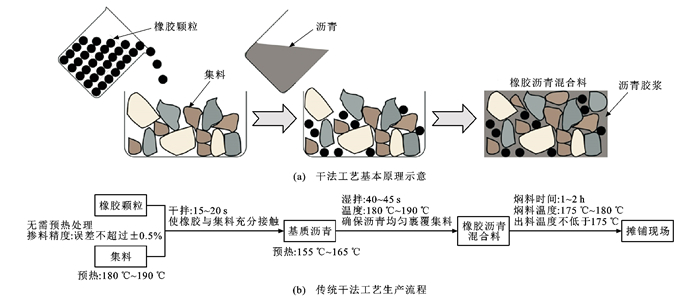
摘要: 明确界定了不同工艺橡胶沥青混合料的定义,系统梳理了橡胶颗粒的组成及制备技术;围绕其改性理念,深入分析了橡胶颗粒作为弹性集料的作用模式、与沥青的相互作用及关键影响因素;总结了干法橡胶沥青混合料的设计参数及其对混合料性能的影响,并基于数理统计与现行规范划分了性能等级。研究结果表明:材料层面,橡胶颗粒的形态特征与组分异质性共同决定其“弹性集料”效能,但现有研究对炭黑迁移、组分重分布等二次改性机制尚未完全阐明;机理层面,揭示了干法工艺中“梯度溶胀-动态降解”的核心机制,指出橡胶颗粒外层与内芯的溶胀差异;设计层面,通过对级配设计、橡胶粒径与掺量、沥青含量、工艺改进及焖料时间等参数的精准调控,可有效提升干法橡胶沥青混合料的整体性能;性能层面,掺入多种外加剂至干法橡胶沥青混合料中,可强化橡胶颗粒与沥青的结合,进一步提高混合料路用性能与稳定性。建议未来研究应聚焦于橡胶-沥青界面反应的微观表征指标开发、融合环境与功能属性的全生命周期评价体系构建,以及基于智能化技术重塑干法橡胶沥青混合料的研究范式,为干法工艺工程化应用提供理论支撑。Abstract: The definition of rubberized asphalt mixtures with different processes was clearly defined, and the composition and preparation technology of rubber particles were systematically sorted out. By focusing on their modification concept, the mode of action of rubber particles as an elastic aggregate, their interaction with asphalt, and the key influencing factors were deeply analyzed. The design parameters of dry rubber asphalt mixtures and their influence on the performance of the mixtures were summarized. The performance grades were classified on the basis of mathematical statistics and current specifications. According to the results, at the material level, the morphological characteristics of rubber particles and the heterogeneity of components jointly determine their "elastic aggregate" performance. However, the existing studies have yet to fully elucidate the secondary modification mechanisms, such as the migration of carbon black and the redistribution of components. At the mechanism level, the core mechanism of "gradient swelling-dynamic degradation" in the dry process was revealed, pointing out the swelling difference between the outer layer of rubber particles and the inner core. At the design level, through the precise control of parameters including gradation design, rubber particle size and mixing amount, asphalt content, process improvement, and simmering time, the overall performance of the dry rubberized asphalt mixtures could be effectively improved. At the performance level, mixing various admixtures into the dry rubberized asphalt mixtures could strengthen the bonding of rubber particles with asphalt, further improving the road performance and stability of the mixtures. Future research should focus on the development of microscopic characterization indexes for rubber-asphalt interfacial reactions, the construction of a full life cycle evaluation system integrating environmental and functional attributes, and the reshaping of the research paradigm of dry rubberized asphalt mixtures based on intelligent technology. A theoretical support is thus provided for the application of the engineering of the dry process.
-

图 6 常温粉碎法制备橡胶颗粒的生产工艺流程
Figure 6. Production process of rubber particles prepared by room temperature crushing method

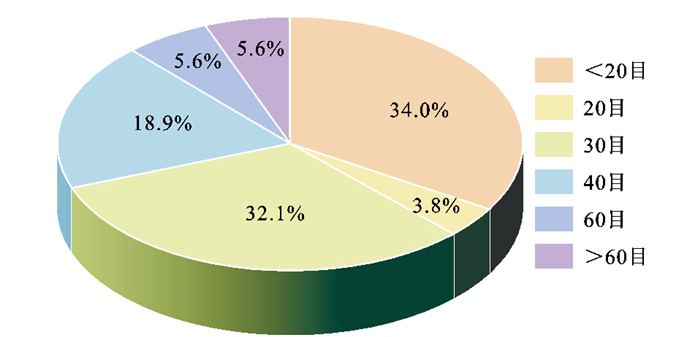
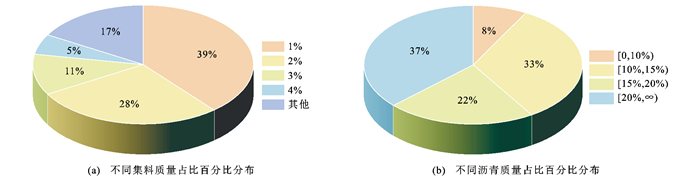
图 8 橡胶沥青混合料中橡胶颗粒分布
Figure 8. Distribution of rubber particles in rubberized asphalt mixture


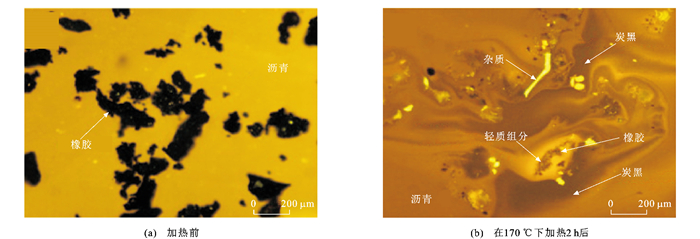
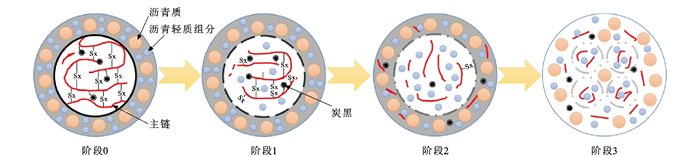
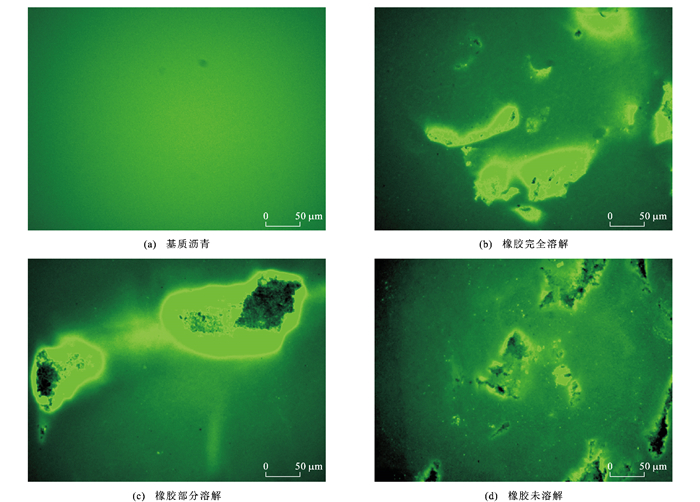
图 15 橡胶与沥青的相互作用阶段(微观层面)
Figure 15. Interaction stages of rubber and asphalt (micro-level)

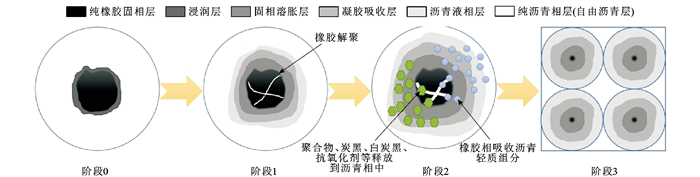
图 16 橡胶与沥青的相互作用阶段(宏观层面)
Figure 16. Interaction stages of rubber and asphalt (macro-level)

图 17 橡胶与沥青相互作用的影响因素
Figure 17. Influencing factors of interaction between rubber and asphalt

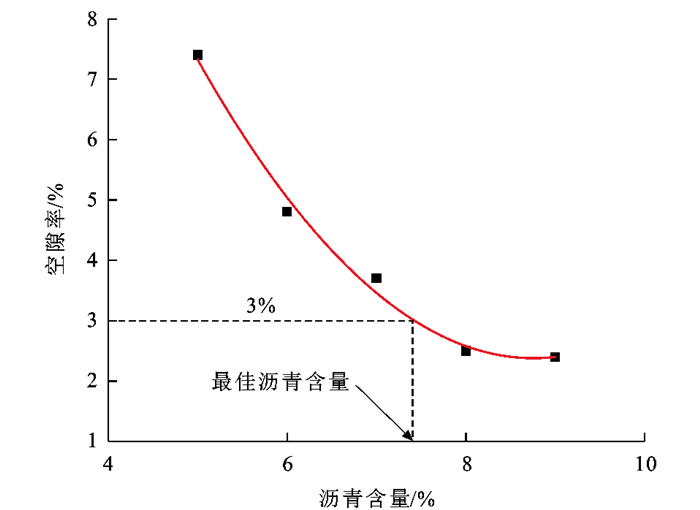
图 23 基于目标空隙率确定最佳沥青含量
Figure 23. Optimum asphalt content is determined based on the target porosity

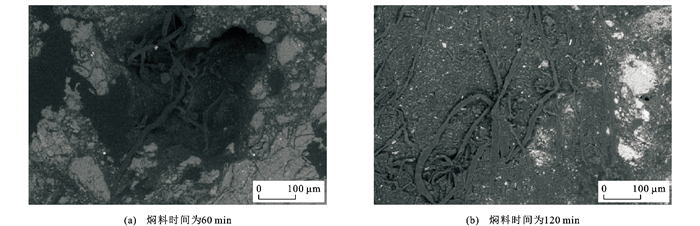
图 24 不同文献中干法橡胶沥青混合料的焖料时间
Figure 24. Stuffy time of dry process rubberized asphalt mixtures in different literatures

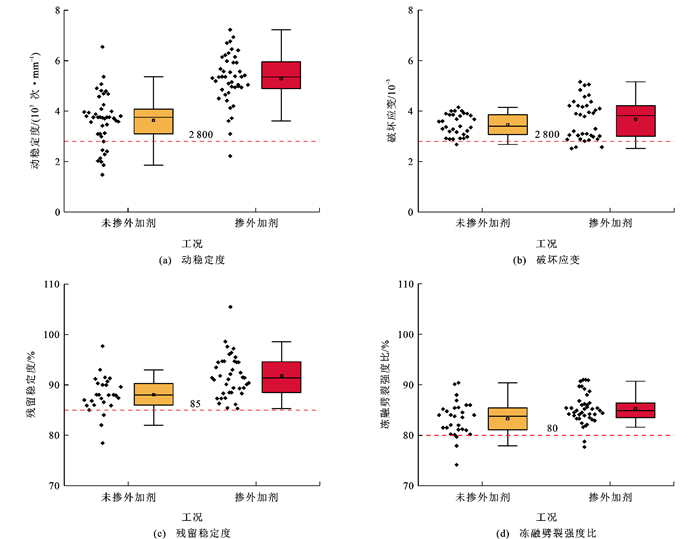
图 25 干法橡胶沥青混合料路用性能
Figure 25. Road performance of dry process rubberized asphalt mixtures
表 1 湿法工艺中不同技术的名称和定义
技术 定义 别名 参考文献 湿法-高黏度 沥青、橡胶颗粒(掺量不少于15%)及添加剂组成的混合物,生产过程必须保证橡胶颗粒与基质沥青在高温下充分溶胀 McDonald工艺;高黏橡胶改性沥青;橡胶高黏沥青;Asphalt-Rubber Binder;Bitumen Rubber Binder [14]~[18] 连续共混 与McDonald工艺类似,不同之处在于使用更细的橡胶颗粒与沥青连续拌和后储存于储罐中 Florida技术; Continuous Blending-Reaction Systems [17]、[18] 湿法-无搅拌 在炼油厂或沥青储运终端,橡胶颗粒与热沥青经混合并脱硫降解,形成近似均相体系后,运至沥青混凝土搅拌站或施工现场应用 Terminal Blend; Field-Blends;再生橡胶改性沥青(RTR-MBS);溶解性胶粉改性沥青 [14]、[19]、[20] 注:湿法是指在混合料加入沥青之前,先将橡胶颗粒与沥青拌和的任何方法,如图 1所示。  下载: 导出CSV
表 2 干法工艺中不同技术的名称和定义
技术 定义 别名 参考文献 RUMAC 将占混合料质量3%~5%、粒径为2.0~6.3 mm的橡胶颗粒预先掺入混合料中,作为集料组成部分,以制备热拌橡胶沥青混合料 PlusRide [18]、[21] 一般干法工艺 与RUMAC技术类似,但使用的橡胶颗粒粒径更小(0.18~2.00 mm),用量更低(占混合料质量3%) 类集料TAK系统 [18]、[21]、[22] 块胶工艺 与RUMAC技术类似,但使用的橡胶颗粒粒径更大(4.75~9/12.50 mm),用量更高(占混合料质量3%~12%) [18]、[21] 新干法 全部采用细橡胶颗粒,摒弃其作为弹性集料的功能,橡胶颗粒用量下降至混合料的1%以下,将骨料、橡胶颗粒与外掺剂进行拌和,再与沥青拌和形成混合料 [10]、[22] 注:干法是指在混合料加入沥青之前,先将橡胶颗粒与集料拌和的任何方法,如图 2所示。
下载: 导出CSV
轮胎类型 元素的质量分数/% C H N S O 轿车 86.40 8.00 0.50 1.70 3.40 74.30 7.20 0.90 1.71 15.89 83.92 6.83 0.78 0.92 7.55 卡车 83.20 7.70 1.50 1.44 6.16 80.30 7.18 0.50 1.19 10.80 摩托车 75.50 6.75 0.81 1.44 15.50
下载: 导出CSV
表 4 不同橡胶材料低温性能
Table 4. Low temperature properties of different
材料 玻璃化转变温度/℃ 脆性温度/℃ TR10/℃ 天然橡胶 -70 -55 -55 丁腈橡胶 -40 -25 -30 氯丁橡胶 -45 -30 -30 丁苯橡胶 -60 -50 -45 弹性体热塑性橡胶 -60 -55 -50
下载: 导出CSV
表 5 橡胶颗粒粉碎技术
Table 5. Rubber particle crushing technologies
生产方式 概念 特性 缺点 干法粉碎 常温粉碎 辊筒粉碎机 加工温度为50 ℃±5 ℃或稍高的情况下,通过辊筒的剪切和挤压等作用力对废旧橡胶进行粉碎处理[28] 所生产的橡胶颗粒比表面积大、密度低、质地粗糙、形状不规则、疏松多孔 粉碎过程产生的热量可能导致橡胶颗粒过热焦化,不仅会损害橡胶颗粒性能,还存在火灾安全隐患 双螺杆挤出机 通过热能和机械力对橡胶进行剪切,使得橡胶颗粒分子链发生断裂,短时间脱硫降解的机械化学方法[29] 污染小,可连续生产,且具备高工作速度、高工作温度及高效率[29] 低温粉碎 利用液氮、空气涡轮膨胀、液化天然气冷冻技术等将废旧橡胶冷却至玻璃化转变温度以下,并使用锤式或盘式粉碎机进行粉碎处理 所生产的橡胶颗粒粒径较小、表面光滑、热氧化程度低 工艺成本偏高,与沥青的相互作用较差 湿法粉碎 RAPRA法 在水或有机溶剂等介质中,粉碎废旧橡胶生产橡胶颗粒的方法 所生产的橡胶颗粒粒径为2~20 μm,表面呈现凹凸和毛刺状特征,补强效果好[28] 所用溶剂对环境具有负面影响,生产成本高,应用范围有限 常温浸混粉碎法 克服了常温粉碎工艺中常见的高温成糊和生热降解问题 所用溶剂对环境具有负面影响 全水相法 所生产的橡胶颗粒粒径为75~180 μm,颗粒均匀、比表面积大、表面活性高无焦化层、不带静电[30] 高压水射流冲击粉碎法 所生产的橡胶颗粒表面粗糙,且部分实现脱硫[31]
下载: 导出CSV
表 6 沥青四组分Hildebrand溶解度参数值[48]
Table 6. Hildebrand solubility parameter values of four asphalt fractions[48]
沥青四组分 饱和分 芳香分 胶质 沥青质 溶解度参数/(J·cm-3)0.5 17.4~20.0 19.0~22.5 21.9~26.6 24.9~32.9
下载: 导出CSV
组分 NR SR 橡胶颗粒(主要成分聚苯乙烯丁二烯) 溶解度参数/(J·cm-3)0.5 16.9 18.1 17.8
下载: 导出CSV
表 8 干法工艺改进方法
Table 8. Dry process improvement methods
参考文献 工艺改进 优点 进一步研究方向 [107] 复合工艺:先将集料于180℃~190 ℃预热搅拌60 s以保证均匀,继而加入预热沥青混合30 s制成基质混合料,最后逐步添加同温预热的橡胶颗粒终混60 s 与传统干法和湿法相比,该工艺能更显著地提高沥青混合料的性能 仅开展了部分性能试验,后续仍需增补相关试验,以明确该方法的适用性与可靠性 [108] 在连续级配沥青混合料的拌制过程中加入40目的橡胶颗粒 混合料在高温和低温下的性能均有明显改善,而水稳定性基本保持不变 [109] 混合法:采用80 μm细橡胶颗粒制备橡胶改性沥青,将其与掺入1~3 mm粗橡胶颗粒的集料拌制成橡胶沥青混合料;干拌时间延长5~10 s,随后加入橡胶沥青湿拌1 min,再加入矿粉拌和1 min以上,总拌和时间不少于3 min 该工艺所制橡胶沥青混合料,其高温与低温性能均优于干法与湿法工艺,且橡胶掺量为湿法工艺的3倍、干法工艺的1.5倍 该工艺因兼具干、湿2道工序,需配备橡胶沥青拌制设备及橡胶颗粒添加设备,流程相对复杂,有待进一步研发优化 [110] 半湿法工艺:采用经预处理并与部分沥青反应制得的活化橡胶,将其均匀掺入集料,随后加入沥青终混至均匀;混合料于175 ℃制备,165 ℃压实,焖料仅需30 min 该工艺在保留湿法工艺性能优势的基础上,无需专用设备及改造传统沥青工厂即可生产橡胶沥青混合料;同时,通过设定焖料时间下限,提高生产效率 需进一步开展多因素耦合试验,聚焦温度分布与焖料时长的协同作用研究,并增设长期性能跟踪试验 [111] 将橡胶颗粒作为SMA混合料的活性填料添加至混合物。结合SBS改性沥青、添加剂及石蜡,可优化工作性能并降低混合与生产温度 该工艺下,橡胶的掺入不影响混合物的体积特性,且在130 ℃摊铺温度下仍能保持工作性,性能与传统SMA相当且更环保 需开展进一步试验,评估新工艺橡胶沥青混合料的疲劳性能,并依据其应用需求确定适宜的混合料设计方案
下载: 导出CSV
表 9 干法橡胶沥青混合料抗疲劳性文献总结
Table 9. Literature summary of fatigue resistance of dry process rubberized asphalt mixtures
参考文献 外加剂 试验方法 结果 [121] 四点弯曲(FPB) 干法橡胶沥青混合料与湿法展现出相似的抗疲劳性能 [122] 盘状紧凑拉伸(DCT) 相较于常规沥青混合料和聚合物改性沥青混合料,干法橡胶沥青混合料的断裂能分别提高了17.1%~30.5%和6.8%~9.1%。无论处于未老化还是长期老化状态,干法橡胶沥青混合料的断裂能均为表现最优 [123] 四点弯曲(FPB) 相较于等厚常规沥青混合料加固的路面,采用干法橡胶沥青混合料加固的路面预期使用寿命可延长约10倍。若以初始劲度模量下降20%作为开裂阈值,干法橡胶沥青混合料加固的路面在开裂后的剩余使用寿命较等厚常规沥青混合料加固路面至少高出20倍 [95] 实际路面评估 调研路面结构与功能特性的结果显示,掺入橡胶的沥青路面在使用8年后仍保持良好质量,并预计在未来8年内将持续保持优异的道路性能 [10] TOR,CTOR(橡胶质量的4.5%) 劈裂疲劳(IDT) 相同试验荷载条件下,干法TOR橡胶沥青混合料与干法CTOR橡胶沥青混合料的疲劳性能均优于SBS改性沥青混合料 [118] SBS-T(沥青质量的4%) 动态剪切流变(DSR) 与4%SBS-T干法改性沥青相比,SBS-T掺量为4%,橡胶掺量为沥青质量12% 的干法复合改性沥青在13 ℃下的疲劳因子G*·sin(δ)值由3 988 kPa降至2 876 kPa,降低了27.88% [124] TOR(橡胶质量的4.5%) 直接拉伸(DT) 30目橡胶掺量为沥青质量10%的干法和湿法SMA混合料的疲劳寿命相近,均高于SMA,低于TB法SMA和SBS改性SMA [116] CTOR(橡胶质量的8%) 室内模拟干法橡胶沥青在自然条件下老化后路用性能变化 橡胶颗粒中所含的炭黑、橡胶烃、抗紫外线剂、氧化抑制剂等其他改性成分在CTOR连接剂的作用下释放出来,对于橡胶沥青混合料抗疲劳性改善效果明显 [125] TOR(橡胶质量的4.5%) 四点弯曲(FPB) 在3种测试应变水平(450×10-6、550×10-6、650×10-6)下,干法温拌TOR橡胶沥青混合料的疲劳寿命分别为湿法温拌TOR沥青混合料的1.4、1.5、1.8倍
下载: 导出CSV
表 10 干法橡胶沥青混合料性能等级划分
Table 10. Performance grade division of dry rubberized asphalt mixtures
技术指标 动稳定度/(次·mm-1) 破坏应变/10-6 残留稳定度/% 冻融劈裂强度比/% 分级标准 Q3 4 084 3 856 90.3 85.4 Q2 3 754 3 400 88.0 83.8 Q1 3 092 3 076 86.0 81.1 规范要求 >2 800 >2 800 >85 >80 等级 优 [4 200, +∞] [3 900, +∞) [90, +∞) [86, +∞) 良 [3 800, 4 100) [3 400, 3 900) [88, 90) [84, 86) 中 [2 800, 3 800) [2 800, 3 400) [85, 88) [80, 84) 差 [0, 2 800) [0, 2 800) [0, 85) [0, 80)
下载: 导出CSV
-
[1] 赵树杰, 许竣媛, 曾现来. 典型轮胎可回收性评估及生态设计[J]. 中国环境科学, 2024, 44(8): 4731-4736.ZHAO Shu-jie, XU Jun-yuan, ZENG Xian-lai. Measuring the recyclability and eco-design of typical tires[J]. China Environmental Science, 2024, 44(8): 4731-4736. [2] 葛冬冬, 姜向阳, 吕松涛, 等. 湿法橡胶改性沥青研究进展[J]. 中外公路, 2024, 44(6): 27-50.GE Dong-dong, JIANG Xiang-yang, LYU Song-tao, et al. Research progress of rubber-modified asphalt by wet process[J]. Journal of China & Foreign Highway, 2024, 44(6): 27-50. [3] DUAN K X, WANG C H, LIU J K, et al. Research progress and performance evaluation of crumb-rubber-modified asphalts and their mixtures[J]. Construction and Building Materials, 2022, 361: 129687. doi: 10.1016/j.conbuildmat.2022.129687 [4] 杨三强, 孙爽, 李倩, 等. 胶粉改性沥青混合料动荷载力学响应分析[J]. 中外公路, 2023, 43(2): 227-233.YANG San-qiang, SUN Shuang, LI Qian, et al. Dynamic load response analysis of rubber powder modified asphalt mixture[J]. Journal of China & Foreign Highway, 2023, 43(2): 227-233. [5] 勾俊芳. 干法胶粉沥青混合料性能研究[D]. 西安: 长安大学, 2017.GOU Jun-fang. Research on dry powder asphalt mixture behaviour[D]. Xi'an: Chang'an University, 2017. [6] 梁波, 廖威, 郑健龙. 改性剂与沥青相容性作用中分子动力学模拟综述[J]. 交通运输工程学报, 2024, 24(5): 54-85. doi: 10.19818/j.cnki.1671-1637.2024.05.005LIANG Bo, LIAO Wei, ZHENG Jian-long. Review on molecular dynamics simulation for compatibilities of modifiers with asphalt[J]. Journal of Traffic and Transportation Engineering, 2024, 24(5): 54-85. doi: 10.19818/j.cnki.1671-1637.2024.05.005 [7] 高中洋. 干拌法橡胶粉改性沥青及其混合料性能研究[D]. 苏州: 苏州科技大学, 2019.GAO Zhong-yang. Interaction of crumb rubber modifier(CRM) with asphalt in dry process and the performance of dry-processed CRM asphalt mixtures[D]. Suzhou: Suzhou University of Science and Technology, 2019. [8] 马涛, 陈葱琳, 张阳, 等. 胶粉应用于沥青改性技术的发展综述[J]. 中国公路学报, 2021, 34(10): 1-16.MA Tao, CHEN Cong-lin, ZHANG Yang, et al. Development of using crumb rubber in asphalt modification: A review[J]. China Journal of Highway and Transport, 2021, 34(10): 1-16. [9] XU L, NI H T, TIAN Y F, et al. Multi-scale analysis of damping characteristics of dry mixed rubberized porous asphalt mixtures for tire-pavement noise reduction[J]. Journal of Cleaner Production, 2023, 425: 138969. doi: 10.1016/j.jclepro.2023.138969 [10] 朱永. 干法橡胶沥青混合料SMA的应用研究[D]. 南京: 东南大学, 2015.ZHU Yong. Research on application of dry-rubber-asphalt-mixture SMA[D]. Nanjing: Southeast University, 2015. [11] ABUSHARARS W. Laboratory evaluation of rubberized asphalt using the dry process[J]. Journal of Multidisciplinary Engineering Science and Technology, 2016, 3(5): 4815-4820. [12] TAN E H, ZAHRAN E M M, TAN S J. The optimal use of crumb rubber in hot-mix asphalt by dry process: A laboratory investigation using Marshall mix design[J]. Transportation Engineering, 2022, 10: 100145. doi: 10.1016/j.treng.2022.100145 [13] WANG T, XIAO F P, ZHU X Y, et al. Energy consumption and environmental impact of rubberized asphalt pavement[J]. Journal of Cleaner Production, 2018, 180: 139-158. doi: 10.1016/j.jclepro.2018.01.086 [14] 韩丽丽, 赵洪琦, 朱家剑. Terminal Blend低黏度胶粉改性沥青技术在北美地区的应用进展[J]. 石油沥青, 2019, 33(1): 50-55.HAN Li-li, ZHAO Hong-qi, ZHU Jia-jian. Applications and advances of terminal blend crumb rubber modified asphalt binder in North America[J]. Petroleum Asphalt, 2019, 33(1): 50-55. [15] 石福周, 王瑶玉, 龙朵, 等. 高黏橡胶改性沥青制备及其流变性能研究[J]. 合成材料老化与应用, 2024, 53(4): 62-65.SHI Fu-zhou, WANG Yao-yu, LONG Duo, et al. Preparation and study on the rheological behavior of highly viscous rubber modified asphalt[J]. Synthetic Materials Aging and Application, 2024, 53(4): 62-65. [16] 宋冬平, 韩菁, 李晓林, 等. 再生橡胶改性沥青湿法工艺的研究[J]. 橡胶科技, 2022, 20(8): 369-373.SONG Dong-ping, HAN Jing, LI Xiao-lin, et al. Study on wet process of recycled rubber modified asphalt[J]. Rubber Science and Technology, 2022, 20(8): 369-373. [17] LOPRESTI D. Recycled tyre rubber modified bitumens for road asphalt mixtures: A literature review[J]. Construction and Building Materials, 2013, 49: 863-881. doi: 10.1016/j.conbuildmat.2013.09.007 [18] BRESSI S, FIORENTINI N, HUANG J D, et al. Crumb rubber modifier in road asphalt pavements: State of the art and statistics[J]. Coatings, 2019, 9(6): 384. doi: 10.3390/coatings9060384 [19] 黄卫东, 周艳, 傅星恺. 有关Terminal Blend胶粉改性沥青研究的文献综述[J]. 华东交通大学学报, 2017, 34(1): 52-60.HUANG Wei-dong, ZHOU Yan, FU Xing-kai. Literature review of study on terminal blend rubberized asphalt[J]. Journal of East China Jiaotong University, 2017, 34(1): 52-60. [20] 谢娟, 张永宁, 阳月明. Terminal Blend胶粉改性沥青的发展[J]. 塑料, 2020, 49(4): 124-130, 140.XIE Juan, ZHANG Yong-ning, YANG Yue-ming. Development trends of terminal blend rubber modified asphalt[J]. Plastics, 2020, 49(4): 124-130, 140. [21] TAI NGUYEN H T, NHAN TRAN T. Effects of crumb rubber content and curing time on the properties of asphalt concrete and stone mastic asphalt using dry process[J]. International Journal of Pavement Research and Technology, 2018, 11(3): 236-244. doi: 10.1016/j.ijprt.2017.09.014 [22] 周政. 干拌橡胶沥青混合料沥青改性微观形态和效果分析[J]. 公路, 2018, 63(5): 259-262.ZHOU Zheng. Micro-morphology and effect analysis of asphalt modification of dry-mixed rubber asphalt mixture[J]. Highway, 2018, 63(5): 259-262. [23] ZHENG W H, WANG H N, CHEN Y, et al. A review on compatibility between crumb rubber and asphalt binder[J]. Construction and Building Materials, 2021, 297: 123820. doi: 10.1016/j.conbuildmat.2021.123820 [24] NANJEGOWDA V H, BILIGIRI K P. Recyclability of rubber in asphalt roadway systems: A review of applied research and advancement in technology[J]. Resources, Conservation and Recycling, 2020, 155: 104655. doi: 10.1016/j.resconrec.2019.104655 [25] ROWHANI A, RAINEY T. Scrap tyre management pathways and their use as a fuel: A review[J]. Energies, 2016, 9(11): 888. doi: 10.3390/en9110888 [26] 陈瑞璞. 橡胶改性沥青热氧老化机理与性能评价[D]. 重庆: 重庆交通大学, 2024.CHEN Rui-pu. Crumb rubber modified asphalt binder thermal-oxygen aging mechanism and performance evaluation[D]. Chongqing: Chongqing Jiaotong University, 2024. [27] HASSAN N, AIREY G, JAYA R, et al. A review of crumb rubber modification in dry mixed rubberised asphalt mixtures[J]. Jurnal Teknologi, 2014, 70(4): 127-134. [28] 巩雨注, 王小萍, 贾德民. 废旧轮胎粉碎技术及其应用进展[J]. 橡胶工业, 2021, 68(1): 66-72.GONG Yu-zhu, WANG Xiao-ping, JIA De-min. Crushing technology and application progress of waste tires[J]. China Rubber Industry, 2021, 68(1): 66-72. [29] 张广泰, 方烁, 叶奋. 双螺杆挤出胶粉改性沥青流变性能研究[J]. 中国公路学报, 2019, 32(5): 57-63, 99.ZHANG Guang-tai, FANG Shuo, YE Fen. Rheological properties of crumb rubber-modified asphalt prepared by twin-screw extrusion[J]. China Journal of Highway and Transport, 2019, 32(5): 57-63, 99. [30] 刘会林. 废胶粉改性及其在橡胶和沥青的应用研究[D]. 广州: 华南理工大学, 2019.LIU Hui-lin. Modification of waste rubber powder and its application in rubber and asphalt[D]. Guangzhou: South China University of Technology, 2019. [31] WANG Z F, KANG Y, WANG Z, et al. Recycling waste tire rubber by water jet pulverization: Powder characteristics and reinforcing performance in natural rubber composites[J]. Journal of Polymer Engineering, 2018, 38(1): 51-62. doi: 10.1515/polyeng-2016-0383 [32] LI F, ZHANG X, WANG L B, et al. The preparation process, service performances and interaction mechanisms of crumb rubber modified asphalt (CRMA) by wet process: A comprehensive review[J]. Construction and Building Materials, 2022, 354: 129168. doi: 10.1016/j.conbuildmat.2022.129168 [33] SHEN J N, AMIRKHANIAN S, XIAO F P, et al. Influence of surface area and size of crumb rubber on high temperature properties of crumb rubber modified binders[J]. Construction and Building Materials, 2009, 23(1): 304-310. doi: 10.1016/j.conbuildmat.2007.12.005 [34] FONTES L P T L, TRICHÊS G, PAIS J C, et al. Evaluating permanent deformationin asphalt rubber mixtures[J]. Construction and Building Materials, 2010, 24(7): 1193-1200. doi: 10.1016/j.conbuildmat.2009.12.021 [35] WANG H N, DANG Z X, YOU Z P, et al. Effect of warm mixture asphalt (WMA) additives on high failure temperature properties for crumb rubber modified (CRM) binders[J]. Construction and Building Materials, 2012, 35: 281-288. doi: 10.1016/j.conbuildmat.2012.04.004 [36] 琚花花. 干湿复合橡胶粉改性沥青混合料性能及抑冻破冰试验研究[J]. 新型建筑材料, 2020, 47(9): 89-93.JU Hua-hua. Study on performance and antifreeze and ice breaking performance of dry and wet composite rubber powder modified asphalt mixture[J]. New Building Materials, 2020, 47(9): 89-93. [37] KUENNEN T. Asphalt rubber makes a quiet comeback[J]. Better Roads, 2004, 74(5): 32-38, 40, 42. [38] JIN D Z, GE D D, WANG J Q, et al. Reconstruction of asphalt pavements with crumb rubber modified asphalt mixture in cold region: material characterization, construction, and performance[J]. Materials, 2023, 16(5): 1874. doi: 10.3390/ma16051874 [39] MIKHAILENKO P, PIAO Z Y, KAKAR M R, et al. Low-Noise pavement technologies and evaluation techniques: A literature review[J]. International Journal of Pavement Engineering, 2022, 23(6): 1911-1934. doi: 10.1080/10298436.2020.1830091 [40] 谭忆秋, 张驰, 徐慧宁, 等. 主动除冰雪路面融雪化冰特性及路用性能研究综述[J]. 中国公路学报, 2019, 32(4): 1-17.TAN Yi-qiu, ZHANG Chi, XU Hui-ning, et al. Snow melting and deicing characteristics and pavement performance of active deicing and snow melting pavement[J]. China Journal of Highway and Transport, 2019, 32(4): 1-17. [41] 任寻. 橡胶颗粒沥青路面结构及破冰性能研究[D]. 重庆: 重庆交通大学, 2018.REN Xun. Research on structure and ice breaking performance of rubber particle asphalt pavement[D]. Chongqing: Chongqing Jiaotong University, 2018. [42] 刘西雷. 自应力弹性沥青混凝土除冰技术研究[D]. 重庆: 重庆交通大学, 2011.LIU Xi-lei. Flexible asphalt concrete of self-stress for ice deicing technology[D]. Chongqing: Chongqing Jiaotong University, 2011. [43] 徐岩, 张弼强, 王长棋. 橡胶颗粒沥青混合料除冰机理及效果[J]. 大连工业大学学报, 2020, 39(5): 359-364.XU Yan, ZHANG Bi-qiang, WANG Chang-qi. Deicing mechanism and effect of crumb rubber in asphalt mixtures[J]. Journal of Dalian Polytechnic University, 2020, 39(5): 359-364. [44] 张文武. 废胎胶粉改性沥青机理研究[D]. 重庆: 重庆交通大学, 2009.ZHANG Wen-wu. Study on mechanism of crumb rubber modified asphalt[D]. Chongqing: Chongqing Jiaotong University, 2009. [45] WANG S F, CHENG D X, XIAO F P. Recent developments in the application of chemical approaches to rubberized asphalt[J]. Construction and Building Materials, 2017, 131: 101-113. doi: 10.1016/j.conbuildmat.2016.11.077 [46] WANG H P, APOSTOLIDIS P, ZHU J Q, et al. The role of thermodynamics and kinetics in rubber-bitumen systems: A theoretical overview[J]. International Journal of Pavement Engineering, 2021, 22(14): 1785-1800. doi: 10.1080/10298436.2020.1724289 [47] TU Y O, OUANO A C. Model for the kinematics of polymer dissolution[J]. IBM Journal of Research and Development, 1977, 21(2): 131-142. doi: 10.1147/rd.212.0131 [48] ZHU J Q, BALIEU R, WANG H P. The use of solubility parameters and free energy theory for phase behaviour of polymer-modified bitumen: a review[J]. Road Materials and Pavement Design, 2021, 22(4): 757-778. doi: 10.1080/14680629.2019.1645725 [49] BEHNOOD A, MODIRI GHAREHVERAN M. Morphology, rheology, and physical properties of polymer-modified asphalt binders[J]. European Polymer Journal, 2019, 112: 766-791. doi: 10.1016/j.eurpolymj.2018.10.049 [50] ZANZOTTO L, KENNEPOHL G J. Development of rubber and asphalt binders by depolymerization and devulcanization of scrap tires in asphalt[J]. Transportation Research Record: Journal of the Transportation Research Board, 1996(1530): 51-58. [51] ABDELRAHMAN M A, CARPENTER S H. Mechanism of interaction of asphalt cement with crumb rubber modifier[J]. Transportation Research Record: Journal of the Transportation Research Board, 1999(1661): 106-113. [52] TANGN P, HUANG W D, XIAO F P. Chemical and rheological investigation of high-cured crumb rubber-modified asphalt[J]. Construction and Building Materials, 2016, 123: 847-854. doi: 10.1016/j.conbuildmat.2016.07.131 [53] YAO H R, ZHOU S, WANG S F. Structural evolution of recycled tire rubber in asphalt[J]. Journal of Applied Polymer Science, 2016, 133(6): 42954. doi: 10.1002/app.42954 [54] PRESTI D L, IZQUIERDO M A, JIMÉNEZ DEL BARCO CARRIÓN A. Towards storage-stable high-content recycled tyre rubber modified bitumen[J]. Construction and Building Materials, 2018, 172: 106-111. doi: 10.1016/j.conbuildmat.2018.03.226 [55] DALY W H, BALAMURUGAN S S, NEGULESCU I, et al. Characterization of crumb rubber modifiers after dispersion in asphalt binders[J]. Energy & Fuels, 2019, 33(4): 2665-2679. [56] LÓPEZ-MORO F J, MORO M C, HERNÁNDEZ-OLIVARES F, et al. Microscopic analysis of the interaction between crumb rubber and bitumen in asphalt mixtures using the dry process[J]. Construction and Building Materials, 2013, 48: 691-699. doi: 10.1016/j.conbuildmat.2013.07.041 [57] 杨晚生, 易帅兵, 戴天乐, 等. 废轮胎热解炭黑(TPCB)改性沥青抗紫外老化性能试验研究[J]. 中外公路, 2024, 44(2): 103-109.YANG Wan-sheng, YI Shuai-bing, DAI Tian-le, et al. Experimental research on anti-UV aging performance of tire pyrolysis carbon black(TPCB) modified asphalt[J]. Journal of China & Foreign Highway, 2024, 44(2): 103-109. [58] YAMAGUCHI K, SASAKI I, NISHIZAKI I, et al. Reinforcing effects of carbon black on asphalt binder for pavement[J]. Journal of the Japan Petroleum Institute, 2005, 48(6): 373-379. doi: 10.1627/jpi.48.373 [59] LI C X, FAN S Y, XU T. Method for evaluating compatibility between SBS modifier and asphalt matrix using molecular dynamics models[J]. Journal of Materials in Civil Engineering, 2021, 33(8): 04021207. doi: 10.1061/(ASCE)MT.1943-5533.0003863 [60] GUO F C, ZHANG J P, PEI J Z, et al. Investigating the interaction behavior between asphalt binder and rubber in rubber asphalt by molecular dynamics simulation[J]. Construction and Building Materials, 2020, 252: 118956. doi: 10.1016/j.conbuildmat.2020.118956 [61] HALLMARK-HAACK B L, HERNANDEZ N B, WILLIAMS R C, et al. Ground tire rubber modification for improved asphalt storage stability[J]. Energy & Fuels, 2019, 33(4): 2659-2664. [62] WANG H P, LIU X Y, APOSTOLIDIS P, et al. Experimental investigation of rubber swelling in bitumen[J]. Transportation Research Record: Journal of the Transportation Research Board, 2020, 2674(2): 203-212. doi: 10.1177/0361198120906423 [63] ARTAMENDI I, KHALID H. Diffusion kinetics of bitumen into waste tyre rubber[J]. Journal of the Association of Asphalt Paving Technologists, 2006, 75: 133-164. [64] 石雪琴, 刘勇, 王都兴. 橡胶粉改性沥青及其性能研究[J]. 科学技术与工程, 2013, 13(17): 5050-5053, 5066.SHI Xue-qin, LIU Yong, WANG Du-xing. Study of rubber modified asphalt and its properties[J]. Science Technology and Engineering, 2013, 13(17): 5050-5053, 5066. [65] WANG H P, LIU X Y, ZHANG H, et al. Asphalt-rubber interaction and performance evaluation of rubberised asphalt binders containing non-foaming warm-mix additives[J]. Road Materials and Pavement Design, 2020, 21(6): 1612-1633. doi: 10.1080/14680629.2018.1561380 [66] SHEN J N, LI B, XIE Z X. Interaction between crumb rubber modifier (CRM) and asphalt binder in dry process[J]. Construction and Building Materials, 2017, 149: 202-206. doi: 10.1016/j.conbuildmat.2017.04.191 [67] RODRÍGUEZ-FERNÁNDEZ I, TARPOUDI BAHERI F, CAVALLI M C, et al. Microstructure analysis and mechanical performance of crumb rubber modified asphalt concrete using the dry process[J]. Construction and Building Materials, 2020, 259: 119662. doi: 10.1016/j.conbuildmat.2020.119662 [68] BADRI R M, ALKAISSI Z A, SUTANTO M. Physical, rheological and morphological characterization of modified asphalt binder with differing crumb rubber contents[J]. Materials Today: Proceedings, 2021, 42: 3028-3034. doi: 10.1016/j.matpr.2020.12.819 [69] CHERIET F, CARTER A, HADDADI S. Rheological and chemical properties of bitumen modified with crumb rubber in the dry process[J]. Canadian Journal of Civil Engineering, 2021, 48(6): 616-627. doi: 10.1139/cjce-2019-0206 [70] WANG H P, LIU X Y, ZHANG H, et al. Micromechanical modelling of complex shear modulus of crumb rubber modified bitumen[J]. Materials and Design, 2020, 188: 108467. doi: 10.1016/j.matdes.2019.108467 [71] WU Z D, GE D D, JU Z H, et al. The performance evaluation of extracted asphalt binder from dry process produced rubber modified asphalt mixture[J]. Construction and Building Materials, 2023, 401: 131864. doi: 10.1016/j.conbuildmat.2023.131864 [72] AIREY G D, RAHMAN M M, COLLOP A C. Absorption of bitumen into crumb rubber using the basket drainage method[J]. International Journal of Pavement Engineering, 2003, 4(2): 105-119. doi: 10.1080/1029843032000158879 [73] FAROUK A I B, HASSAN N A, MAHMUD M Z H, et al. Effects of mixture design variables on rubber-bitumen interaction: properties of dry mixed rubberized asphalt mixture[J]. Materials and Structures, 2016, 50(1): 12. [74] GHAVIBAZOO A, ABDELRAHMAN M. Composition analysis of crumb rubber during interaction with asphalt and effect on properties of binder[J]. International Journal of Pavement Engineering, 2013, 14(5): 517-530. doi: 10.1080/10298436.2012.721548 [75] BUCKLEY D J, BERGER M. The swelling of polymer systems in solvents. Ⅱ. Mathematics of diffusion[J]. Journal of Polymer Science, 1962, 56(163): 175-188. doi: 10.1002/pol.1962.1205616315 [76] WANG H P, LIU X Y, APOSTOLIDIS P, et al. Numerical investigation of rubber swelling in bitumen[J]. Construction and Building Materials, 2019, 214: 506-515. doi: 10.1016/j.conbuildmat.2019.04.144 [77] LI J, SANTOS J, VARGAS-FARIAS A, et al. Prospective LCA of valorizing end-of-life tires in asphalt mixtures with emerging pretreatment technologies of crumb rubber[J]. Resources, Conservation and Recycling, 2024, 210: 107828. doi: 10.1016/j.resconrec.2024.107828 [78] LIANG M, QIU Z M, LUAN X H, et al. The effects of activation treatments for crumb rubber on the compatibility and mechanical performance of modified asphalt binder and mixture by the dry method[J]. Frontiers in Materials, 2022, 9: 845718. doi: 10.3389/fmats.2022.845718 [79] XUE Y Y, GE D D, LV S T, et al. Evaluation of asphalt modified with bio-oil and high rubber content: Low temperature and short mixing time production condition[J]. Construction and Building Materials, 2023, 408: 133656. doi: 10.1016/j.conbuildmat.2023.133656 [80] JU Z H, GE D D, ZHANG H G, et al. Rheological behavior and microscopic characteristic of electromagnetic thermal activated crumb rubber and SBS modified asphalt[J]. Construction and Building Materials, 2024, 444: 137892. doi: 10.1016/j.conbuildmat.2024.137892 [81] 汪海年, 郑文华, 尤占平, 等. 聚合物改性剂和石油沥青相容性评价方法研究进展[J]. 交通运输工程学报, 2023, 23(1): 8-26. doi: 10.19818/j.cnki.1671-1637.2023.01.002WANG Hai-nian, ZHENG Wen-hua, YOU Zhan-ping, et al. Research progress on compatibility evaluation methods of polymer modifiers and petroleum asphalts[J]. Journal of Traffic and Transportation Engineering, 2023, 23(1): 8-26. doi: 10.19818/j.cnki.1671-1637.2023.01.002 [82] 张梦洁, 宫亭亭, 王慎平, 等. 基于Hansen理论的轮胎用防老剂与橡胶的相容性判定[J]. 轮胎工业, 2023, 43(7): 431-435.ZHANG Meng-jie, GONG Ting-ting, WANG Shen-ping, et al. Compatibility determination of tire antioxidant and rubber based on Hansen theory[J]. Tire Industry, 2023, 43(7): 431-435. [83] AIREY G, RAHMAN M, COLLOP A C. Crumb rubber and bitumen interaction as a function of crude source and bitumen viscosity[J]. Road Materials and Pavement Design, 2004, 5(4): 453-475. doi: 10.1080/14680629.2004.9689981 [84] GAWEL I, STEPKOWSKI R, CZECHOWSKI F. Molecular interactions between rubber and asphalt[J]. Industrial and Engineering Chemistry Research, 2006, 45(9): 3044-3049. doi: 10.1021/ie050905r [85] BAHIA H U, ZHAI H C. Storage stability of modified binders using the newly developed LAST procedure[J]. Road Materials and Pavement Design, 2000, 1(1/2): 53-73. [86] MA F, DAI J S, FU Z, et al. A new type of crumb rubber asphalt mixture: A dry process design and performance evaluation[J]. Applied Sciences, 2020, 10(1): 372. doi: 10.3390/app10010372 [87] 余苗, 吴国雄. 干法橡胶改性沥青混合料配合比设计研究[J]. 建筑材料学报, 2014, 17(1): 100-105.YU Miao, WU Guo-xiong. Research on the mix design of dry process crumb rubber modified asphalt mixture[J]. Journal of Building Materials, 2014, 17(1): 100-105. [88] VENUDHARAN V, BILIGIRI K P, SOUSA J B, et al. Asphalt-rubber gap-graded mixture design practices: A state-of-the-art research review and future perspective[J]. Road Materials and Pavement Design, 2017, 18(3): 730-752. doi: 10.1080/14680629.2016.1182060 [89] CAO W D. Study on properties of recycled tire rubber modified asphalt mixtures using dry process[J]. Construction and Building Materials, 2007, 21(5): 1011-1015. doi: 10.1016/j.conbuildmat.2006.02.004 [90] 李聪, 李志刚, 张建孔. 干法橡胶沥青混合料性能影响参数研究[J]. 国防交通工程与技术, 2015, 13(1): 20-22, 7, 11.LI Cong, LI Zhi-gang, ZHANG Jian-kong. A study of the performance-affecting parameters for the dry-process rubber-bitumen mixture[J]. Traffic Engineering and Technology for National Defence, 2015, 13(1): 20-22, 7, 11. [91] MORENO F, RUBIO M C, MARTINEZ-ECHEVARRIA M J. Analysis of digestion time and the crumb rubber percentage in dry-process crumb rubber modified hot bituminous mixes[J]. Construction and Building Materials, 2011, 25(5): 2323-2334. doi: 10.1016/j.conbuildmat.2010.11.029 [92] 曹卫东, 吕伟民. 废橡胶粉改性骨架密实型沥青混合料的设计方法[J]. 公路, 2007, 52(4): 166-169.CAO Wei-dong, LU Wei-min. Design method of crumb rubber modified skeleton dense asphalt mixture[J]. Highway, 2007, 52(4): 166-169. [93] 段功瓅. 贝雷法用于橡胶粉改性沥青混合料的级配优化研究[D]. 武汉: 武汉工程大学, 2017.DUAN Gong-li. Gradation optimization of crumb rubber modified asphalt mixture based on bailey design method[D]. Wuhan: Wuhan Institute of Technology, 2017. [94] HERNÁNDEZ-OLIVARES F, WITOSZEK-SCHULTZ B, ALONSO-FERNÁNDEZ M, et al. Rubber-modified hot-mix asphalt pavement by dry process[J]. International Journal of Pavement Engineering, 2009, 10(4): 277-288. doi: 10.1080/10298430802169416 [95] PICADO-SANTOS L G, CAPITÃO S D, FEITEIRA DIAS J L. Crumb rubber asphalt mixtures by dry process: Assessment after eight years of use on a low/medium trafficked pavement[J]. Construction and Building Materials, 2019, 215: 9-21. doi: 10.1016/j.conbuildmat.2019.04.129 [96] TAHAMI S A, MIRHOSSEINI A F, DESSOUKY S, et al. The use of high content of fine crumb rubber in asphalt mixes using dry process[J]. Construction and Building Materials, 2019, 222: 643-653. doi: 10.1016/j.conbuildmat.2019.06.180 [97] UNSIWILAI S, SANGPETNGAM B. Influences of particle size and content on deformation resistance of crumb rubber modified asphalt using dry process mix[J]. Engineering Journal, 2018, 22(3): 181-193. doi: 10.4186/ej.2018.22.3.181 [98] ABDUL H N, AIREY G D, YUSOFF N I M, et al. Microstructural characterisation of dry mixed rubberised asphalt mixtures[J]. Construction and Building Materials, 2015, 82: 173-183. doi: 10.1016/j.conbuildmat.2015.02.015 [99] NAVARRO F M, GÁMEZ M C R. Influence of crumb rubber on the indirect tensile strength and stiffness modulus of hot bituminous mixes[J]. Journal of Materials in Civil Engineering, 2012, 24(6): 715-724. doi: 10.1061/(ASCE)MT.1943-5533.0000436 [100] YU M, WU G X, ZHOU J C, et al. Proposed compaction procedure for dry process crumb rubber modified asphalt mixtures using air void content and expansion ratio[J]. Journal of Testing and Evaluation, 2014, 42(2): 328-338. doi: 10.1520/JTE20120337 [101] ZHOU X D, CHEN S Y, JIN D Z, et al. Discrete element simulation of the internal structures of asphalt mixtures with high content of tire rubber[C]//Springer. Advances in Transportation Geotechnics Ⅳ. Berlin: Springer, 2021: 425-439. [102] MORENO F, RUBIO M C, MARTINEZ-ECHEVARRIA M J. The mechanical performance of dry-process crumb rubber modified hot bituminous mixes: The influence of digestion time and crumb rubber percentage[J]. Construction and Building Materials, 2012, 26(1): 466-474. doi: 10.1016/j.conbuildmat.2011.06.046 [103] RIEKSTINS A, BAUMANIS J, BARBARS J. Laboratory investigation of crumb rubber in dense graded asphalt by wet and dry processes[J]. Construction and Building Materials, 2021, 292: 123459. doi: 10.1016/j.conbuildmat.2021.123459 [104] 刘红瑛. 干法橡胶沥青混合料性能试验研究[J]. 中外公路, 2012, 32(6): 283-286.LIU Hong-ying. Experimental study on performance of dry rubber asphalt mixture[J]. Journal of China and Foreign Highway, 2012, 32(6): 283-286. [105] 王志臣. 干法橡胶沥青混合料动蠕变试验及黏弹性模型研究[J]. 内蒙古大学学报(自然科学版), 2013, 44(6): 647-653.WANG Zhi-chen. A study on dynamic creep tests and viscoelastic model of dry-blending crumb rubber modified asphalt mixtures[J]. Journal of Inner Mongolia University (Natural Science Edition), 2013, 44(6): 647-653. [106] CETIN A. Effects of crumb rubber size and concentration on performance of porous asphalt mixtures[J]. International Journal of Polymer Science, 2013, 2013(1): 789612. [107] BAKHEIT I, HUANG X M. Modification of the dry method for mixing crumb rubber modifier with aggregate and asphalt based on the binder mix design[J]. Construction and Building Materials, 2019, 220: 278-284. doi: 10.1016/j.conbuildmat.2019.06.050 [108] 徐鸥明, 侯德华, 任万艳, 等. 外掺胶粉对AC-13沥青混合料适用性研究[J]. 公路, 2016, 61(11): 194-197.XU Ou-ming, HOU De-hua, REN Wan-yan, et al. Study of applicability of adding crumb rubber to AC-13 asphalt mixture[J]. Highway, 2016, 61(11): 194-197. [109] 曹卫东, 吕伟民. 废旧轮胎橡胶混合法改性沥青混合料的研究[J]. 建筑材料学报, 2007, 10(1): 110-114.CAO Wei-dong, LV Wei-min. Experimental research on recycled tire rubber modified asphalt mixture using hybrid process[J]. Journal of Building Materials, 2007, 10(1): 110-114. [110] CHAVEZ F, MARCOBAL J, GALLEGO J. Laboratory evaluation of the mechanical properties of asphalt mixtures with rubber incorporated by the wet, dry, and semi-wet process[J]. Construction and Building Materials, 2019, 205: 164-174. doi: 10.1016/j.conbuildmat.2019.01.159 [111] SANGIORGI C, TATARANNI P, SIMONE A, et al. Stone mastic asphalt (SMA) with crumb rubber according to a new dry-hybrid technology: a laboratory and trial field evaluation[J]. Construction and Building Materials, 2018, 182: 200-209. doi: 10.1016/j.conbuildmat.2018.06.128 [112] OZTURK H I, KAMRAN F. Laboratory evaluation of dry process crumb rubber modified mixtures containing warm mix asphalt additives[J]. Construction and Building Materials, 2019, 229: 116940. doi: 10.1016/j.conbuildmat.2019.116940 [113] LIU H Y, CHEN Z J, WANG W, et al. Investigation of the rheological modification mechanism of crumb rubber modified asphalt (CRMA) containing TOR additive[J]. Construction and Building Materials, 2014, 67: 225-233. doi: 10.1016/j.conbuildmat.2013.11.031 [114] NG PUGA K L N, WILLIAMS R C. Low temperature performance of laboratory produced asphalt rubber (AR) mixes containing polyoctenamer[J]. Construction and Building Materials, 2016, 112: 1046-1053. doi: 10.1016/j.conbuildmat.2016.03.013 [115] 朱月风, 姜鹏. 掺加国产TOR的橡胶沥青黏温特性及路用性能研究[J]. 材料导报, 2016, 30(12): 134-139.ZHU Yue-feng, JIANG Peng. Viscosity-temperature characteristics and pavement performance rubber-modified asphalt added with domestic TOR[J]. Materials Review, 2016, 30(12): 134-139. [116] 许平, 陈安成, 李月森. CTOR干法橡胶沥青混合料老化耐久性研究[J]. 公路, 2018, 63(10): 105-109.XU Ping, CHEN An-cheng, LI Yue-sen. Study on aging durability of CTOR dry rubber asphalt mixture[J]. Highway, 2018, 63(10): 105-109. [117] 李志刚, 李聪, 蔡敏东. 接枝杜仲胶对干法橡胶沥青混合料的改性机理与效果[J]. 东南大学学报(自然科学版), 2014, 44(4): 845-848.LI Zhi-gang, LI Cong, CAI Min-dong. Modification mechanism and effect of grafted eucommia ulmoides gum on dry-process rubber bitumen mixture[J]. Journal of Southeast University (Natural Science Edition), 2014, 44(4): 845-848. [118] CHEN B S, SHEN J N, WANG W. Study on macro and micro properties of SBS-T/CRM dry mixed composite modified asphalt[J]. Construction and Building Materials, 2024, 437: 136752. doi: 10.1016/j.conbuildmat.2024.136752 [119] 吕松涛, 刘超超, 屈芳婷, 等. 沥青混合料疲劳性能试验与表征方法综述[J]. 中国公路学报, 2020, 33(10): 67-75.LYU Song-tao, LIU Chao-chao, QU Fang-ting, et al. Test methods and characterization of fatigue performance of asphalt mixtures: a review[J]. China Journal of Highway and Transport, 2020, 33(10): 67-75. [120] 李南鹏, 王国清, 王志斌, 等. 高速公路胶粉沥青混合料疲劳损伤细观力学分析及试验研究[J]. 中外公路, 2024, 44(3): 53-62.LI Nan-peng, WANG Guo-qing, WANG Zhi-bin, et al. Micro mechanical analysis and experiment on fatigue damage of rubber powder asphalt mixture of expressway[J]. Journal of China and Foreign Highway, 2024, 44(3): 53-62. [121] FEITEIRA DIAS J L, PICADO-SANTOS L G, CAPITÃO S D. Mechanical performance of dry process fine crumb rubber asphalt mixtures placed on the Portuguese road network[J]. Construction and Building Materials, 2014, 73: 247-254. doi: 10.1016/j.conbuildmat.2014.09.110 [122] JIN Dong-zhao, BOATENG K A, CHEN Si-yu, et al. Comparison of rubber asphalt with polymer asphalt under long-term aging conditions in Michigan[J]. Sustainability, 2022, 14(17): 10987. doi: 10.3390/su141710987 [123] DA SILVA L, BENTA A, PICADO-SANTOS L. Asphalt rubber concrete fabricated by the dry process: Laboratory assessment of resistance against reflection cracking[J]. Construction and Building Materials, 2018, 160: 539-550. doi: 10.1016/j.conbuildmat.2017.11.081 [124] XIE Z X, SHEN J N. Performance properties of rubberized stone matrix asphalt mixtures produced through different processes[J]. Construction and Building Materials, 2016, 104: 230-234. doi: 10.1016/j.conbuildmat.2015.12.063 [125] 康爱红, 姚明部. 干、湿法温拌TOR橡胶沥青混合料路用性能对比试验[J]. 公路工程, 2016, 41(1): 131-133. -









计量
- 文章访问数: 486
- HTML全文浏览量: 130
- PDF下载量: 84
- 被引次数: 0
