


Preference solution of fuzzy shortest path in logistics transportation networks
Article Text (Baidu Translation)
-
摘要: 考虑到物流运输网络中存在的不确定性, 针对弧长为模糊数的最短路问题, 提出了基于加权函数重心法的模糊数排序方法, 根据标号法得到网络中从某一指定节点到其他节点的与偏好信息相一致的最短路。该排序方法提供了决策偏好信息的参数化表示, 决策者通过设定极大熵加权函数表示的悲观或乐观水平, 就可以得到与目前偏好结构相一致的模糊数排序结果, 以及相应的模糊最短路权值和选择方案。计算结果显示, 在不同的偏好参数下, 决策者得到的最短路方案是不同的, 而且计算结果与设定的偏好完全一致。Abstract: Considering the uncertainty of logistics networks, the paper proposed a fuzzy number ranking method of the shortest path based on weighting function centroid method, the arcs were represented by fuzzy numbers, the fuzzy shortest path could be obtained by the label method, which corresponded to preference information. The fuzzy number ranking method provided a parameterized representation method of decision preference information. With the given pessimistic levels expressed by maximum entropy weighting function, the fuzzy numbers ranking results, the fuzzy shortest path and the corresponding alternative project could be gained, which accorded with the preference information. A numerical example shows that the shortest path varies with preference parameter, and it is completely consistent with the given preference.
-
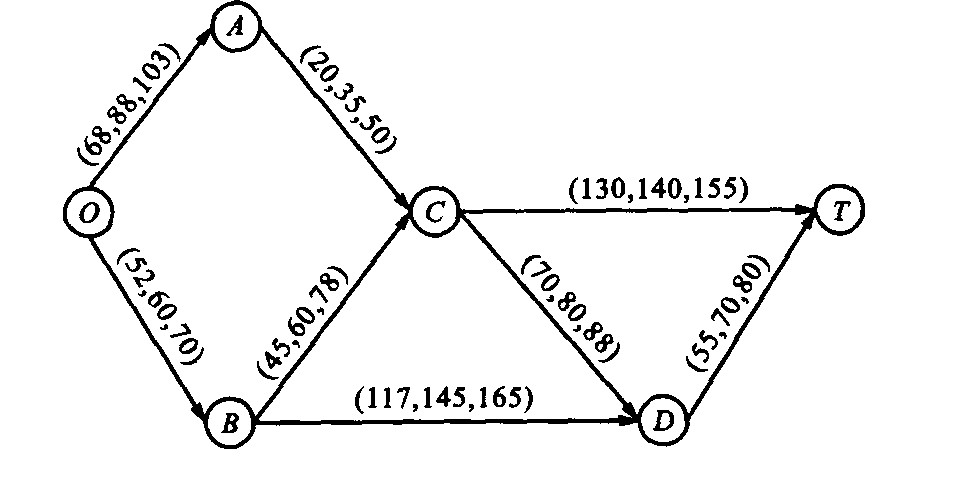
表 1 最短路计算过程
Table 1. Computational process of shortest paths
K i∈Gs j∈Gu 全部距离Fj(i) Vf[Fj(i)] 第n个最近节点 最小距离Rj 最后连接 1 O A (68, 88, 103) 86.33 B (52, 60, 70) OB O B (52, 60, 70) 60.67 2 O A (68, 88, 103) 86.33 A (68, 88, 103) OA B C (97, 120, 148) 121.67 B D (169, 205, 235) 203.00 3 A C (88, 123, 153) 121.33 C (88, 123, 153) AC B C (97, 120, 148) 121.67 B D (169, 205, 235) 203.00 4 C D (158, 203, 241) 200.67 D (158, 203, 241) CD C T (218, 263, 308) 263.00 B D (169, 205, 235) 203.00 5 C T (218, 263, 308) 263.00 T (218, 263, 308) CT D T (222, 270, 316) 269.00  下载: 导出CSV
表 2 不同决策态度下的最短路计算结果
Table 2. Shortest paths with different decision attitudes
Ωf 最短路距离 最短距离估计值 最短路径 0.1 (213, 273, 321) 234.09 O→A→C→D→T 0.3 (218, 263, 308) 253.27 O→A→C→T 0.5 (218, 263, 308) 263.00 O→A→C→T 0.7 (227, 260, 303) 271.87 O→B→C→T 0.9 (227, 260, 303) 288.14 O→B→C→T
下载: 导出CSV
-
[1] 张国强, 晏克非. 城市道路网交通特性仿真模型及最短路径算法[J]. 交通运输工程学报, 2002, 2(3): 60-62. doi: 10.3321/j.issn:1671-1637.2002.03.013Zhang Guo-qiang, Yan Ke-fei. Simulation model based upon characteristics of urban road network and its shortest path algorithm[J]. Journal of Traffic and Transportation Engineering, 2002, 2(3): 60-62. (in Chinese) doi: 10.3321/j.issn:1671-1637.2002.03.013 [2] Dubois D, Prade H. Fuzzy Sets and Systems: Theory and Applications[M]. Newyork: Academic Press, 1980. [3] Klein C M. Fuzzy shortest paths[J]. Fuzzy Sets and Systems, 1991, 39(1): 27-41. doi: 10.1016/0165-0114(91)90063-V [4] Okada S, Soper T. A shortest path problem on a network with fuzzy arc lengths[J]. Fuzzy Sets and Systems, 2000, 109(1): 129-140. doi: 10.1016/S0165-0114(98)00054-2 [5] Chang P T, Lee E S. Fuzzy decision networks and deconvolution[J]. Computers and Mathematics with Applications, 1999, 37(11): 53-57. [6] BortolanG, Degani R. A review of some methods for ranking fuzzy subsets[J]. Fuzzy Sets and Systems, 1985, 15(1): 1-19. doi: 10.1016/0165-0114(85)90012-0 [7] Chen L H, Lu H W. An approximate approach for ranking fuzzy numbers based on left and right dominance[J]. Computers and Mathematics with Applications, 2001, 41(12): 1 589-1 602. doi: 10.1016/S0898-1221(01)00124-9 [8] Cheng C H. A new approach for ranking fuzzy numbers by distance method[J]. Fuzzy Sets and Systems, 1998, 95(3): 307-317. doi: 10.1016/S0165-0114(96)00272-2 [9] Chen S J, Chen S M. A new method for handling multicriteria fuzzy decision-making problems using FN-IOWA operators [J]. Cybernetics and Systems, 2003, 34(2): 109-137. doi: 10.1080/01969720302866 [10] Chang P T, Lee E S. Ranking of fuzzy sets based on the concept of existence[J]. Computers and Mathematics with Applications, 1994, 27(1): 1-21. doi: 10.1016/0898-1221(94)90001-9 [11] Facchinetti G, Ricci R G, Muzzioli S. Note on ranking fuzzy triangular numbers[J]. International Journal of Intelligent Systems, 1998, 13(5): 613-622. [12] Peneva V, Popchev I. Comparison of clusters from fuzzy numbers[J]. Fuzzy Sets and Systems, 1998, 97(1): 75-81. doi: 10.1016/S0165-0114(96)00360-0 [13] Detyniecki M, Yager R R. Ranking fuzzy numbers using a weighted valuations[J]. International Journal of Uncertainty, Fuzziness Knowledge-Based Systems, 2000, 8(5): 573-591. [14] Matarazzo B, Munda G. New approaches for the comparison of L-R fuzzy numbers: a theoretical and operational analysis [J]. Fuzzy Sets and Systems, 2001, 118(3): 407-418. -

图(1) / 表(2)
计量
- 文章访问数: 862
- HTML全文浏览量: 532
- PDF下载量: 381
- 被引次数: 0
