


Coordinated scheduling model of arriving aircraft at large airport
-
摘要: 为减少进场航空器总延误与总滑行时间,研究了大型机场进场航空器联合调度问题;分别以跑道排序时间跨度和总延误加权和最小、被分配至远机位航班数量最少、进场航空器总滑行时间最短为目标函数,构建了跑道、停机位、滑行道三大系统的正向联合调度模型;在此基础上引入停机位再调整模型,通过调整额外滑行时间较大的航空器的停机位指派方案对滑行道调度进行反向优化;设计了一种改进型基因编码的遗传算法以避免非可行解的产生,提高求解效率。仿真结果表明:对比先到先服务策略,改进型遗传算法的进场航空器跑道排序时间减少了20 s,总延误从254 350 s降至199 760 s,减少了21%;对比蚁群算法,改进型遗传算法的总延误减少了20 060 s,降低了9%,且迭代曲线更平稳;改进遗传算法迭代12次时即能为进场航空器全部分配至近机位,18架进场航空器的总滑行时间从4 575 s降至4 145 s,降低了9%,且滑行过程中仅发生3次冲突;11架航空器均选择最短路滑行,仅3架航空器的额外滑行时间超过40 s;经停机位调整后,总额外滑行时间减少58 s,降低了27%。可见,进场航空器联合调度模型能提高大型机场运行效率,为场面资源管理提供决策参考。Abstract: The problem of coordinated scheduling of arriving aircraft at large airports was studied to reduce the total delay and taxi times of arriving aircraft. The minimum weighted sum of runway sequencing time span and total delay time, the fewest number of flights assigned to remote gates, and the shortest taxi time of arriving aircraft were taken as the objective functions, respectively. A forward coordinated scheduling model for the systems of runway, gate, and taxiway was constructed. A gate re-adjustment model was used to perform the reverse optimization of the taxiway by adjusting the gate assignments of aircrafts with long taxi times. A genetic algorithm (GA) with improved gene coding was designed to prevent the generation of unfeasible solutions and to improve efficiency. Simulation results show that, compared with the first-come-first-serve strategy, the improved GA reduces the runway sequencing time of arriving aircraft by 20 s and the total delay time by 21% from 254 350 s to 199 760 s, respectively. Compared with the ant colony optimization, the improved GA reduces the total delay time by 20 060 s (9%) and produces a smoother iteration curve. After 12 iterations of the improved GA, all arrival aircrafts can be assigned to bridge gates. The total taxi time of 18 arriving aircrafts decreases by 9% from 4 575 s to 4 145 s, and only 3 taxi conflicts occur. 11 aircrafts choose the shortest routes, and only 3 aircrafts have extra taxi time of more than 40 s. After gate adjustment, the total extra taxi time decreases by 58 s or 27%. Therefore, the proposed coordinated scheduling model for arriving aircraft can improve the operational efficiency of large airports and provide decision-making support for airfield resource management. 5 tabs, 11 figs, 31 refs.
-

图 1 大型机场进场航空器联合调度流程
Figure 1. Flow of coordinated scheduling for arriving aircraft at large airport

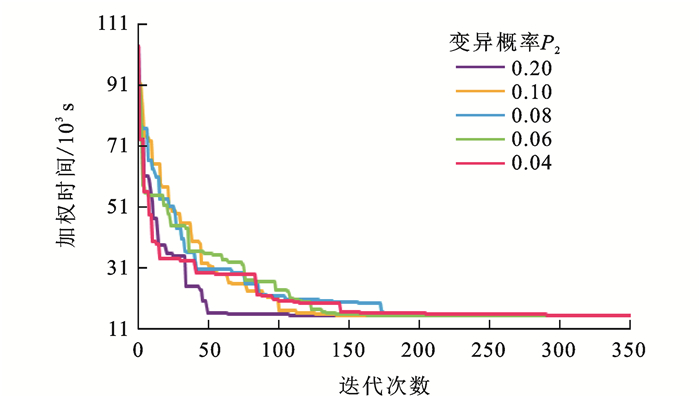
图 4 不同变异概率跑道排序目标函数进化曲线
Figure 4. Evolution curves of runway sequencing objective function under different mutation probabilities

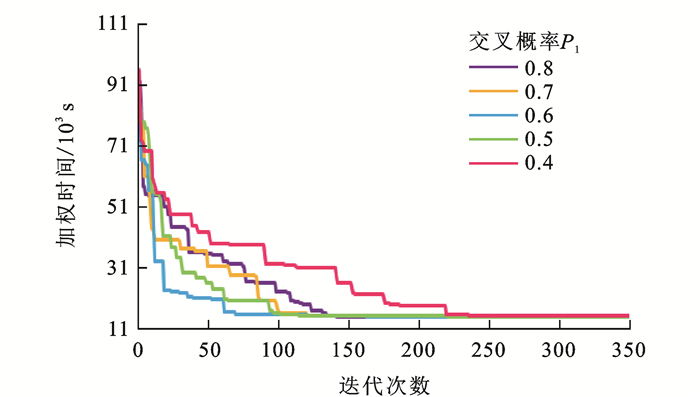
图 5 不同交叉概率跑道排序目标函数进化曲线
Figure 5. Evolution curves of runway sequencing objective function under different crossing probabilities

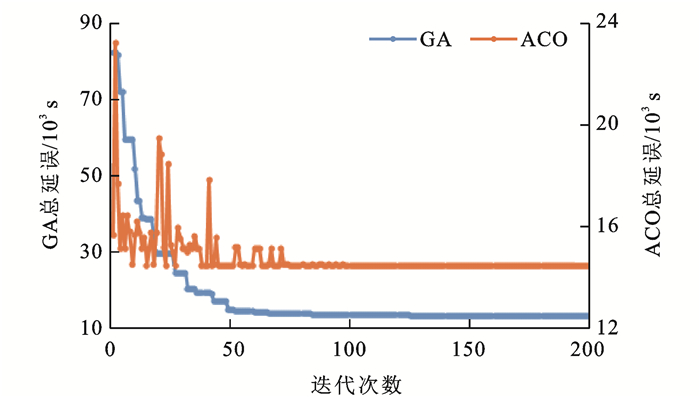
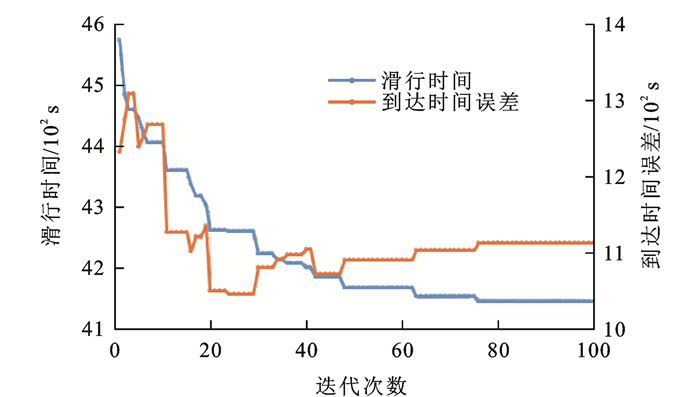
图 8 进场航空器滑行道调度进化曲线
Figure 8. Evolution curves of taxiway scheduling of arriving aircrafts

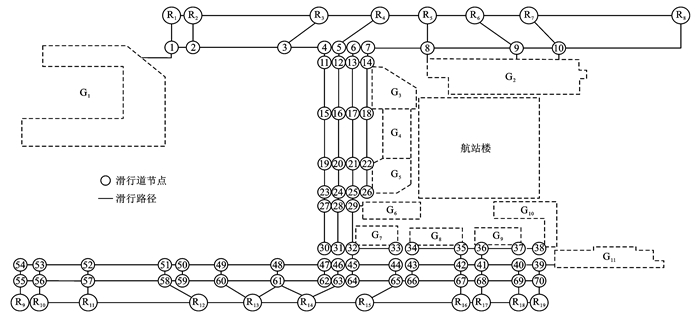
图 10 各航空器实际滑行时间与理论最短滑行时间
Figure 10. Actual taxi times and theoretical shortest taxi times of each aircraft
表 1 航班数据信息
Table 1. Flight data information
航空器 进/离场 预计时间 过站时间/min 机型类别 F1 离场 18:00 60 中型 F14 进场 18:10 75 大型  下载: 导出CSV
表 3 跑道排序仿真结果对比
Table 3. Comparison of runway sequencing simulation results
算法 排序时间跨度/s 总延误/s FCFS 3 550 254 350 改进GA 3 530 199 760 ACO 3 515 219 820
下载: 导出CSV
表 4 进场航空器停机位指派结果
Table 4. Gate assignment results of arriving aircrafts
航空器 停机位 航空器 停机位 航空器 停机位 F6 g13 F20 g1 F34 g11 F10 g4 F22 g5 F35 g3 F14 g27 F27 g21 F39 g7 F15 g17 F28 g18 F40 g23 F16 g9 F29 g6 F41 g10 F19 g2 F33 g22 F42 g8
下载: 导出CSV
表 5 调整后停机位指派结果
Table 5. Gate assignment results after adjustment
航空器 停机位 航空器 停机位 航空器 停机位 F6 g13 F20 g1 F34 g11 F10 g4 F22 g5 F35 g3 F14 g23 F27 g21 F39 g7 F15 g17 F28 g6 F40 g19 F16 g9 F29 g18 F41 g10 F19 g2 F33 g22 F42 g8
下载: 导出CSV
-
[1] MAHARJAN B, MATIS T I. Multi-commodity flow network model of the flight gate assignment problem[J]. Computers and Industrial Engineering, 2012, 63(4): 1135-1144. doi: 10.1016/j.cie.2012.06.020 [2] DIEPEN G, AKKER J M, HOOGEVEEN J A, et al. Finding a robust assignment of flights to gates at Amsterdam Airport Schiphol[J]. Journal of Scheduling, 2012, 15(6): 703-715. doi: 10.1007/s10951-012-0292-y [3] DORNDORF U, JAEHN F, PESCH E. Flight gate assignment and recovery strategies with stochastic arrival and departure times[J]. OR Spectrum, 2017, 39(1): 65-93. doi: 10.1007/s00291-016-0443-1 [4] CASTAING J, MUKHERJEE I, COHN A, et al. Reducing airport gate blockage in passenger aviation: models and analysis[J]. Computers and Operations Research, 2016, 65: 189-199. doi: 10.1016/j.cor.2014.02.011 [5] KIM S H, FERON E. Robust gate assignment against gate conflicts[J]. Journal of Air Transportation, 2017, 25(3): 87-94. doi: 10.2514/1.D0067 [6] AOUN O, EL AFIA A. Using Markov decision processes to solve stochastic gate assignment problem[C]//IEEE. 2nd IEEE International Conference on Logistics Operations Management. New York: IEEE, 2014: 42-47. [7] DELL'ORCO M, MARINELLI M, ALTIERI M G. Solving the gate assignment problem through the fuzzy bee colony optimization[J]. Transportation Research Part C: Emerging Technologies, 2017, 80: 424-438. doi: 10.1016/j.trc.2017.03.019 [8] DENG Wu, ZHAO Hui-min, YANG Xin-hua, et al. Study on an improved adaptive PSO algorithm for solving multi-objective gate assignment[J]. Applied Soft Computing, 2017, 59: 288-302. doi: 10.1016/j.asoc.2017.06.004 [9] DENG Wu, SUN Meng, ZHAO Hui-min, et al. Study on an airport gate assignment method based on improved ACO algorithm[J]. Kybernetes, 2018, 47(1): 20-43. doi: 10.1108/K-08-2017-0279 [10] YU Sheng-peng, CAO Xian-bin, ZHANG Jun. A real-time schedule method for Aircraft Landing Scheduling problem based on Cellular Automation[J]. Applied Soft Computing, 2011, 11(4): 3485-3493. doi: 10.1016/j.asoc.2011.01.022 [11] 张军峰, 郑志祥, 葛腾腾. 基于复合分派规则的进场航班排序方法[J]. 交通运输工程学报, 2017, 17(3): 141-150. doi: 10.3969/j.issn.1671-1637.2017.03.015ZHANG Jun-feng, ZHENG Zhi-xiang, GE Teng-teng. Sequencing approach of arrival aircrafts based on composite dispatching rules[J]. Journal of Traffic and Transportation Engineering, 2017, 17(3): 141-150. (in Chinese) doi: 10.3969/j.issn.1671-1637.2017.03.015 [12] 王世豪, 杨红雨, 李玉贞, 等. 基于精英存档自适应微分进化算法的多跑道独立进近排序[J]. 工程科学与技术, 2017, 49(3): 153-161. https://www.cnki.com.cn/Article/CJFDTOTAL-SCLH201703020.htmWANG Shi-hao, YANG Hong-yu, LI Yu-zhen, et al. Multi-runways independent approach scheduling using self-adaptive differential evolution algorithm with elite archive[J]. Advanced Engineering Sciences, 2017, 49(3): 153-161. (in Chinese) https://www.cnki.com.cn/Article/CJFDTOTAL-SCLH201703020.htm [13] HANCERLIOGULLARI G, RABADI G, AL-SALEM A H, et al. Greedy algorithms and metaheuristics for a multiple runway combined arrival-departure aircraft sequencing problem[J]. Journal of Air Transport Management, 2013, 32: 39-48. doi: 10.1016/j.jairtraman.2013.06.001 [14] BALL M O, BERARDINO F, HANSEN M. The use of auctions for allocating airport access rights[J]. Transportation Research Part A: Policy and Practice, 2018, 114: 186-202. doi: 10.1016/j.tra.2017.09.026 [15] LANDRY S J, CHEN X W, NOF S Y. A decision support methodology for dynamic taxiway and runway conflict prevention[J]. Decision Support Systems, 2013, 55(1): 165-174. doi: 10.1016/j.dss.2013.01.016 [16] 冯程, 胡明华, 丛玮. 基于滚动时域算法的航班滑行路径优化模型[J]. 航空计算技术, 2014, 44(4): 80-85. doi: 10.3969/j.issn.1671-654X.2014.04.021FENG Cheng, HU Ming-hua, CONG Wei. Optimization model of taxiway routing based on receding horizon[J]. Aeronautical Computing Technique, 2014, 44(4): 80-85. (in Chinese) doi: 10.3969/j.issn.1671-654X.2014.04.021 [17] LUO Xiao, TANG Yong, WU Hong-gang, et al. Real-time adjustment strategy for conflict-free taxiing route of A-SMGCS aircraft on airport surface[C]//IEEE. International Conference on Mechatronics and Automation (ICMA). New York: IEEE, 2015: 929-934. [18] ZHANG Tian-ci, DING Meng, WANG Bang-feng, et al. Conflict-free time-based trajectory planning for aircraft taxi automation with refined taxiway modeling[J]. Journal of Advanced Transportation, 2016, 50(3): 326-347. doi: 10.1002/atr.1324 [19] ZHANG Tian-ci, DING Meng, ZUO Hong-fu. Improved approach for time-based taxi trajectory planning towards conflict-free, efficient and fluent airport ground movement[J]. IET Intelligent Transport Systems, 2018, 12(10): 1360-1368. doi: 10.1049/iet-its.2018.5193 [20] BADRINATH S, BALAKRISHNAN H. Control of a non-stationary tandem queue model of the airport surface[C]//IEEE. 2017 American Control Conference (ACC). New York: IEEE. 2017: 655-661. [21] WEISZER M, CHEN J, LOCATELLI G. An integrated optimization approach to airport ground operations to foster sustainability in the aviation sector[J]. Applied Energy, 2015, 157(1): 567-582. [22] BROWNLEE A E I, WEISZER M, CHEN J, et al. A fuzzy approach to addressing uncertainty in Airport Ground Movement optimization[J]. Transportation Research Part C: Emerging Technologies, 2018, 92: 150-175. doi: 10.1016/j.trc.2018.04.020 [23] CHEN J, WEISZER M, ZAREIAN E, et al. Multi-objective fuzzy rule-based prediction and uncertainty quantification of aircraft taxi time[C]//IEEE. 20th International Conference on Intelligent Transportation Systems. New York: IEEE, 2017: 1-5. [24] GUÉPET J, BRIANT O, GAYON J P, et al. The aircraft ground routing problem: Analysis of industry punctuality indicators in a sustainable perspective[J]. European Journal of Operational Research, 2016, 248(3): 827-839. doi: 10.1016/j.ejor.2015.08.041 [25] BENLIC U, BROWNLEE A E I, BURKE E K. Heuristic search for the coupled runway sequencing and taxiway routing problem[J]. Transportation Research Part C: Emerging Technologies, 2016, 71: 333-355. doi: 10.1016/j.trc.2016.08.004 [26] YU C H, LAU H Y K. Integrated optimization of airport taxiway and runway scheduling[J]. Journal of Automation and Control Engineering, 2014, 2(4): 338-342. doi: 10.12720/joace.2.4.338-342 [27] YU Chu-hang, ZHANG Dong, LAU H Y K. A heuristic approach for solving an integrated gate reassignment and taxi scheduling problem[J]. Journal of Air Transport Management, 2017, 62: 189-196. doi: 10.1016/j.jairtraman.2017.04.006 [28] GUÉPET J, BRIANT O, GAYON J P, et al. Integration of aircraft ground movements and runway operations[J]. Transportation Research Part E: Logistics and Transportation Review, 2017, 104: 131-149. doi: 10.1016/j.tre.2017.05.002 [29] MURÇA M C R. A robust optimization approach for airport departure metering under uncertain taxi-out time predictions[J]. Aerospace Science and Technology, 2017, 68: 269-277. doi: 10.1016/j.ast.2017.05.020 [30] SIMAIAKIS I, KHADILKAR H, BALAKRISHNAN H, et al. Demonstration of reduced airport congestion through pushback rate control[J]. Transportation Research Part A: Policy and Practice, 2014, 66: 251-267. doi: 10.1016/j.tra.2014.05.014 [31] 余朝军, 江驹, 徐海燕, 等. 基于改进遗传算法的航班-登机口分配多目标优化[J]. 交通运输工程学报, 2020, 20(2): 121-130. doi: 10.19818/j.cnki.1671-1637.2020.02.010YU Chao-jun, JIANG Ju, XU Hai-yan, et al. Multi-objective optimization of flight-gate assignment based on improved genetic algorithm[J]. Journal of Traffic and Transportation Engineering, 2020, 20(2): 121-130. (in Chinese) doi: 10.19818/j.cnki.1671-1637.2020.02.010 -





计量
- 文章访问数: 1806
- HTML全文浏览量: 499
- PDF下载量: 125
- 被引次数: 0
