


Optimization of heat transfer in electric heating snow melting systems for turnout
-
摘要:
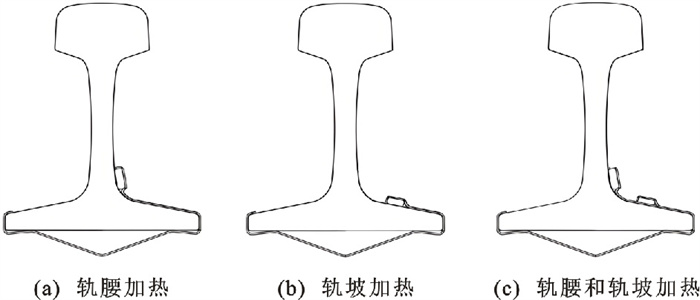
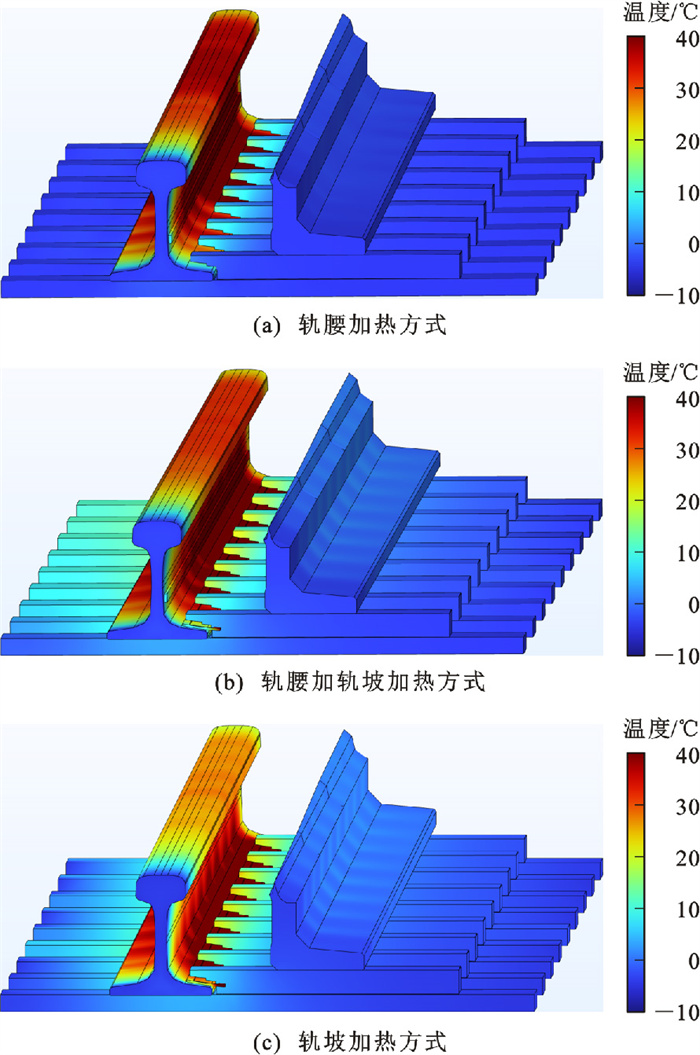
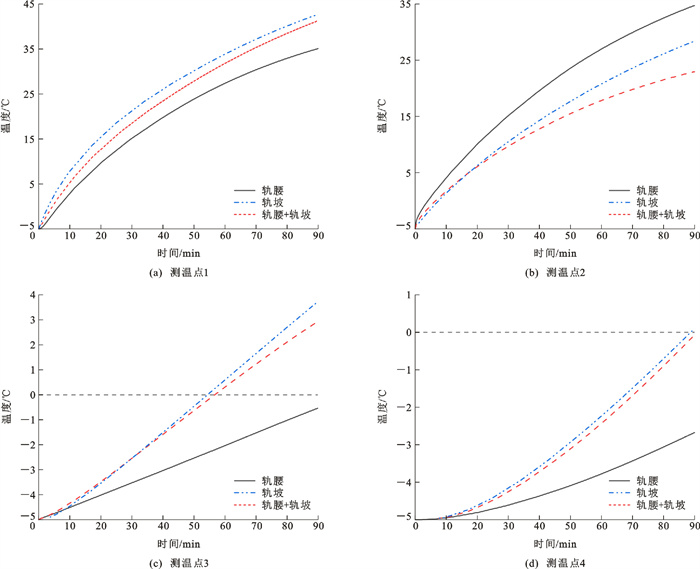
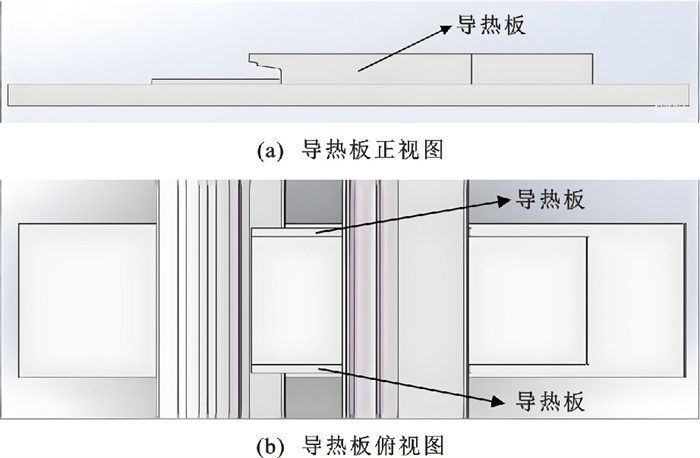
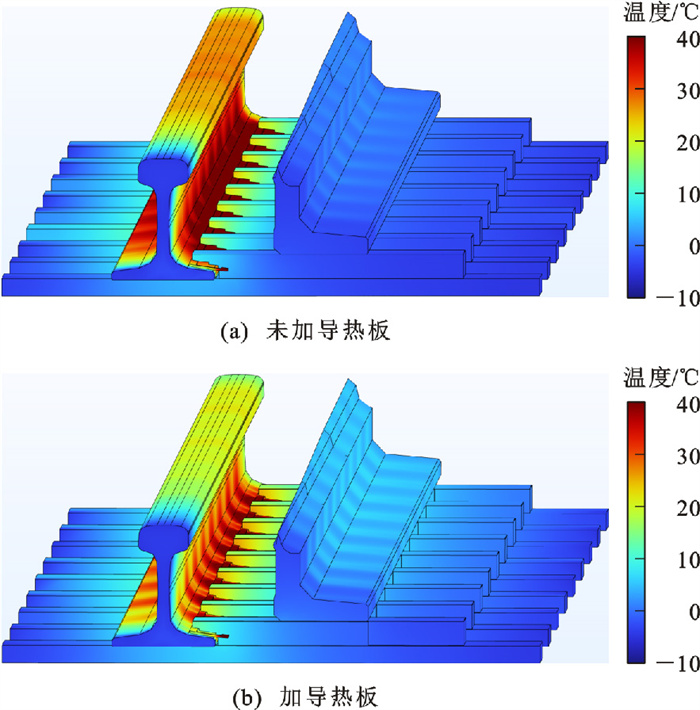
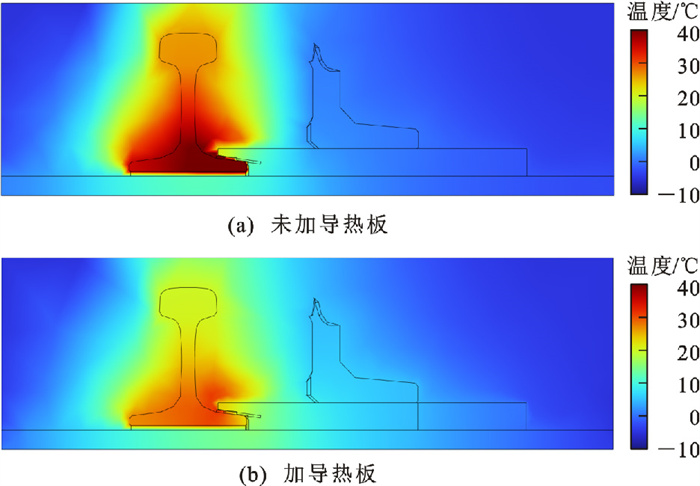
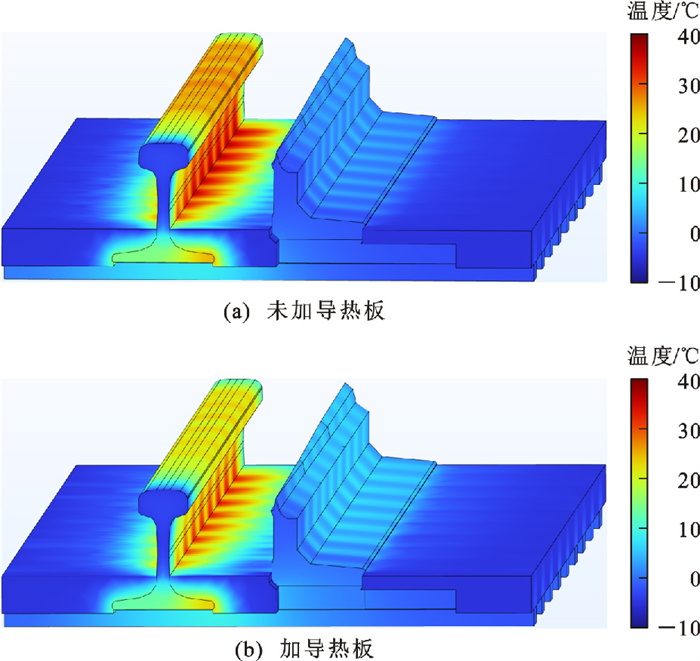
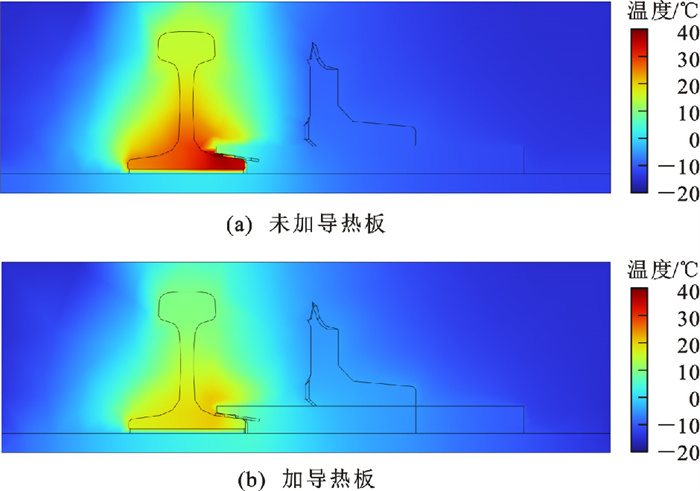
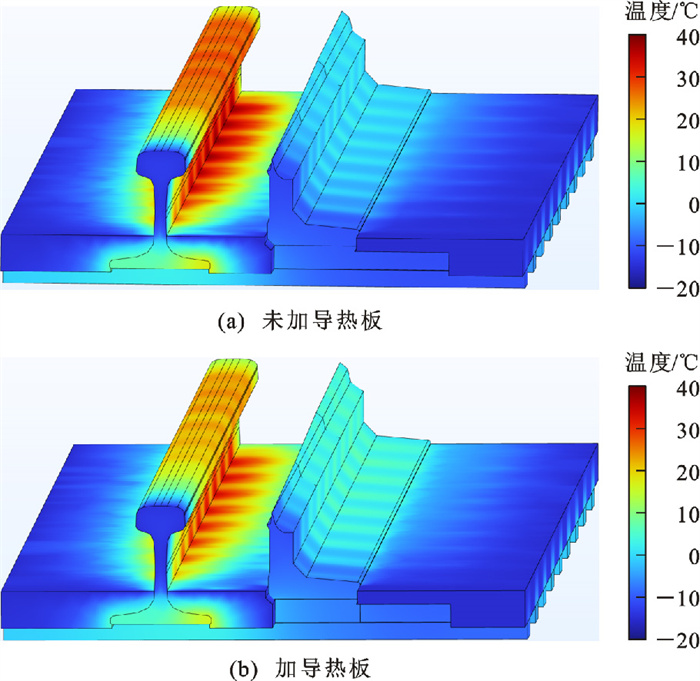
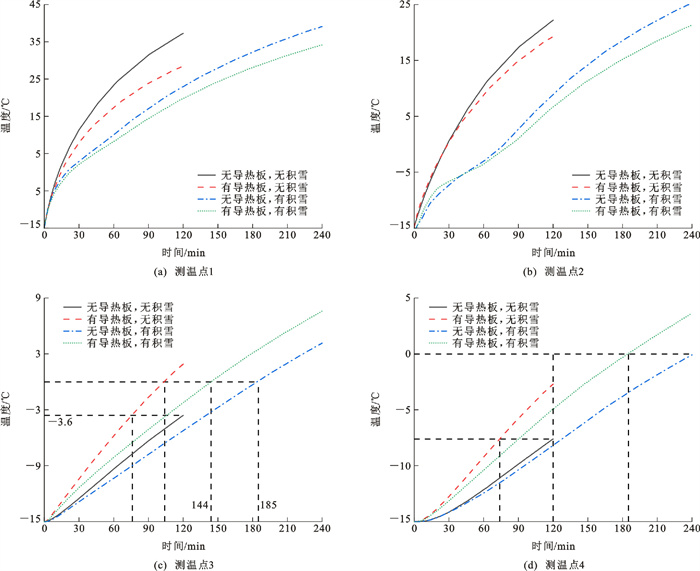
为解决道岔电加热元件能耗高、热效率低、融雪不彻底的问题,以60 kg·m-1钢轨18号道岔为研究对象,基于有限元和固体流体传热物理场分析方法,构建了“道岔-加热元件-积雪-空气”的物理模型。模型表面定义为开放边界,底部定义为热绝缘,在相同初始条件下,对比了轨腰、轨坡、轨腰加轨坡3种加热方式的仿真效果,提出了在滑床台侧面加装导热板的优化方法,并在不同温度和不同风速风向情况下进行了仿真分析。分析结果表明:在控制总功率的前提下,轨坡加热方式较另外2种加热方式的滑床台温度上升更明显;安装导热板后,由于导热板热响应速度更高,使加热元件产生的热量向滑床台传递;在-5 ℃和-15 ℃的环境温度以及无积雪的情况下,有导热板相较于无导热板的一般情况,加热元件升温到相应温度的时间缩短了40%,增加20 mm的积雪后,较一般情况也缩短了20%以上;基本轨近端积雪融化速度低于一般情况,之后速度升高,对远端积雪的融化更快且更为彻底;不同风向作用于道岔部分的不同位置,产生不同的升温抑制效果,风速越高,使得温度上升越缓慢,越快到达吸收热量与散失热量基本一致的平衡状态;建立的道岔尖轨部分导热板传热模型可为不同地区现场优化功率,加热元件功率选择和精准控制加热时间提供理论依据。
Abstract:To address the issues of high energy consumption, low thermal efficiency, and incomplete snow melting in electric heating elements of turnout, No. 18 turnout of a 60 kg·m-1 steel rail was selected as the research subject. Based on finite element analysis and physical field analysis methods of solid-fluid heat transfer, a physical model of "turnout-heating element-snow accumulation-air" was constructed. The model surface was defined as an open boundary, with the bottom defined as thermally insulated. Under identical initial conditions, the simulation results of heating methods of rail web, rail slope, and combined rail web and slope heating were compared. An optimized method involving the installation of heat-conducting plates on the sides of the slide bed was proposed. Simulation analyses were conducted under varying temperatures, wind speeds, and directions. Analysis results show that, under constant total power, a more pronounced rise in the slide bed temperature is observed when the rail slope heating method is employed, as compared with the other two heating methods. After installing heat-conducting plates, heat generated by the heating element transfers faster to the sliding bed due to their higher thermal response speed. Under the temperatures of -5 ℃ and -15 ℃ and in the absence of snow accumulation, the time required for the heating element to reach the corresponding temperature is shortened by 40% when a heat-conducting plate is used, compared with the general condition without such a plate. With an additional 20 mm of snow accumulation, a lead time of over 20% is achieved compared with the general condition. Snow-melting rate at the near end of the stock rail is initially lower than under general conditions. Later, the rate increases. As a result, the snow at the far end melts faster and more completely. Different wind directions act on different positions of the turnout and produce different effects in suppressing temperature rise. Higher wind speed makes the temperature rise more slowly. It also causes the system to reach a balance between heat absorption and heat loss more quickly. The established heat transfer model of the heat-conducting plate in the switch rail provides a theoretical basis for power optimization in different regions. It can also guide the selection of heating element power and the precise control of heating time.
-

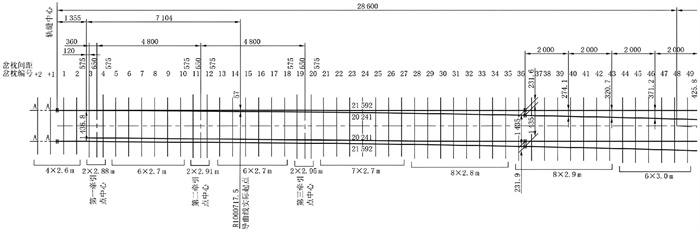
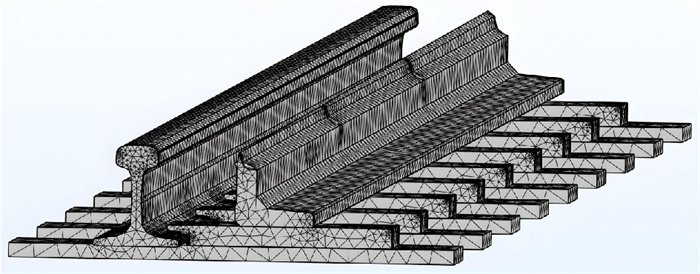
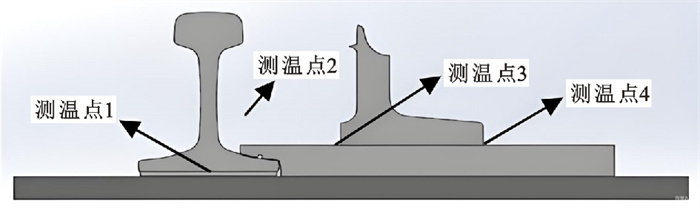
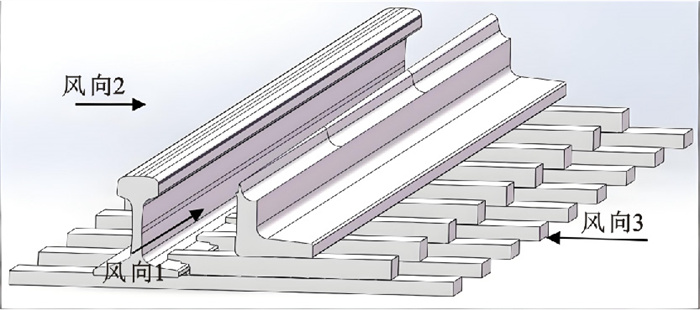
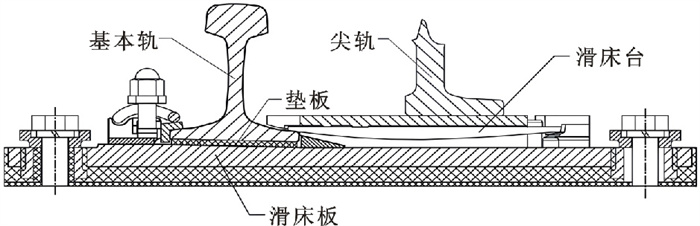
图 2 18号道岔尖轨部分工程(单位: mm)
Figure 2. Engineering of No. 18 turnout tip rail section (unit: mm)

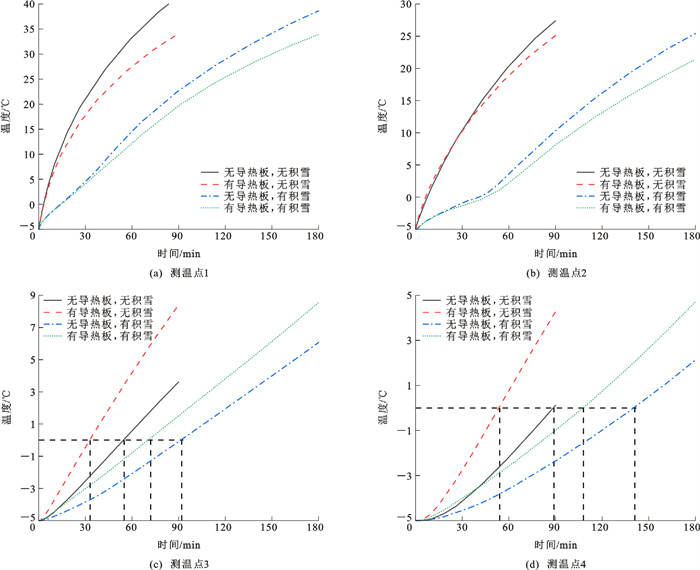
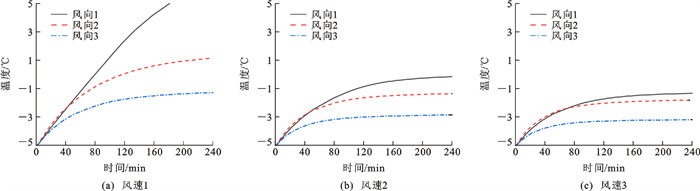
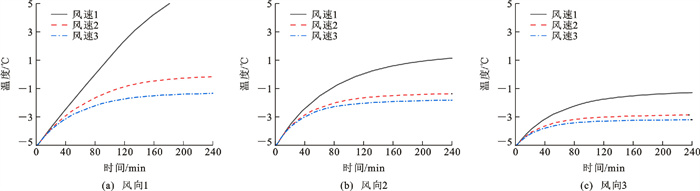
图 14 环境温度为-5 ℃时各测温点的温度变化
Figure 14. Temperature changes at each measurement point when the ambient temperature is -5 ℃

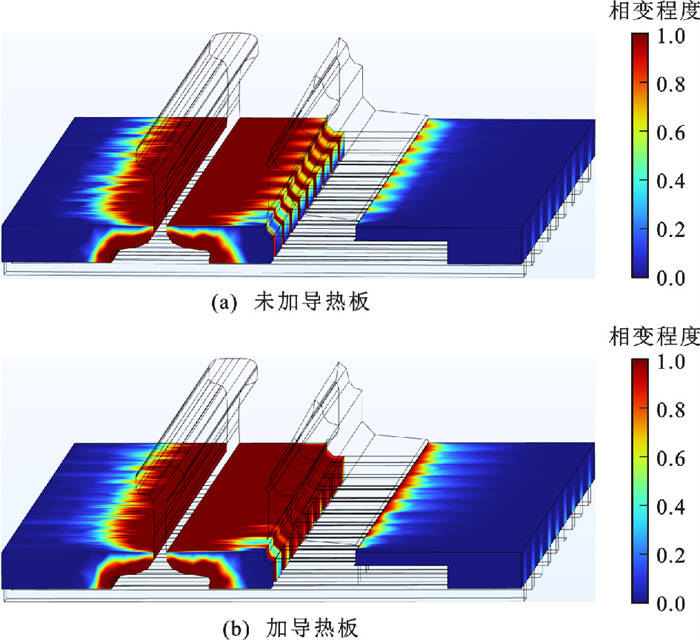
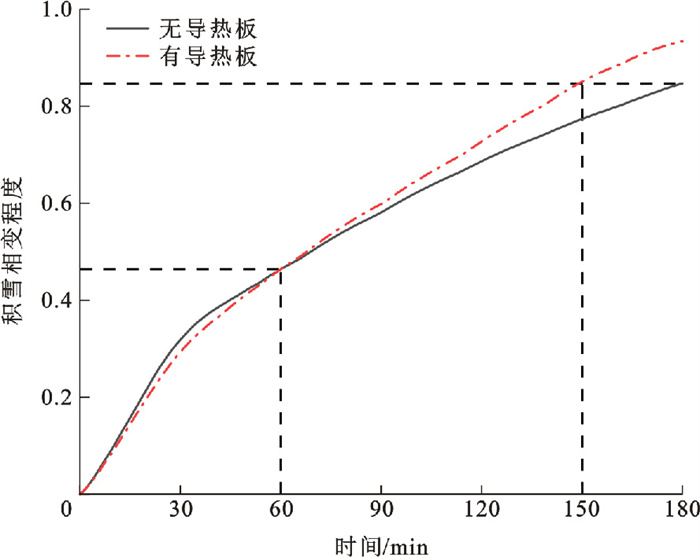
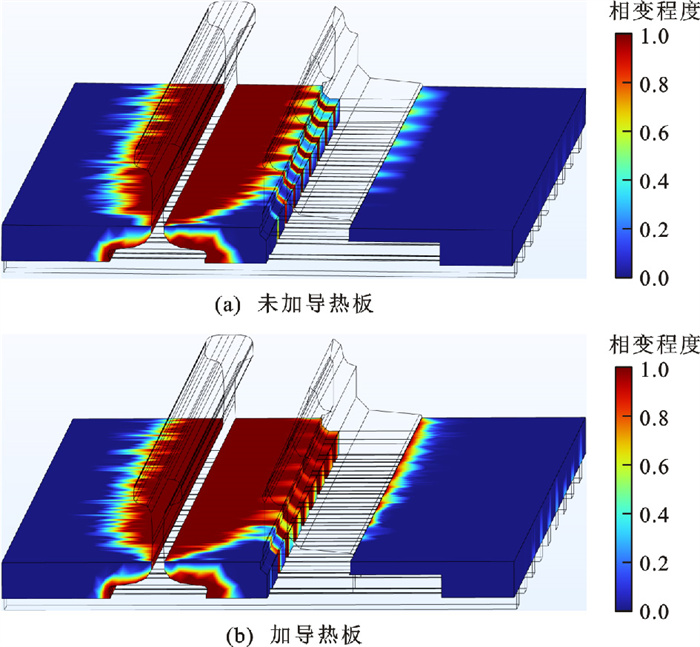
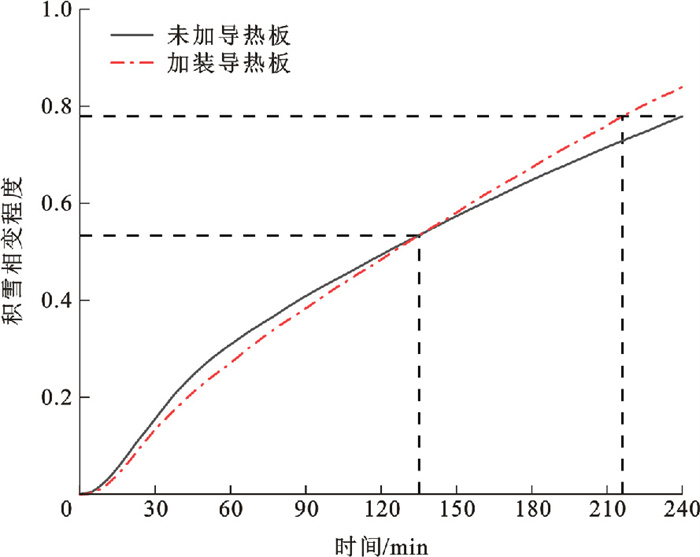
图 16 积雪相变程度变化(条件2)
Figure 16. Variation in the degree of snow phase transition (condition 2)

图 20 环境温度为-15 ℃时各测温点的温度变化
Figure 20. Temperature changes at each measurement point when the ambient temperature is -15 ℃

图 22 积雪相变程度变化(条件4)
Figure 22. Variation in the degree of snow phase transition (condition 4)
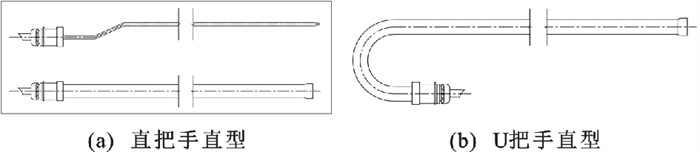
表 1 常用电加热元件规格型号
Table 1. Commonly used electric heating element specifications and models
类型 长度/mm 功率/W 直把手直型 5 200 2 400 直把手直型 4 700 2 650 直把手直型 3 720 2 250 直把手直型 2 880 1 750 直把手直型 1 680 1 050 U把手直型 5 200 2 400 U把手直型 4 700 2 650 U把手直型 3 720 2 250 U把手直型 2 880 1 750 U把手直型 1 680 1 050  下载: 导出CSV
表 2 部分道岔材料的物理参数
Table 2. Physical parameters of some turnout materials
材料 材质 密度/ (kg·m-3) 比热容/[J· (kg·K)-1] 热导率/[W· (m·K)-1] 钢轨 U75V 7 850 475 44.5 滑床板 Q235钢 7 850 500 53.0 滑床台 Q235钢 7 850 500 53.0 加热元件 镍铬合金 7 800 470 57.0 垫板 橡胶 1 350 1 700 0.2
下载: 导出CSV
表 3 试验初始条件
Table 3. Initial conditions of the test
加热方式 功率配置/kW 初始温度/℃ 加热时长/min 风速/ (m·s-1) 相对湿度 轨腰 2 -5 90 0.2 0.6 轨腰加轨坡 1+1 轨坡 2
下载: 导出CSV
表 4 导热板物理属性
Table 4. Physical properties of thermally conductive plates
导热板材质 密度/ (kg·m-3) 比热容/[J· (kg·K)-1] 热导率/[W· (m·K)-1] 氧化铝陶瓷 3 850 900 30 石墨 2 100 700 500 铜 8 960 385 400 铝 2 800 939 205 不锈钢 7 900 500 15
下载: 导出CSV
表 5 试验初始条件
Table 5. Initial conditions of the test
条件 环境温度/℃ 是否有积雪 是否安装导热板 加热元件功率/kW 相对湿度 1 -5 无积雪 是 2 0.6 否 2 0.7 2 -5 有积雪 是 2 0.6 否 2 0.7 3 -15 无积雪 是 2 0.6 否 2 0.7 4 -15 有积雪 是 2 0.6 否 2 0.7
下载: 导出CSV
-
[1] SZYCHTA E, SZYCHTA L. Comparative analysis of effec-tiveness of resistance and induction turnout heating[J]. Energies, 2020, 13(20): 5262. doi: 10.3390/en13205262 [2] SZYCHTA E, SZYCHTA L. Testing of turnout resistance and induction heating in climatic chamber[C]//IEEE. 2021 IEEE 19th International Power Electronics and Motion Control Conference (PEMC). New York: IEEE, 2021: 629-634. [3] OH H S, LEE J, LEE S H, et al. Parasitic capacitance analysis of PCB-type induction heating coil and LCCC/S matching network design for railway turnouts[J]. Journal of Electrical Engineering & Technology, 2023, 18(4): 3311-3320. [4] OH H S, KIM D K, HONG S M, et al. Anti-icing system on railway turnouts using induction heating technology for energy saving[C]//IEEE. 2022 IEEE 21st Mediterranean Electrotechnical Conference (MELECON). New York: IEEE, 2022: 342-347. [5] FLIS M. Energy efficiency analysis of railway turnout heating system with a melting snow model heated by classic and contactless heating method[J]. Archives of Electrical Engineering, 2019, 68(3): 511-520. [6] FLIS M. Contactless turnouts' heating for energy consumption optimization[J]. Archives of Electrical Engineering, 2020, 69(1): 133-145. [7] BRODOWSKI D, FLIS M. Experimental verification of contactless heating method in railway turnouts heating system[J]. Problemy Kolejnictwa-Railway Reports, 2022, 66(194): 73-79. doi: 10.36137/1941E [8] 陈新. 电加热道岔融雪系统加热功率配置方案探讨[J]. 铁路通信信号工程技术, 2019, 16(1): 14-17.CHEN Xin. Discussion on heating power configuration scheme of electric heating switch snow-melting system[J]. Railway Signalling & Communication Engineering, 2019, 16(1): 14-17. [9] 丁闪峰, 满开泉, 王婷婷. 冰雪天气对高速铁路转辙设备的影响及对策[J]. 铁路通信信号工程技术, 2020, 17(10): 76-79, 82.DING Shan-feng, MAN Kai-quan, WANG Ting-ting. Influence and countermeasures of snow and ice weather on switch equipment of high-speed railway[J]. Railway Signalling & Communication Engineering, 2020, 17(10): 76-79, 82. [10] NORDLUND E. Inductive railway switch point heating: Improved control algorithm and phase compensation analysis for an inductive turnout heating system, and comparison with a resistive heating system[D]. Eskilstuna: Mälardalen University, 2023. [11] WANG S, SUN G, LI Y, et al. A study on electromagnetic inductive heating unit for railway turnout[C]//Springer. Developments and Applications in SmartRail, Traffic, and Transportation Engineering. Berlin: Springer, 2024: 509-517. [12] HONG S Y, KIM D K, OH H S, et al. Development of PFC converter for induction heating system in railway[C]//IEEE. 2022 25th International Conference on Electrical Machines and Systems (ICEMS). New York: IEEE, 2022: 1-4. [13] 余冠华, 卫旭初. 张吉怀高铁智能道岔融雪系统方案探讨[J]. 铁路通信信号工程技术, 2022, 19(2): 15-17, 34.YU Guan-hua, WEI Xu-chu. scheme of intelligent point heating system for Zhangjiajie-Jishou-Huaihua High Speed Railway[J]. Railway Signalling & Communication Engi-neering, 2022, 19(2): 15-17, 34. [14] 邱战国, 安岩, 杨俊, 等. 电加热道岔融雪设备节能控制方案探讨[J]. 铁道通信信号, 2022, 58(9): 46-49.QIU Zhan-guo, AN Yan, YANG Jun, et al. Discussion on energy-saving control scheme of equipment for electric point heating system[J]. Railway Signalling & Communication, 2022, 58(9): 46-49. [15] 邱战国. 电加热道岔融雪系统设备的智能化控制[J]. 铁道通信信号, 2022, 58(2): 15-18.QIU Zhan-guo. Intelligent control of electric heating switch snowmelt system[J]. Railway Signalling & Communication, 2022, 58(2): 15-18. [16] 王嵩. 道岔融雪装置智能控制方案研究[J]. 铁路工程技术与经济, 2023, 38(5): 27-30.WANG Song. Research on intelligent control scheme of snow melting devices for turnouts[J]. Railway Engineering Technology and Economy, 2023, 38(5): 27-30. [17] 黄译锐. 基于过滤算法的电加热道岔融雪系统的分析与优化[D]. 大连: 大连交通大学, 2020.HUANG Yi-rui. Analysis and optimisation of electrically heated turnout snow melting system based on filtering algorithm[D]. Dalian: Dalian Jiaotong University, 2020. [18] 赵康效. 基于COMSOL的道岔融雪系统电加热元件配置优化研究[D]. 兰州: 兰州交通大学, 2023.ZHAO Kang-xiao. Optimisation of electric heating element configuration for turnout snow melting system based on COMSOL[D]. Lanzhou: Lanzhou Jiaotong University, 2023. [19] 安岩. 提高电加热道岔融雪系统热效率的研究[J]. 铁道通信信号, 2024, 60(2): 88-94.AN Yan. Research on improving the thermal efficiency of equipment for electric point heating system[J]. Railway Signalling & Communication, 2024, 60(2): 88-94. [20] 袁玉卿, 张永健, 蔚旭灿. 沥青混凝土预埋碳纤维绳发热升温试验[J]. 长安大学学报(自然科学版), 2015, 35(1): 49-55.YUAN Yu-qing, ZHANG Yong-jian, YU Xu-can. Experi-ments on heating and warming of carbon fibers ropes embedded in asphalt concrete[J]. Journal of Chang'an University (Natural Science Edition), 2015, 35(1): 49-55. [21] 宋世德, 周卫杰. 格栅增强沥青混凝土电热性能数值模拟[J]. 铁道科学与工程学报, 2016, 13(8): 1515-1521.SONG Shi-de, ZHOU Wei-jie. Numerical simulation on electrothermal properties of geogrid reinforced asphalt concrete[J]. Journal of Railway Science and Engineering, 2016, 13(8): 1515-1521. [22] VAJDI M, SADEGH MOGHANLOU F, SHARIFIANJAZI F, et al. A review on the Comsol Multiphysics studies of heat transfer in advanced ceramics[J]. Journal of Composites and Compounds, 2019, 2(1): 35-44. [23] 曾姝, 闫振国, 张正威, 等. 基于浅层地热能流体加热技术的机场道面融雪方案[J]. 太阳能学报, 2022, 43(11): 376-382.ZENG Shu, YAN Zhen-guo, ZHANG Zheng-wei, et al. Research of novelty airport runways snow-melting system based on shallow geothermal hydronic heating technology[J]. Acta Energiae Solaris Sinica, 2022, 43(11): 376-382. [24] HU T F, ZHAO L Q, WANG T F, et al. Field evaluation of a novel thermally controlled subgrade for mitigating frost heave[J]. International Journal of Rail Transportation, 2025, 13(6): 1114-1134. doi: 10.1080/23248378.2024.2443978 [25] HUANG C P, TAN J J, GAN S K, et al. Experimental study and numerical simulation of sidewalk electrical heating for deicing and snow melting[J]. International Journal of Pavement Engineering, 2023, 24(2): 2088752. doi: 10.1080/10298436.2022.2088752 [26] WANG F, FU C L, LIU K, et al. Experimental study and numerical simulation of concrete pavement electrical heating for snow melting[J]. Construction and Building Materials, 2024, 442: 137611. doi: 10.1016/j.conbuildmat.2024.137611 [27] STYPUŁKOWSKI K, KUKULSKI J. The use of thermal imaging studies in the diagnosis of railroad infrastructure elements[J]. Pojazdy Szynowe, 2023(3/4): 40-46. [28] ZHOU L, DING L, YI X. A review of snow melting and de-icing technologies for trains[J]. Proceedings of the Institution of Mechanical Engineers, Part F: Journal of Rail and Rapid Transit, 2022, 236(8): 877-886. doi: 10.1177/09544097211059631 [29] 周清跃, 张银花, 刘丰收, 等. 高速铁路道岔钢轨材质及强度等级选用研究[J]. 中国铁路, 2017(8): 5-9.ZHOU Qing-yue, ZHANG Yin-hua, LIU Feng-shou, et al. Study on selection of rail material and strength level for HSR turnout[J]. China Railway, 2017(8): 5-9. [30] HE Q, ZHAO K X, DU Y F. Frontier research: Road and traffic engineering[M]. London: CRC Press, 2022. [31] 贺清, 赵康效. 基于传热模型的融雪道岔优化方案研究[J]. 铁道标准设计, 2023, 67(7): 69-74.HE Qing, ZHAO Kang-xiao. Research on optimization scheme of snowmelt switch based on heat transfer model[J]. Railway Standard Design, 2023, 67(7): 69-74. [32] 贺清, 李宗霖, 黄勇, 等. 道岔融雪系统电加热元件传热模型构建及分析[J]. 铁道科学与工程学报, 2025, 22(2): 841-851.HE Qing, LI Zong-lin, HUANG Yong, et al. Construction and analysis of heat transfer model for electric heating elements in switch snow melting system[J]. Journal of Railway Science and Engineering, 2025, 22(2): 841-851. -

计量
- 文章访问数: 230
- HTML全文浏览量: 97
- PDF下载量: 45
- 被引次数: 0
