


Material optimization and cross-scale enhancement mechanism of porous concrete based on response surface method
-
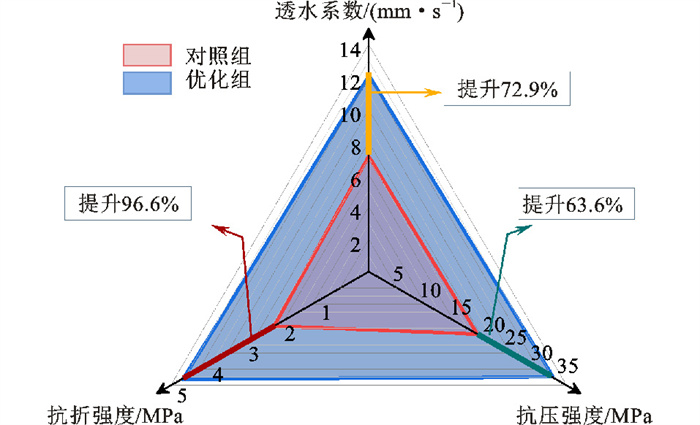
摘要: 为提升多孔混凝土(PC)的力学性能和耐久性,系统研究了玄武岩纤维(BF)、纳米SiO2(NS)和纳米CaCO3(NC)对PC的增强作用。通过单因素试验确定3种增强材料的掺量范围,并基于响应面法(RSM),以3种增强材料的掺量作为变量因素,以PC透水系数、抗压强度和抗折强度为响应指标,设计试验并建立回归模型;通过统计分析和模型优化,研究3种增强材料的交互效应,结合渴求函数确定了最佳掺量比例;进一步通过宏观性能与微观结构对比分析,揭示了其跨尺度协同增强机制。研究结果表明:单掺BF、NS和NC均能在一定范围内提升PC的抗压强度和透水系数;3种材料的增强作用并非简单的线性叠加,而是表现出显著的交互效应,RSM优化出BF的最佳体积分数为0.34%,NS和NC的最佳质量分数分别为0.38%和0.47%;相比增强前,优化后的PC透水系数、抗压强度和抗折强度分别提升了72.9%、63.6%和96.6%,且具有良好的抗冻融性能;BF主要通过介观尺度上的“桥联”效应提升PC的韧性,而NS和NC则通过微观尺度上的火山灰效应、成核效应和填充效应,促进水化产物的生成,改善基体和界面过渡区的致密性,从而增强PC的力学性能和耐久性;基于RSM进行纤维-活性纳米材料优化设计,可显著提升PC综合性能,为PC的性能优化和工程应用提供理论依据和试验基础。Abstract: To enhance the mechanical properties and durability of porous concrete (PC), the enhancement effect of basalt fiber (BF), nano-SiO2 (NS), and nano-CaCO3 (NC) on PC was systematically investigated. The appropriate dosage ranges of the three enhancement materials were determined through the single-factor test. Based on response surface method (RSM), with the dosages of these materials as variables, and the permeability coefficient, compressive strength, and flexural strength of PC as response objectives, an experiment was designed, and a regression model was established. The interaction effect of the three enhancement materials was studied using statistical analysis and model optimization, with the optimal dosages determined via desirability function. Further, the cross-scale synergistic enhancement mechanism was revealed through a comparative analysis of macroscopic performance and microscopic structure. Analysis results indicate that individual incorporation of BF, NS, and NC can enhance the compressive strength and permeability coefficient of PC within a certain range. The effect of the three enhancement materials is not merely a simple linear combination, but exhibits significant interactions. The optimal volume fraction of BF optimized by RSM is 0.34%, and the optimal mass fractions of NS and NC are 0.38% and 0.47%, respectively. Compared to the unenhanced PC, the optimized one is 72.9%, 63.6%, and 96.6% higher in permeability coefficient, compressive strength, and flexural strength, respectively, with excellent freeze-thaw resistance. BF primarily enhances the toughness of PC through the 'bridging' effect at the mesoscopic scale, while NS and NC promote the formation of hydration products and improve the density of the matrix and interfacial transition zone through pozzolanic, nucleation, and filling effects at the microscopic scale, thereby enhancing the mechanical properties and durability of PC. Optimized design of fiber-activated nanomaterials based on RSM can significantly enhance the overall performance of PC and provide a theoretical basis and experimental foundation for its performance optimization and engineering applications.
-

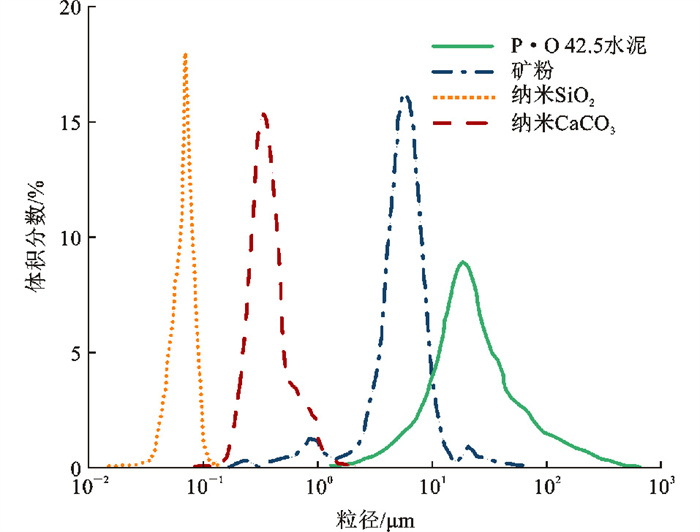
图 1 水泥、矿粉及活性纳米材料的粒径分布
Figure 1. Particle size distribution of cement, mineral powders and activated nanomaterials

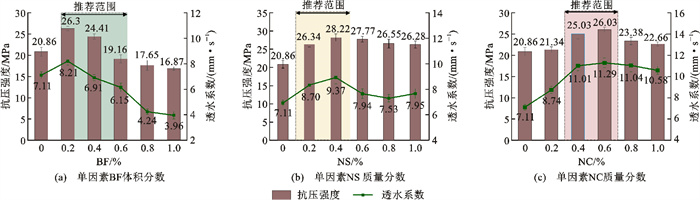
图 3 单因素对PC抗压强度和透水系数的影响
Figure 3. Effect of single factor on compressive strength and permeability coefficient of PC

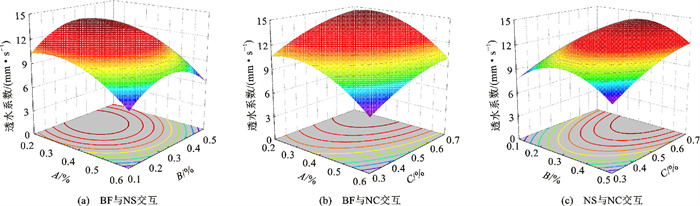
图 4 透水系数响应面及等值线
Figure 4. Response surface and contour diagram of permeability coefficient

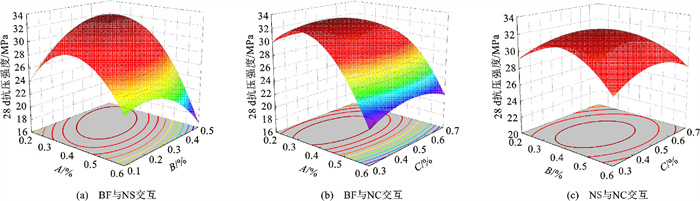
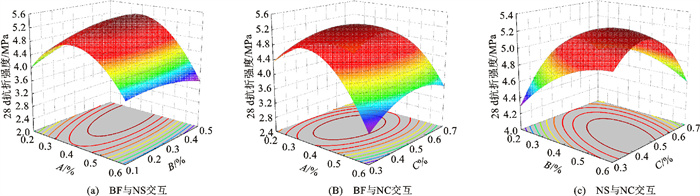
图 5 抗压强度响应面及等值线
Figure 5. Response surface and contour diagram of compressive strength
表 1 水泥、矿粉及活性纳米材料化学成分
Table 1. Chemical composition of cement, mineral powders and active nanomaterials
% 类型 SiO2 Al2O3 Fe2O3 CaO MgO Na2O SO3 烧失量 水泥 21.59 4.07 5.01 64.15 1.98 0.11 2.19 0.90 矿粉 34.10 15.23 0.32 39.71 6.51 0.23 2.29 1.24 NS 97.74 0.39 0.08 0.20 0.15 0.09 1.35 NC 0.12 0.09 0.25 54.77 0.18 0.06 1.23 43.30  下载: 导出CSV
表 2 玄武岩纤维基本物理技术指标
Table 2. Basic performance parameters of basalt fiber
指标 密度/ (g·cm-3) 平均直径/μm 长度/ mm 拉伸强度/ MPa 弹性模量/ GPa 玄武岩纤维 2.65 16 6~10 3 300~4 500 95~115
下载: 导出CSV
表 4 响应面因素与水平
Table 4. Factors and levels of RSM
% 水平设置 体积分数 质量分数 BF NS NC - 0.2 0.1 0.3 0 0.4 0.3 0.5 + 0.6 0.5 0.7
下载: 导出CSV
表 5 响应面试验设计
Table 5. Experimental design based on RSM
% 编号 编码 体积分数 质量分数 BF NS NC 1 000 0.4 0.3 0.5 2 0++ 0.4 0.5 0.7 3 -0- 0.2 0.3 0.3 4 +0+ 0.6 0.3 0.7 5 0-- 0.4 0.1 0.3 6 000 0.4 0.3 0.5 7 0-+ 0.4 0.1 0.7 8 000 0.4 0.3 0.5 9 --0 0.2 0.1 0.5 10 0+- 0.4 0.5 0.3 11 000 0.4 0.3 0.5 12 -+0 0.2 0.5 0.5 13 +0- 0.6 0.3 0.3 14 000 0.4 0.3 0.5 15 -0+ 0.2 0.3 0.7 16 ++0 0.6 0.5 0.5 17 +-0 0.6 0.1 0.5
下载: 导出CSV
表 6 RSM试验结果
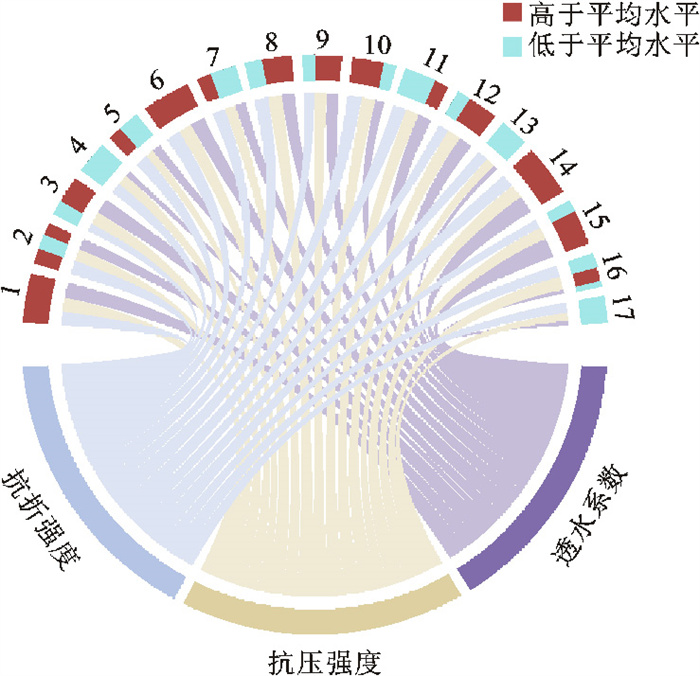
Table 6. RSM results
编号 编码 响应指标 透水系数/(mm·s-1) 抗压强度/MPa 抗折强度/MPa 1 000 11.01 32.80 5.26 2 0++ 9.89 27.87 4.51 3 -0- 10.29 29.74 4.26 4 +0+ 3.83 21.64 3.65 5 0-- 9.21 29.11 4.33 6 000 12.01 32.51 5.22 7 0-+ 8.19 25.28 4.55 8 000 11.84 31.67 5.36 9 --0 9.27 24.12 4.04 10 0+- 12.29 28.42 5.16 11 000 12.17 32.56 5.28 12 -+0 10.32 29.87 4.69 13 +0- 6.25 20.52 3.02 14 000 12.21 33.03 4.99 15 -0+ 8.31 27.42 4.11 16 ++0 5.78 16.63 3.45 17 +-0 3.93 23.42 3.87
下载: 导出CSV
表 7 透水系数回归模型方差分析
Table 7. ANOVA of permeability coefficient regression model
方差来源 平方和 自由度 均方 F值 P值 显著性 Y1 125.46 9 13.94 55.43 <0.000 1 是 A 42.26 1 42.26 168.03 <0.000 1 是 B 7.38 1 7.38 29.33 0.001 0 是 C 7.66 1 7.66 30.44 0.000 9 是 AB 0.16 1 0.16 0.64 0.450 2 否 AC 0.05 1 0.05 0.19 0.676 9 否 BC 0.47 1 0.45 1.87 0.214 2 否 A2 55.28 1 55.28 219.80 <0.000 1 是 B2 3.40 1 3.40 13.52 0.007 9 是 C2 4.68 1 4.68 18.59 0.003 5 是 残差 1.76 7 0.25 失拟项 0.79 3 0.26 1.09 0.450 6 否 绝对误差 0.97 4 0.24 总离差 127.23 16
下载: 导出CSV
表 8 抗压强度回归模型方差分析
Table 8. ANOVA of compressive strength regression model
方差来源 平方和 自由度 均方 F值 P值 显著性 Y2 371.60 9 41.29 81.47 <0.000 1 是 A 104.69 1 104.69 206.58 <0.000 1 是 B 0.092 4 1 0.092 4 0.182 4 0.682 1 否 C 3.89 1 3.89 7.68 0.027 6 是 AB 39.31 1 39.31 77.57 <0.000 1 是 AC 2.96 1 2.96 5.84 0.046 4 是 BC 2.69 1 2.69 5.31 0.054 7 否 A2 147.66 1 147.66 291.38 <0.000 1 是 B2 39.99 1 39.99 78.92 <0.000 1 是 C2 13.07 1 13.07 25.79 0.001 4 是 残差 3.55 7 0.506 8 失拟项 2.48 3 0.828 3 3.12 0.150 3 否 绝对误差 1.06 4 0.265 6 总离差 375.15 16
下载: 导出CSV
表 9 抗折强度回归模型方差分析
Table 9. ANOVA of flexural strength regression model
方差来源 平方和 自由度 均方 F值 P值 显著性 Y3 7.76 9 0.861 9 26.13 0.000 1 是 A 1.21 1 1.21 36.65 0.000 5 是 B 0.130 0 1 0.130 0 3.94 0.087 5 否 C 0.000 3 1 0.000 3 0.009 5 0.925 2 否 AB 0.286 2 1 0.286 2 8.68 0.021 5 是 AC 0.152 1 1 0.152 1 4.61 0.068 9 否 BC 0.189 2 1 0.189 2 5.74 0.047 8 是 A2 4.58 1 4.58 138.99 <0.000 1 是 B2 0.116 0 1 0.116 0 3.52 0.102 8 否 C2 0.737 4 1 0.737 4 22.36 0.002 1 是 残差 0.230 9 7 0.033 0 失拟项 0.153 2 3 0.051 1 2.63 0.186 7 否 绝对误差 0.077 7 4 0.019 4 总离差 7.99 16
下载: 导出CSV
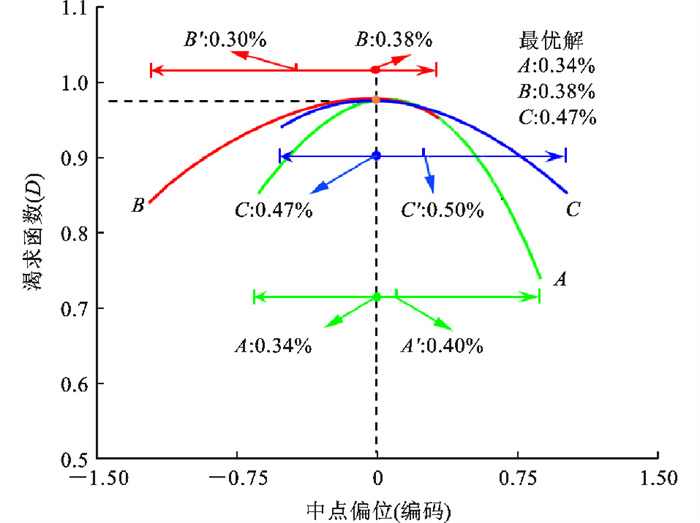
表 10 响应指标的目标值与权重
Table 10. Target values and weights of response indicators
响应指标 指标权重 上限值 下限值 目标值 透水系数/(mm·s-1) 1 3.8 12.3 最大值 28 d抗压强度/MPa 1 16.6 33.0 最大值 28 d抗折强度/MPa 1 3.0 5.36 最大值
下载: 导出CSV
表 11 最优设计结果与试验验证
Table 11. Optimal design results and experimental validation
最优解 透水系数 抗压强度 抗折强度 A: 体积分数为0.34%
B: 质量分数为0.38%
C: 质量分数为0.47%预测值/(mm·s-1) 实测值/(mm·s-1) 相对误差/% 预测值/MPa 实测值/MPa 相对误差/% 预测值/MPa 实测值/MPa 相对误差/% 12.58 12.29 2.3 33.03 34.12 3.3 5.31 5.17 2.5
下载: 导出CSV
-
[1] RODIN H, RANGELOV M, NASSIRI S, et al. Enhancing mechanical properties of pervious concrete using carbon fiber composite reinforcement[J]. Journal of Materials in Civil Engineering, 2018, 30(3): 117-126. [2] AZAD A, SAEEDIAN A, MOUSAVI S F, et al. Effect of zeolite and pumice powders on the environmental and physical characteristics of green concrete filters[J]. Construction and Building Materials, 2020, 240: 117931. doi: 10.1016/j.conbuildmat.2019.117931 [3] JOSHAGHANI A, RAMEZANIANPOUR A A, ATAEI O, et al. Optimizing pervious concrete pavement mixture design by using the Taguchi method[J]. Construction and Building Materials, 2015, 101: 317-325. doi: 10.1016/j.conbuildmat.2015.10.094 [4] JIA H C, SHENG Y P, GUO P, et al. Effect of synthetic fibers on the mechanical performance of asphalt mixture: A review[J]. Journal of Traffic and Transportation Engineering (English Edition), 2023, 10(3): 331-348. doi: 10.1016/j.jtte.2023.02.002 [5] BEIGI M H, BERENJIAN J, OMRAN O L, et al. An experimental survey on combined effects of fibers and nanosilica on the mechanical, rheological, and durability properties of self-compacting concrete[J]. Materials & Design, 2013, 50: 1019-1029. [6] CHOCKALINGAM T, VIJAYAPRABHA C, RAJ J L. Experimental study on size of aggregates, size and shape of specimens on strength characteristics of pervious concrete[J]. Construction and Building Materials, 2023, 385: 131320. doi: 10.1016/j.conbuildmat.2023.131320 [7] XIE N, AKIN M, SHI X M. Permeable concrete pavements: A review of environmental benefits and durability[J]. Journal of Cleaner Production, 2019, 210: 1605-1621. doi: 10.1016/j.jclepro.2018.11.134 [8] FANG M J, CHEN Y M, DENG Y G, et al. Toughness improvement mechanism and evaluation of cement concrete for road pavement: A review[J]. Journal of Road Engineering, 2023, 3(2): 125-140. doi: 10.1016/j.jreng.2023.01.005 [9] WANG Z, LIU Z C, ZENG F, et al. Review on frost resistance and anti-clogging of pervious concrete[J]. Journal of Traffic and Transportation Engineering (English Edition), 2024, 11(3): 481-496. doi: 10.1016/j.jtte.2023.05.008 [10] SHA A M, LIU Z Z, JIANG W, et al. Advances and development trends in eco-friendly pavements[J]. Journal of Road Engineering, 2021, 1: 1-42. doi: 10.1016/j.jreng.2021.12.002 [11] LIU N Y Z, WANG Y Q, BAI Q, et al. Road life-cycle carbon dioxide emissions and emission reduction technologies: A review[J]. Journal of Traffic and Transportation Engineering (English Edition), 2022, 9(4): 532-555. doi: 10.1016/j.jtte.2022.06.001 [12] 李辉, 杨洁, 付凯敏, 等. 基于胶浆特性的透水混凝土强度及抗冻性研究[J]. 材料导报, 2022, 36(16): 13-20.LI Hui, YANG Jie, FU Kai-min, et al. Investigation on the strength and freeze-thaw resistance of pervious concrete based on the properties of cement paste[J]. Materials Reports, 2022, 36(16): 13-20. [13] ALSHAREEDAH O, NASSIRI S. Pervious concrete mixture optimization, physical, and mechanical properties and pavement design: A review[J]. Journal of Cleaner Production, 2021, 288: 125095. doi: 10.1016/j.jclepro.2020.125095 [14] 陈锐, 陈海, 包卫星, 等. 地聚合物固化含黏风积沙土-水特征曲线[J]. 交通运输工程学报, 2023, 23(4): 128-141. doi: 10.19818/j.cnki.1671-1637.2023.04.009CHEN Rui, CHEN Hai, BAO Wei-xing, et al. Soil-water characteristic curve of geopolymer stabilized aeolian sand with clay[J]. Journal of Traffic and Transportation Engineering, 2023, 23(4): 128-141. doi: 10.19818/j.cnki.1671-1637.2023.04.009 [15] 杨立云, 林长宇, 张飞, 等. 玄武岩纤维对活性粉末混凝土受压破坏的影响[J]. 建筑材料学报, 2022, 25(5): 483-489.YANG Li-yun, LIN Chang-yu, ZHANG Fei, et al. Effect of basalt fiber on failure of reactive powder concrete under uniaxial compression[J]. Journal of Building Materials, 2022, 25(5): 483-489. [16] AL-HADITHI A I, NOAMAN A T, MOSLEH W K. Mechanical properties and impact behavior of PET fiber reinforced self-compacting concrete (SCC)[J]. Composite Structures, 2019, 224: 111021. doi: 10.1016/j.compstruct.2019.111021 [17] HUANG B S, WU H, SHU X, et al. Laboratory evaluation of permeability and strength of polymer-modified pervious concrete[J]. Construction and Building Materials, 2010, 24(5): 818-823. doi: 10.1016/j.conbuildmat.2009.10.025 [18] AKAND L, YANG M J, WANG X N. Effectiveness of chemical treatment on polypropylene fibers as reinforcement in pervious concrete[J]. Construction and Building Materials, 2018, 163: 32-39. doi: 10.1016/j.conbuildmat.2017.12.068 [19] LI J, YANG L, HE L, et al. Research progresses of fibers in asphalt and cement materials: A review[J]. Journal of Road Engineering, 2023, 3(1): 35-70. doi: 10.1016/j.jreng.2022.09.002 [20] 陈守开, 卢鹏, 李炳林, 等. 不同纤维对再生骨料透水混凝土性能的影响与评价[J]. 应用基础与工程科学学报, 2022, 30(1): 208-218.CHEN Shou-kai, LU Peng, LI Bing-lin, et al. Influence and evaluation analysis of different fibers on the performance of recycled aggregate pervious concrete[J]. Journal of Basic Science and Engineering, 2022, 30(1): 208-218. [21] OZEL B F, SAKALLI Ş, ŞAHIN Y. The effects of aggregate and fiber characteristics on the properties of pervious concrete[J]. Construction and Building Materials, 2022, 356: 129294. doi: 10.1016/j.conbuildmat.2022.129294 [22] WU J, PANG Q, LV Y Y, et al. Research on the mechanical and physical properties of basalt fiber-reinforced pervious concrete[J]. Materials, 2022, 15(19): 6527. doi: 10.3390/ma15196527 [23] ZHONG R, WILLE K. Influence of matrix and pore system characteristics on the durability of pervious concrete[J]. Construction and Building Materials, 2018, 162: 132-141. doi: 10.1016/j.conbuildmat.2017.11.175 [24] WU H, HUANG B S, SHU X, et al. Laboratory evaluation of abrasion resistance of Portland cement pervious concrete[J]. Journal of Materials in Civil Engineering, 2011, 23(5): 697-702. doi: 10.1061/(ASCE)MT.1943-5533.0000210 [25] ADIL G, KEVERN J T, MANN D. Influence of silica fume on mechanical and durability of pervious concrete[J]. Construction and Building Materials, 2020, 247: 118453. doi: 10.1016/j.conbuildmat.2020.118453 [26] JIAN S W, WEI B, ZHI X, et al. Abrasion resistance improvement of recycled aggregate pervious concrete with granulated blast furnace slag and copper slag[J]. Journal of Advanced Concrete Technology, 2021, 19(11): 1088-1099. doi: 10.3151/jact.19.1088 [27] 程子扬, 陈国夫, 屠艳平. 纳米CaCO3对粉煤灰再生骨料混凝土性能及微结构的影响[J]. 建筑材料学报, 2023, 26(3): 228-235.CHENG Zi-yang, CHEN Guo-fu, TU Yan-ping. Effect of nano CaCO3 on properties and microstructure of fly ash recycled aggregate concrete[J]. Journal of Building Materials, 2023, 26(3): 228-235. [28] SANCHEZ F, SOBOLEV K. Nanotechnology in concrete-A review[J]. Construction and Building Materials, 2010, 24(11): 2060-2071. doi: 10.1016/j.conbuildmat.2010.03.014 [29] NORHASRI M S M, HAMIDAH M S, FADZIL A M. Applications of using nano material in concrete: A review[J]. Construction and Building Materials, 2017, 133: 91-97. doi: 10.1016/j.conbuildmat.2016.12.005 [30] LI G Y. Properties of high-volume fly ash concrete incorporating nano-SiO2[J]. Cement Concrete Research, 2004, 34(6): 1043-1049. doi: 10.1016/j.cemconres.2003.11.013 [31] SHARMA U, SINGH L P, ZHAN B J, et al. RETRACTED: Effect of particle size of nanosilica on microstructure of C-S-H and its impact on mechanical strength[J]. Cement and Concrete Composites, 2019, 97: 312-321. doi: 10.1016/j.cemconcomp.2019.01.007 [32] LÓPEZ C V, HWANG S. Comparative assessment of pervious concrete mixtures containing fly ash and nanomaterials for compressive strength, physical durability, permeability, water quality performance and production cost[J]. Construction and Building Materials, 2017, 139: 148-158. doi: 10.1016/j.conbuildmat.2017.02.052 [33] MOHAMMED B S, AWANG A B, WONG S S, et al. Properties of nano silica modified rubbercrete[J]. Journal of Cleaner Production, 2016, 119: 66-75. doi: 10.1016/j.jclepro.2016.02.007 [34] LIU R, XIAO H G, GENG J S, et al. Effect of nano-CaCO3 and nano-SiO2 on improving the properties of carbon fibre-reinforced concrete and their pore-structure models[J]. Construction and Building Materials, 2020, 244: 118297. doi: 10.1016/j.conbuildmat.2020.118297 [35] JIMMA B E, RANGARAJU P R. Chemical admixtures dose optimization in pervious concrete paste selection-A statistical approach[J]. Construction and Building Materials, 2015, 101: 1047-1058. doi: 10.1016/j.conbuildmat.2015.10.003 [36] ALGIN Z, OZEN M. The properties of chopped basalt fibre reinforced self-compacting concrete[J]. Construction and Building Materials, 2018, 186: 678-685. doi: 10.1016/j.conbuildmat.2018.07.089 [37] QU G L, ZHENG M L, LU C, et al. Multi-objective optimization based on the RSM-MOPSO-GA algorithm and synergistic enhancement mechanism of high-performance porous concrete[J]. Journal of Cleaner Production, 2025, 486: 144492. doi: 10.1016/j.jclepro.2024.144492 [38] QU G L, ZHENG M L, WANG X L, et al. A freeze-thaw damage evolution equation and a residual strength prediction model for porous concrete based on the Weibull distribution function[J]. Journal of Materials in Civil Engineering, 2023, 35(5): 04023074. doi: 10.1061/(ASCE)MT.1943-5533.0004745 [39] 曲广雷, 闫宗伟, 郑木莲, 等. 基于神经网络与回归分析的多孔混凝土性能预测[J]. 吉林大学学报(工学版), 2025, 55(1): 269-282.QU Guang-lei, YAN Zong-wei, ZHENG Mu-lian, et al. Performance prediction of porous concrete based on neural network and regression analysis[J]. Journal of Jilin University(Engineering and Technology Edition), 2025, 55(1): 269-282. [40] 王静文, 王伟. 玄武岩纤维增强泡沫混凝土响应面多目标优化[J]. 材料导报, 2019, 33(24): 4092-4097.WANG Jing-wen, WANG Wei. Response surface based multi-objective optimization of basalt fiber reinforced foamed concrete[J]. Materials Reports, 2019, 33(24): 4092-4097. [41] 赵新元, 杨科, 何祥, 等. 基于RSM-BBD的多源煤基固废胶结体配比及性能研究[J]. 材料导报, 2024, 38(9): 153-159.ZHAO Xin-yuan, YANG Ke, HE Xiang, et al. Study on proportioning and performance of cemented body from multi-source coal-based solid waste based on RSM-BBD experiment[J]. Materials Reports, 2024, 38(9): 153-159. [42] XU J, WANG B B, ZUO J Q. Modification effects of nanosilica on the interfacial transition zone in concrete: A multiscale approach[J]. Cement and Concrete Composites, 2017, 81: 1-10. doi: 10.1016/j.cemconcomp.2017.04.003 [43] 黄燕, 胡翔, 史才军, 等. 混凝土中水泥浆体与骨料界面过渡区的形成和改进综述[J]. 材料导报, 2023, 37(1): 106-117.HUANG Yan, HU Xiang, SHI Cai-jun, et al. Review on the formation and improvement of interfacial transition zone between cement paste and aggregate in concrete[J]. Materials Reports, 2023, 37(1): 106-117. [44] 祁帅, 田青, 张苗, 等. 水泥基材料成核剂研究进展[J]. 硅酸盐通报, 2022, 41(7): 2223-2234.QI Shuai, TIAN Qing, ZHANG Miao, et al. Research progress on nucleating agent for cement-based materials[J]. Bulletin of the Chinese Ceramic Society, 2022, 41(7): 2223-2234. [45] WANG J L, HAN B G, LI Z, et al. Effect investigation of nanofillers on C-S-H gel structure with Si NMR[J]. Journal of Materials in Civil Engineering, 2019, 31(1): 04018352. doi: 10.1061/(ASCE)MT.1943-5533.0002559 [46] WANG X Y, DONG S F, ASHOUR A, et al. Effect and mechanisms of nanomaterials on interface between aggregates and cement mortars[J]. Construction and Building Materials, 2020, 240: 117942. doi: 10.1016/j.conbuildmat.2019.117942 -

计量
- 文章访问数: 240
- HTML全文浏览量: 115
- PDF下载量: 45
- 被引次数: 0
