


A post-earthquake repair decision method for bridges in regional road networks considering power facility failures
-
摘要: 为降低地震灾害对区域交通系统运行的负面影响,增强公路交通基础设施的震后恢复能力,研究了资源受限条件下区域路网桥梁群的震后修复决策问题;基于路段通行成本函数与交叉口控制延误模型,构建了能够量化交通功能随设施损伤和修复动态变化的区域路网交通性能分析方法;引入2类依存机制,建立了考虑电力设施失效的区域路网桥梁韧性评估模型;以桥梁和电力设施联合修复次序为优化变量,设计了基于韧性最优准则的双层修复决策模型,其中上层为整数规划模型,用于求解桥梁和电力设施的最优修复调度,下层为用户均衡流量分配模型,旨在动态评估桥梁和电力设施服务状态变化对交通用户出行效率的影响;以Centerville社区的交通-电力耦合网络为算例,对模型的有效性和应用价值进行了分析验证。分析结果表明:修复决策方法能够有效解决考虑电力设施失效与多重资源约束的区域路网桥梁修复优化问题,准确再现震后交通功能动态演化过程;相比传统基准策略,近似最优修复策略在网络恢复效率与抗震韧性方面均显著提升;相互依存关系对修复次序优化具有显著影响,忽略功能和修复依存关系将导致区域交通功能与抗震韧性被高估。研究成果可为区域交通基础设施的灾后恢复决策与抗震韧性提升提供科学参考。Abstract: The post-earthquake repair decision-making of bridge groups in regional road networks under resource constraints was studied to mitigate the adverse effects of earthquake disasters on the operation of regional traffic systems and enhance the post-disaster recovery capabilities of road traffic infrastructure. A traffic performance analysis method for regional road networks was developed based on the travel cost function of road segments and the intersection control delay model, enabling the quantification of dynamic changes of traffic functions with infrastructure damage and repair processes. By incorporating two types of interdependency between infrastructure systems, a resilience assessment model for bridges in regional road networks that considers power infrastructure failures was built. By employing the joint repair sequence of bridges and power infrastructure as the optimization variable, a bi-level repair decision-making model was designed based on resilience-oriented criteria. Specifically, the upper level is formulated as an integer programming model for determining the optimal repair scheduling of both bridges and power infrastructure, while the lower level adopts a user equilibrium traffic assignment model to dynamically evaluate the influence of service state changes of bridges and power infrastructure on travel efficiency. The model's validity and application value were analyzed and verified by employing the transportation-power network of the Centerville virtual community as a case study. Analysis results demonstrate that the proposed repair decision-making method can effectively address the optimization problem of post-earthquake bridge repair under power infrastructure failures and multiple resource constraints, accurately reproducing the dynamic evolution of traffic functions. Compared to traditional baseline strategies, the near-optimal repair strategy significantly enhances both its network recovery efficiency and seismic resilience. Furthermore, the interdependency exerts a significant influence on repair sequence optimization, and neglecting both functional and repair dependency results in the overestimation of regional traffic performance and seismic resilience. The findings can provide scientific reference for post-earthquake repair decision-making and seismic resilience enhancement of regional traffic infrastructure.
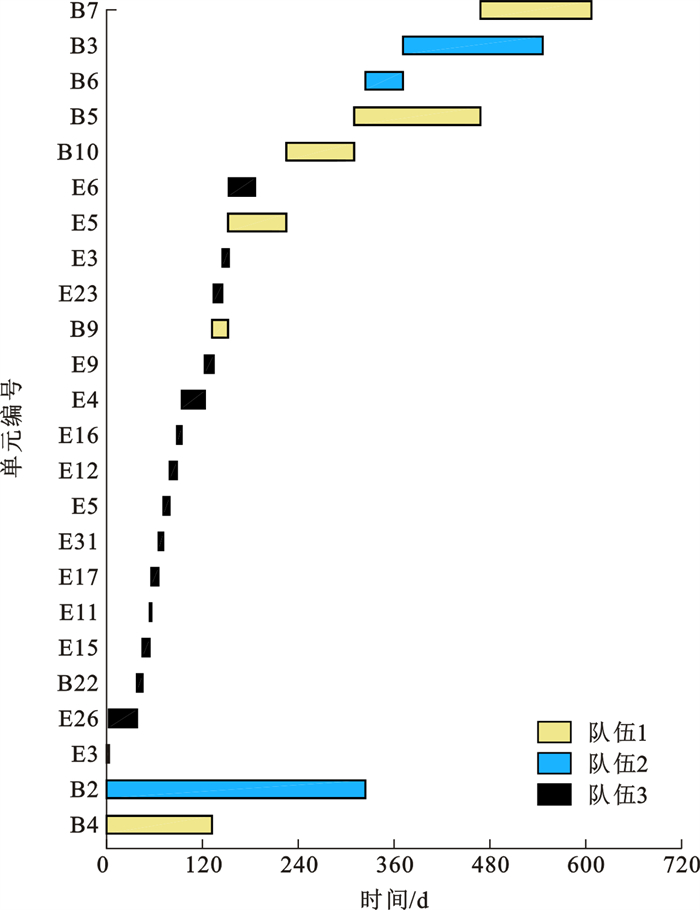
-

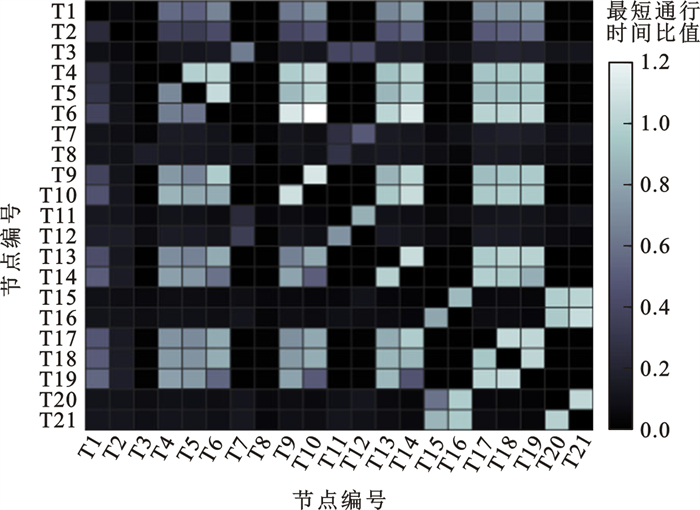
图 9 震前与震后各节点对间的最短通行时间的比值
Figure 9. Ratio of the shortest travel time between each node pair before and after earthquake

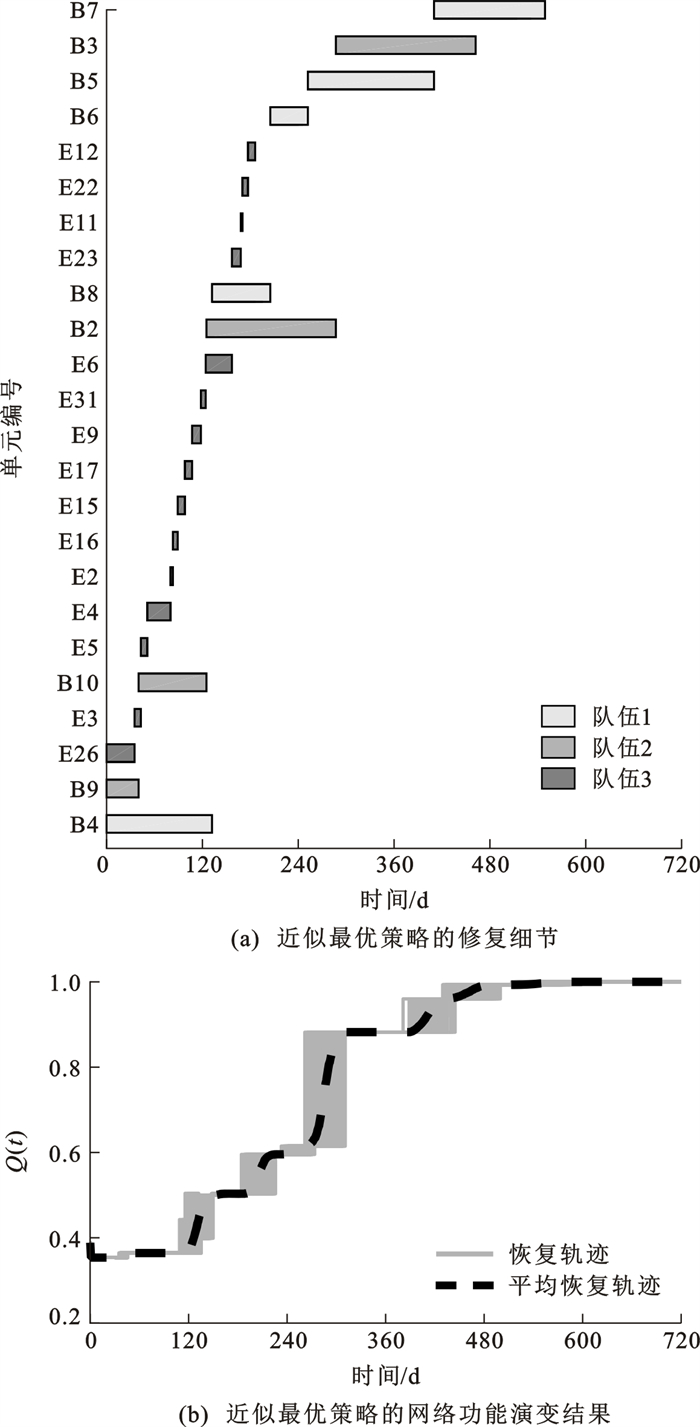
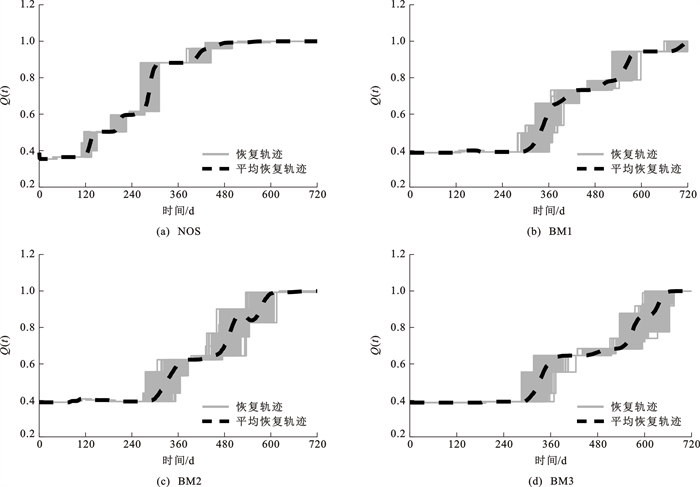
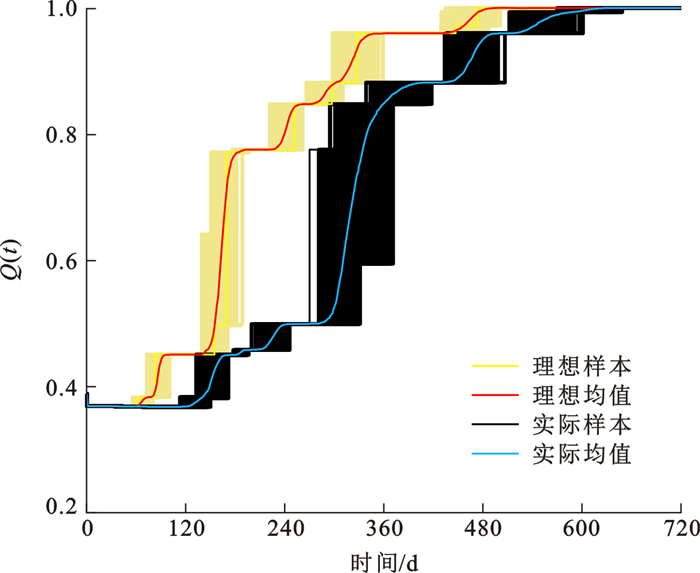
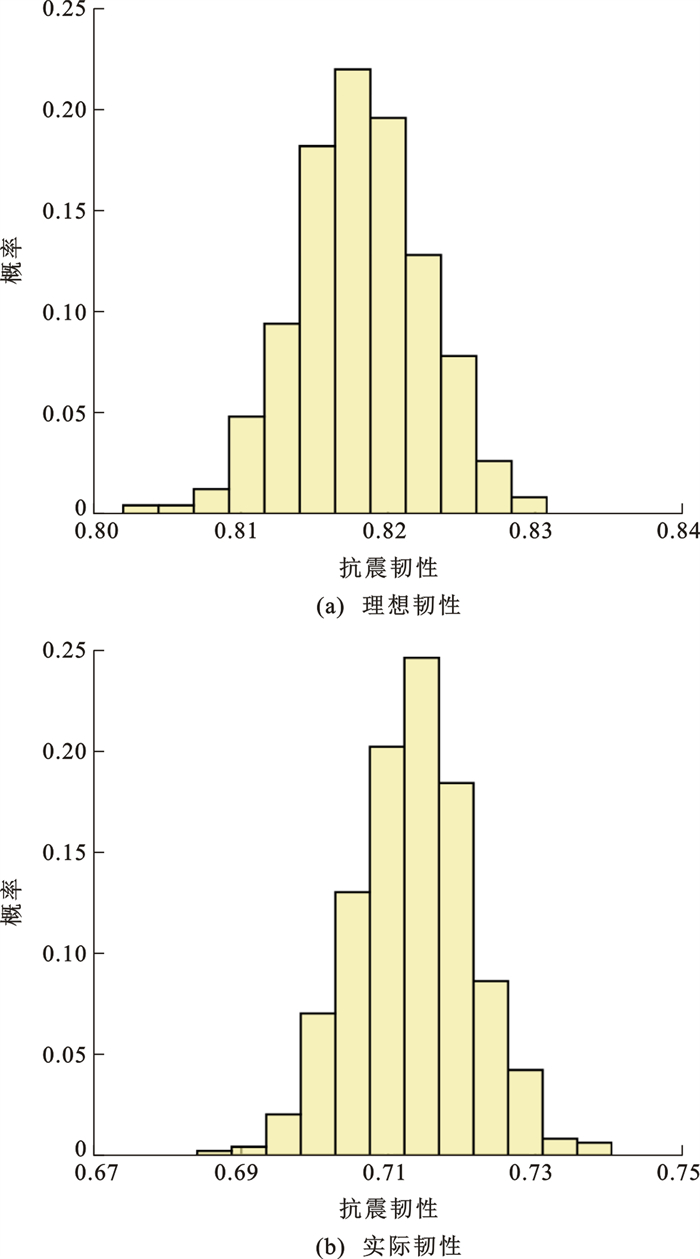
图 13 1 000个样本下不同策略的网络功能演变结果
Figure 13. Results from 1 000 simulations for different strategies

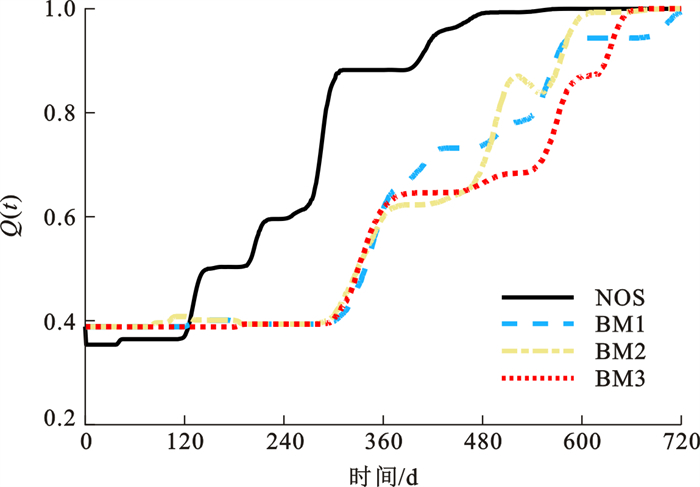
图 14 不同修复策略的平均恢复轨迹
Figure 14. Average network recovery trajectories with different restoration strategies
表 1 相互依存关系的施加方式
Table 1. Implementation of interdependencies
相互依存关系类别 影响因素 施加对象 功能依存关系 交叉口延误 桥梁网络 修复相互依存关系 修复延误 电力网络 延长修复持时 桥梁网络  下载: 导出CSV
表 2 桥梁损伤状态与道路残余性能
Table 2. Bridge damage state and residual performance of road segment
% 损伤状态 残余百分比 交通容量θc 自由流速度θv ND 100 100 SD 70 75 MD 50 50 ED 20 30 CD 0 0
下载: 导出CSV
表 3 损伤状态与预期修复持时
Table 3. Damage states and expected restoration durations of elements
编号 损伤
状态平均修复
持时/d编号 损伤
状态平均修复
持时/dB2 CD 162 E5 ED 8 B3 CD 175 E6 CD 33 B4 ED 66 E9 CD 11 B5 CD 158 E11 ED 2 B6 MD 47 E12 CD 9 B7 CD 139 E15 CD 9 B8 ED 73 E16 CD 6 B9 SD 20 E17 ED 9 B10 ED 85 E22 CD 7 E2 ED 3 E23 ED 11 E3 CD 8 E26 CD 35 E4 CD 29 E31 CD 6
下载: 导出CSV
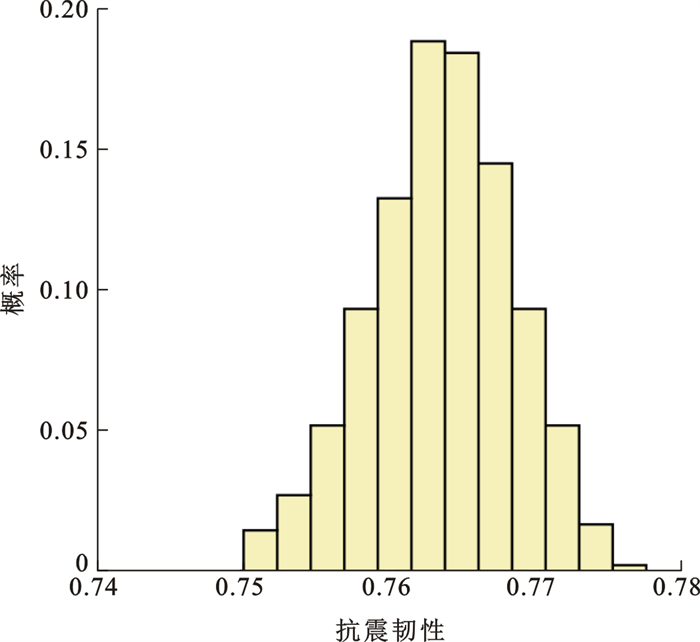
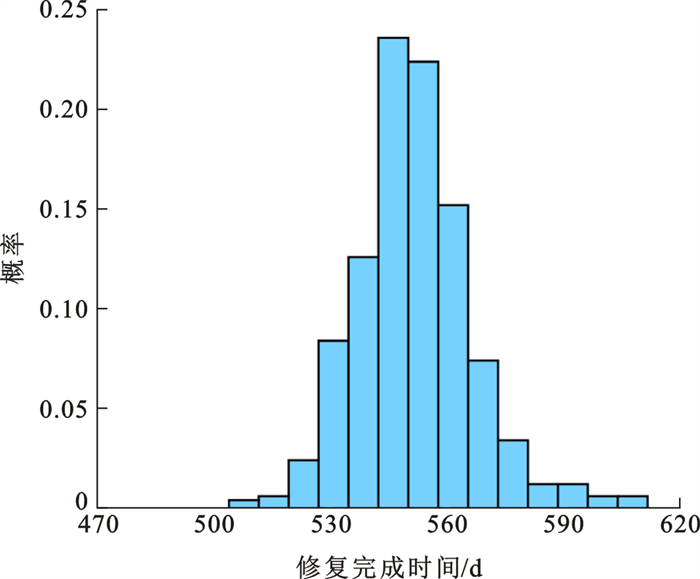
表 4 修复策略的统计结果
Table 4. Statistical results for all strategies
修复策略 NOS BM1 BM2 BM3 抗震
韧性最大值 0.776 8 0.643 2 0.654 5 0.621 6 最小值 0.750 3 0.589 9 0.590 7 0.565 1 均值 0.763 6 0.617 6 0.621 2 0.594 0 变异系数 0.006 4 0.014 7 0.016 8 0.017 3 最终
恢复
时间最大值/d 600.820 4 747.583 4 728.049 7 673.037 3 最小值/d 510.394 4 656.775 6 609.581 8 595.814 6 均值/d 551.777 3 703.332 3 670.063 9 636.338 1 变异系数 0.027 1 0.021 7 0.024 7 0.021 1 P[Q(720)=1]/% 100.0 88.8 98.4 100.0
下载: 导出CSV
-
[1] 钟剑, 王浩, 朱小杰. 多点激励地震动空间效应参数敏感性分析[J]. 东南大学学报(自然科学版), 2024, 54(6): 1377-1385.ZHONG Jian, WANG Hao, ZHU Xiao-jie. Sensitivity analysis on seismic spatial variability parameters subjected to differential support motions[J]. Journal of Southeast University (Natural Science Edition), 2024, 54(6): 1377-1385. [2] ZHONG J, ZHOU S E, WANG H, et al. Regional seismic fragility of bridge network derived by covariance matrix model of bridge portfolios[J]. Engineering Structures, 2024, 309: 118035. doi: 10.1016/j.engstruct.2024.118035 [3] CHANG L, ELNASHAI A S, SPENCER B F. Post-earthquake modelling of transportation networks[J]. Structure and Infrastructure Engineering, 2012, 8(10): 893-911. [4] HAN Q, DU X L, LIU J B, et al. Seismic damage of high-way bridges during the 2008 Wenchuan Earthquake[J]. Earthquake Engineering and Engineering Vibration, 2009, 8(2): 263-273. doi: 10.1007/s11803-009-8162-0 [5] HOLLING C S. Resilience and stability of ecological systems[J]. Annual Review of Ecology and Systematics, 1973, 4: 1-23. doi: 10.1146/annurev.es.04.110173.000245 [6] BRUNEAU M, CHANG S E, EGUCHI R T, et al. A framework to quantitatively assess and enhance the seismic resilience of communities[J]. Earthquake Spectra, 2003, 19(4): 733-752. doi: 10.1193/1.1623497 [7] ALIPOUR A, SHAFEI B. Seismic resilience of transporta-tion networks with deteriorating components[J]. Journal of Structural Engineering, 2016, 142(8): C4015015. doi: 10.1061/(ASCE)ST.1943-541X.0001399 [8] 贾俊峰, 魏博, 杜修力, 等. 从WCEE看国内外韧性抗震梁桥研究进展[J]. 交通运输工程学报, 2022, 22(6): 25-45. doi: 10.19818/j.cnki.1671-1637.2022.06.002JIA Jun-feng, WEI Bo, DU Xiu-li, et al. Research progress of seismic resilient girder bridges at home and abroad from WCEE[J]. Journal of Traffic and Transportation Engi-neering, 2022, 22(6): 25-45. doi: 10.19818/j.cnki.1671-1637.2022.06.002 [9] 张望欣, 韩强, 温佳年, 等. 基于地震灾害管理的桥梁网络韧性决策框架[J]. 土木工程学报, 2023, 56(4): 72-82.ZHANG Wang-xin, HAN Qiang, WEN Jia-nian, et al. A decision framework for improving bridge network resilience based on earthquake disaster management[J]. China Civil Engineering Journal, 2023, 56(4): 72-82. [10] CHEN L C, MILLER-HOOKS E. Resilience: An indicator of recovery capability in intermodal freight transport[J]. Transportation Science, 2011, 46(1): 109-123. [11] 翟长海, 岳清瑞, 谢礼立. 抗震韧性城市评估与构建[J]. 建筑结构学报, 2024, 45(5): 1-13.ZHAI Chang-hai, YUE Qing-rui, XIE Li-li. Evaluation and construction of seismic resilient cities[J]. Journal of Building Structures, 2024, 45(5): 1-13. [12] 毛新华, 王建伟, 袁长伟, 等. 基于韧性最优的灾后公路网修复调度研究[J]. 中国公路学报, 2022, 35(6): 289-298.MAO Xin-hua, WANG Jian-wei, YUAN Chang-wei, et al. Restoration scheduling for post-disaster road networks based on resilience optimization[J]. China Journal of Highway and Transport, 2022, 35(6): 289-298. [13] 路庆昌, 刘鹏, 徐标, 等. 运营事件下基于韧性的地铁网络保护决策优化[J]. 交通运输工程学报, 2023, 23(3): 209-220. doi: 10.19818/j.cnki.1671-1637.2023.03.016LU Qing-chang, LIU Peng, XU Biao, et al. Resilience-based protection decision optimization for metro network under operational incidents[J]. Journal of Traffic and Transpor-tation Engineering, 2023, 23(3): 209-220. doi: 10.19818/j.cnki.1671-1637.2023.03.016 [14] KAVIANI A, THOMPSON R G, RAJABIFARD A, et al. A model for multi-class road network recovery scheduling of regional road networks[J]. Transportation, 2020, 47(1): 109-143. doi: 10.1007/s11116-017-9852-5 [15] MERSCHMAN E, DOUSTMOHAMMADI M, SALMAN A M, et al. Postdisaster decision framework for bridge repair prioritization to improve road network resilience[J]. Trans-portation Research Record: Journal of the Transportation Research Board, 2020(2674): 81-92. [16] SOMY S, SHAFAEI R, RAMEZANIAN R. Resilience-based mathematical model to restore disrupted road-bridge trans-portation networks[J]. Structure and Infrastructure Engi-neering, 2022, 18(9): 1334-1349. doi: 10.1080/15732479.2021.1906711 [17] KARAMLOU A, BOCCHINI P. Sequencing algorithm with multiple-input genetic operators: Application to disaster resilience[J]. Engineering Structures, 2016, 117: 591-602. doi: 10.1016/j.engstruct.2016.03.038 [18] LIU K Z, ZHAI C H, DONG Y. Optimal restoration schedules of transportation network considering resilience[J]. Structure and Infrastructure Engineering, 2021, 17(8): 1141-1154. doi: 10.1080/15732479.2020.1801764 [19] ZHANG W X, DONG H H, WEN J N, et al. A resilience-based decision framework for post-earthquake restoration of bridge networks under uncertainty[J]. Structure and Infrastructure Engineering, 2025, 21(2): 341-356. doi: 10.1080/15732479.2023.2218838 [20] SUN L, STOJADINOVIC B, SANSAVINI G. Resilience evaluation framework for integrated civil infrastructure-community systems under seismic hazard[J]. Journal of Infrastructure Systems, 2019, 25(2): 04019016. doi: 10.1061/(ASCE)IS.1943-555X.0000492 [21] FOTOUHI H, MORYADEE S, MILLER-HOOKS E. Quanti-fying the resilience of an urban traffic-electric power coupled system[J]. Reliability Engineering & System Safety, 2017, 163: 79-94. [22] ZOU Q L, CHEN S R. Resilience modeling of interdependent traffic-electric power system subject to hurricanes[J]. Journal of Infrastructure Systems, 2020, 26: 04019034. doi: 10.1061/(ASCE)IS.1943-555X.0000524 [23] ZOU Q L, CHEN S R. Enhancing resilience of interdepen-dent traffic-electric power system[J]. Reliability Engineering & System Safety, 2019, 191: 106557. [24] LIU Z L, LI S C, ZHAO W G, et al. Post-earthquake assessment model for highway bridge networks considering traffic congestion due to earthquake-induced bridge damage[J]. Engineering Structures, 2022, 262: 114395. doi: 10.1016/j.engstruct.2022.114395 [25] ZHAO T Y, SUN L. Seismic resilience assessment of critical infrastructure-community systems considering looped interde-pendences[J]. International Journal of Disaster Risk Reduc-tion, 2021, 59: 102246. doi: 10.1016/j.ijdrr.2021.102246 [26] DUAN D L, LV C C, SI S B, et al. Universal behavior of cascading failures in interdependent networks[J]. Proceedings of the National Academy of Sciences of the United States of America, 2019, 116(45): 22452-22457. [27] BOCCHINI P, FRANGOPOL D M. Restoration of bridge networks after an earthquake: Multicriteria intervention optimization[J]. Earthquake Spectra, 2012, 28(2): 427-455. doi: 10.1193/1.4000019 [28] WARDROP J G. Road paper. Some theoretical aspects of road traffic research[J]. Proceedings of the Institution of Civil Engineers, 1952, 1(3): 325-362. doi: 10.1680/ipeds.1952.11259 [29] MARTIN W A, MCGUCKIN N A. Travel estimation techniques for urban planning[M]. Washington DC: National Academy Press, 1998. [30] FHWA. Highway capacity manual[M]. Washington DC: FHWA, 2000. [31] LIU Y, WOTHERSPOON L, NAIR N C, et al. Quantifying the seismic risk for electric power distribution systems[J]. Structure and Infrastructure Engineering, 2021, 17(2): 217-232. doi: 10.1080/15732479.2020.1734030 [32] CARDONI A, CIMELLARO G P, DOMANESCHI M, et al. Modeling the interdependency between buildings and the electrical distribution system for seismic resilience assessment[J]. International Journal of Disaster Risk Reduction, 2020, 42: 101315. doi: 10.1016/j.ijdrr.2019.101315 [33] OUYANG M, DUEÑAS-OSORIO L. An approach to design interface topologies across interdependent urban infrastructure systems[J]. Reliability Engineering & System Safety, 2011, 96(11): 1462-1473. [34] WU B C, TANG A P, WU J. Modeling cascading failures in interdependent infrastructures under terrorist attacks[J]. Reliability Engineering & System Safety, 2016, 147: 1-8. [35] WANG F, MAGOUA J J, LI N, et al. Assessing the impact of systemic heterogeneity on failure propagation across interdependent critical infrastructure systems[J]. Inter-national Journal of Disaster Risk Reduction, 2020, 50: 101818. doi: 10.1016/j.ijdrr.2020.101818 [36] LI Z L, JIN C, HU P, et al. Resilience-based transportation network recovery strategy during emergency recovery phase under uncertainty[J]. Reliability Engineering & System Safety, 2019, 188: 503-514. [37] GUO A X, LIU Z L, LI S C, et al. Seismic performance assessment of highway bridge networks considering post-disaster traffic demand of a transportation system in emergency conditions[J]. Structure and Infrastructure Engi-neering, 2017, 13(12): 1523-1537. doi: 10.1080/15732479.2017.1299770 [38] XU M, OUYANG M, MAO Z J, et al. Improving repair sequence scheduling methods for postdisaster critical infrastructure systems[J]. Computer-aided Civil and Infrastructure Engineering, 2019, 34(6): 506-522. doi: 10.1111/mice.12435 [39] CIMELLARO G P, REINHORN A M, BRUNEAU M. Framework for analytical quantification of disaster resilience[J]. Engineering Structures, 2010, 32(11): 3639-3649. doi: 10.1016/j.engstruct.2010.08.008 [40] FRANK M, WOLFE P. An algorithm for quadratic programming [J]. Naval Research Logistics Quarterly, 1956, 3(1/2): 95-110. [41] ELLINGWOOD B R, CUTLER H, GARDONI P, et al. The centerville virtual community: A fully integrated decision model of interacting physical and social infrastructure systems[J]. Sustainable and Resilient Infrastructure, 2016, 1(3/4): 95-107. [42] WU Y Y, HOU G Y, CHEN S R. Post-earthquake resilience assessment and long-term restoration prioritization of trans-portation network[J]. Reliability Engineering & System Safety, 2021, 211: 107612. [43] ZHANG W L, WANG N Y, NICHOLSON C. Resilience-based post-disaster recovery strategies for road-bridge networks[J]. Structure and Infrastructure Engineering, 2017, 13(11): 1404-1413. doi: 10.1080/15732479.2016.1271813 [44] ZHANG W X, HAN Q, SHANG W L, et al. Seismic resilience assessment of interdependent urban transportation-electric power system under uncertainty[J]. Transportation Research Part A: Policy and Practice, 2024, 183: 104078. doi: 10.1016/j.tra.2024.104078 -

计量
- 文章访问数: 208
- HTML全文浏览量: 97
- PDF下载量: 41
- 被引次数: 0
