


-
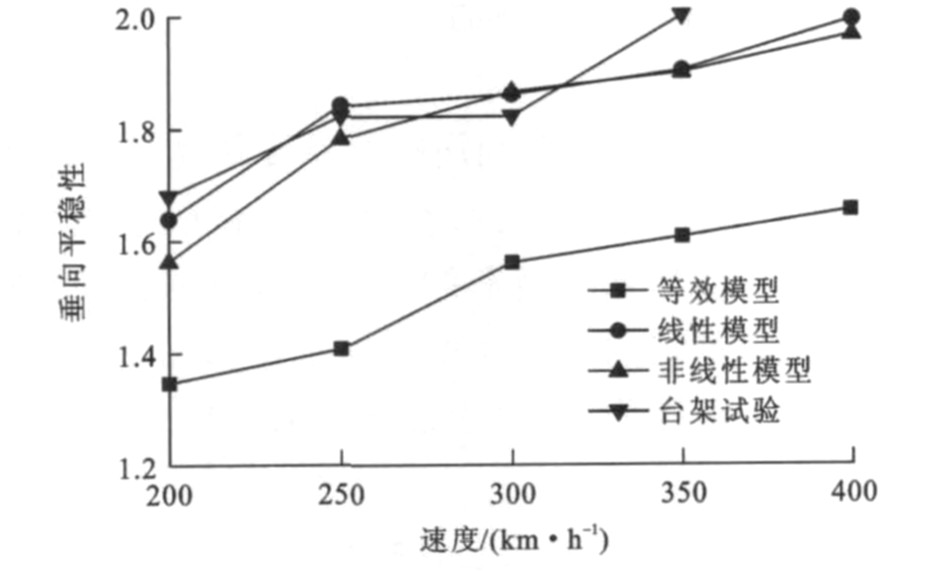
摘要: 建立了空气弹簧等效模型、线性模型与非线性模型, 分析了3种模型对车辆直线平稳性和曲线通过安全性的影响。研究结果表明: 在计算车辆直线垂向平稳性时, 空气弹簧等效模型计算精度较差, 而空气弹簧线性模型和非线性模型计算精度较高; 由于空气弹簧线性模型比非线性模型简单, 建议在计算直线垂向平稳性时优先采用空气弹簧线性模型; 在计算车辆曲线通过安全性时, 空气弹簧非线性模型能反映空气弹簧的充排气特性, 计算精度较高; 由于模型自身的局限性, 空气弹簧线性模型和等效模型无法反映空气弹簧的充排气特性, 计算精度较差, 因此, 建议在计算曲线通过安全性时采用空气弹簧非线性模型。Abstract: The equivalent model, linear model and nonlinear model of air spring were established, and the influences of three models on the ride comfort of straight track and the safety of curve track were studied. Analysis result shows that the accuracy of equivalent model is smaller for the calculation of ride comfort of straight track, but the linear model and the nonlinear model can provide better accuracy. The linear model is simpler than the nonlinear model, therefore, the linear model is suggested to be adapted for the calculation of ride comfort of straight track. Since the nonlinear model of air spring can reflect the dynamic performance of air spring and provide better accuracy compared with the linear model and the equivalent model, therefore, the nonlinear model is recommended to be used in the safety calculation of curve negotiation.
-
Key words:
- railway vehicle /
- air spring /
- equivalent model /
- linear model /
- nonlinear model /
- ride comfort of vehicle /
- vehicle safety
-

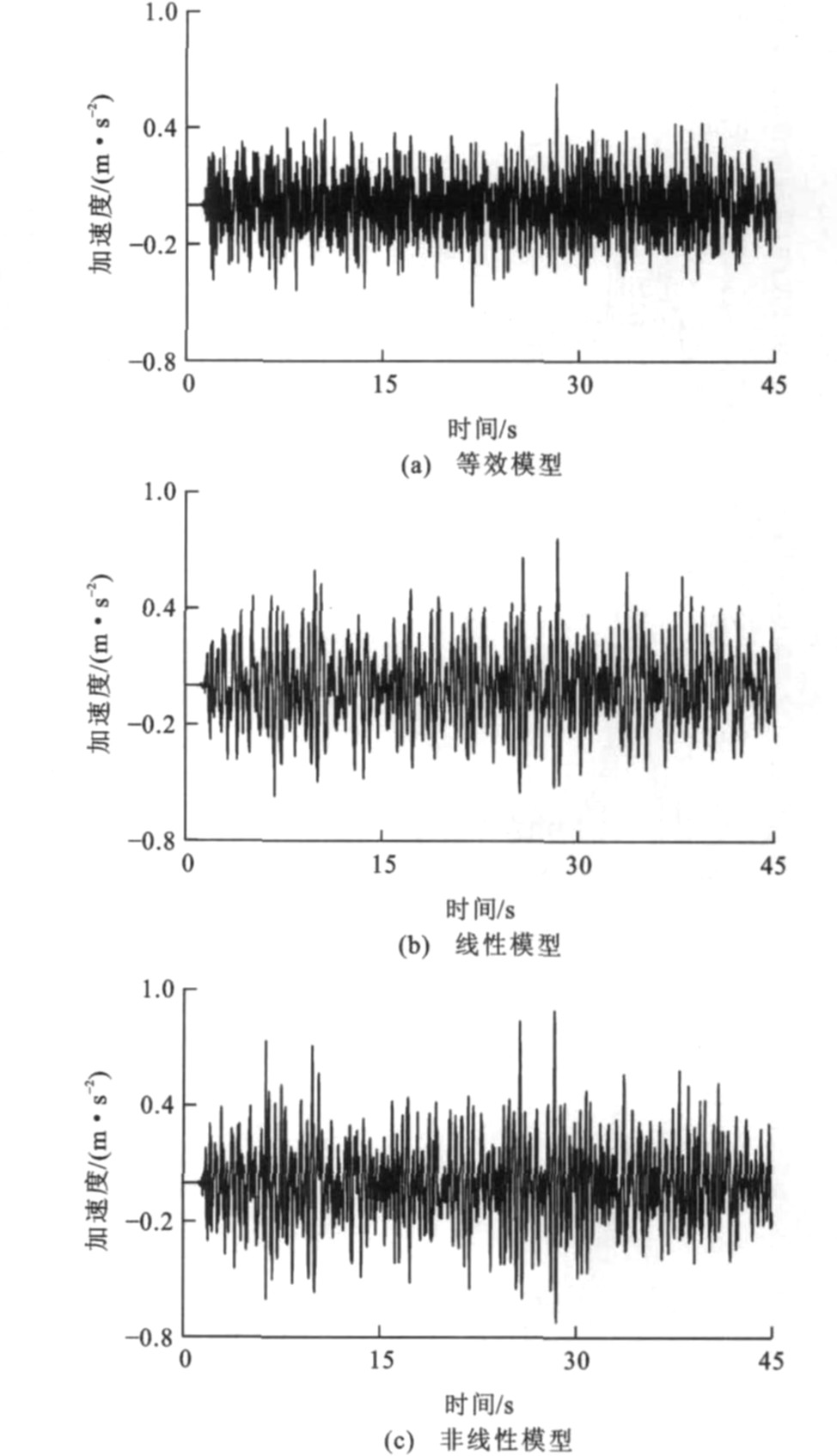
图 8 车体垂向加速度时域对比
Figure 8. Comparison of vertical accelerations of carbody in time domain

图 9 车体垂向加速度频域对比
Figure 9. Comparison of vertical accelerations of carbody in frequency domain
-
[1] 刘增华, 李芾, 黄运华. 空气弹簧系统垂向刚度特性的有限元分析[J]. 西南交通大学学报, 2006, 41(6): 700-704. https://www.cnki.com.cn/Article/CJFDTOTAL-XNJT200606007.htmLIU Zeng-hua, LI Fu, HUANG Yun-hua. Finite element analysis of vertical stiffness of air spring system[J]. Journal of Southwest Jiaotong University, 2006, 41(6): 700-704. (in Chinese). https://www.cnki.com.cn/Article/CJFDTOTAL-XNJT200606007.htm [2] 李芾, 付茂海, 黄运华. 空气弹簧动力学特性参数分析[J]. 西南交通大学学报, 2003, 38(3): 276-281. https://www.cnki.com.cn/Article/CJFDTOTAL-XNJT200303008.htmLI Fu, FU Mao-hai, HUANG Yun-hua. Analysis of dynamic characteristic parameter of air spring[J]. Journal of Southwest Jiaotong University, 2003, 38(3): 276-281. (in Chinese). https://www.cnki.com.cn/Article/CJFDTOTAL-XNJT200303008.htm [3] 罗仁, 曾京, 邬平波. 空气弹簧对车辆曲线通过性能的影响[J]. 交通运输工程学报, 2007, 7(5): 15-18. http://transport.chd.edu.cn/article/id/200705004LUO Ren, ZENG Jing, WU Ping-bo. Influence of air spring on curve negotiating property of vehicle[J]. Journal of Traffic and Transportation Engineering, 2007, 7(5): 15-18. (in Chinese). http://transport.chd.edu.cn/article/id/200705004 [4] 张广世, 沈刚. 带有连接管路的空气弹簧动力学模型研究[J]. 铁道学报, 2005, 27(4): 36-41. https://www.cnki.com.cn/Article/CJFDTOTAL-TDXB200504007.htmZHANG Guang-shi, SHEN Gang. Study on dynamic air spring model with connecting pipe[J]. Journal of the China Railway Society, 2005, 27(4): 36-41. (in Chinese). https://www.cnki.com.cn/Article/CJFDTOTAL-TDXB200504007.htm [5] 王家胜, 朱思洪. 带附加气室空气弹簧垂向刚度影响因素试验研究[J]. 振动与冲击, 2010, 29(6): 1-3, 20. https://www.cnki.com.cn/Article/CJFDTOTAL-ZDCJ201006003.htmWANG Jia-sheng, ZHU Si-hong. Experimental study on influential factors on dynamic stiffness of air spring with auxiliary chamber[J]. Journal of Vibration and Shock, 2010, 29(6): 1-3, 20. (in Chinese). https://www.cnki.com.cn/Article/CJFDTOTAL-ZDCJ201006003.htm [6] 李锋祥, 杨卫民, 丁玉梅. APDL实现空气弹簧动态试验仿真[J]. 特种橡胶制品, 2007, 28(4): 50-54, 70. https://www.cnki.com.cn/Article/CJFDTOTAL-TZXJ200704014.htmLI Feng-xiang, YANG Wei-min, DING Yu-mei. Simulation of dynamic test of air spring by APDL[J]. Special Purpose Rubber Products, 2007, 28(4): 50-54, 70. (in Chinese). https://www.cnki.com.cn/Article/CJFDTOTAL-TZXJ200704014.htm [7] QUAGLIA G, SORLI M. Air suspension dimensionless analysis and design procedure[J]. Vehicle System Dynamics, 2001, 35(6): 443-475. doi: 10.1076/vesd.35.6.443.2040 [8] DIANA G, CHELI F, COLLINA A, et al. The development of a numerical model for railway vehicles comfort assessment through comparison with experimental measurements[J]. Vehicle System Dynamics, 2002, 38(3): 165-183. doi: 10.1076/vesd.38.3.165.8287 [9] FACCHINETTI A, MAZZOLA L, ALFI S, et al. Mathematical modelling of the secondary air spring suspension in railway vehicles and its effect on safety and ride comfort[J]. Vehicle System Dynamics, 2010, 48(S): 429-449. [10] BRUNI S, VINOLAS J, BERG M, et al. Modelling of suspension components in a rail vehicle dynamics context[J]. Vehicle System Dynamics, 2010, 49(7): 1021-1072. [11] SAYYAADI H, SHOKOUHI N. A new model in railvehicles dynamics considering nonlinear suspension components behavior[J]. International Journal of Mechanical Sciences, 2009, 51(3): 222-232. doi: 10.1016/j.ijmecsci.2009.01.003 [12] DOCQUIER N, FISETTE P, JEANMART H. Multiphysic modelling of railway vehicles equipped with pneumatic suspensions[J]. Vehicle System Dynamics, 2007, 45(6): 505-524. doi: 10.1080/00423110601050848 [13] DOCQUIER N, FISETTE P, JEANMART H. Model-based evaluation of railway pneumatic suspensions[J]. Vehicle System Dynamics, 2008, 46(S): 481-493. [14] NIETO A J, MORALES A L, CHICHARRO J M, et al. Unbalanced machinery vibration isolation with a semi-active pneumatic suspension[J]. Jourmal of Sound and Vibration, 2010, 329(1): 3-12. doi: 10.1016/j.jsv.2009.09.001 [15] EICHOFF B M, EVANS J R, MINNIS A J. A review of modelling methods for railway vehicle suspension components[J]. Vehicle System Dynamics, 1995, 24(6/7): 469-496. -

 下载:
下载:





 点击查看大图
图(12)
计量
- 文章访问数: 1300
- HTML全文浏览量: 281
- PDF下载量: 137113
- 被引次数: 0
