


Multi-operator collaborative scheduling model for electric apron shuttle buses at hub airports
-
摘要: 为解决枢纽机场电动摆渡车调度中因运营商独立运行所引发的配置成本高、调度效率低、延误时间长等问题,提出了一种多运营商协作调度模式下的机场电动摆渡车调度方法;设计了运营商协作调度车队的运行机制,允许车辆跨运营商服务航班请求;建立了独立与协作模式下的混合整数规划模型,旨在最小化车辆运行成本与航班保障延误总时间;提出了描述协作程度的参数(共享半径、共享车辆数),设计了基于改进遗传算法的求解框架;通过协作调度策略降低机场整体运行成本,减少航班延误,并以广州白云国际机场为例进行了实证分析。结果表明:与传统独立调度模式相比,多运营商协作调度模式显著提升车辆利用效率,尤其是在复杂运行场景测试下可减少69.4%~100.0%的延误时间,降低21.6%~75.7%的运营成本;改进的遗传算法相较CPLEX求解器可减少85.3%~99.5%的计算时间,能在更短时间内获得高质量解,同时目标函数差距保持在1%以内。针对繁忙的枢纽机场,所提方法能够在降低车辆运行成本与减少航班延误时间方面取得有效平衡。Abstract: In response to high allocation cost, low scheduling efficiency, and long delays caused by the independent operation of electric ferry buses at hub airports, a scheduling method under a multi-operator collaborative scheduling mode was proposed for electric ferry buses at airports. An operation mechanism was designed for operators to dispatch buses collaboratively, allowing buses to serve flight requests from different operators. A mixed-integer programming model was constructed for both independent and collaborative modes, aiming to minimize bus operation cost and the total delay in flight support. Two parameters, namely, shared radius and number of shared vehicles, were introduced to quantify the degree of collaboration. An improved genetic algorithm (IGA)-based solution framework was designed. Through the collaborative scheduling strategy, the overall airport operating cost was reduced and flight delays were mitigated. Empirical validation was carried out with Guangzhou Baiyun International Airport as an example. According to the results, compared with the traditional independent scheduling mode, the proposed multi-operator collaborative model significantly improves bus utilization. Under complex operational scenarios, delays can be eliminated by 69.4%–100.0% and operating costs decease by 21.6%–75.7%. The improved genetic algorithm shortens computation time by 85.3% to 99.5% compared to traditional solvers. A high-quality solution can be acquired within a shorter time, while the gap with the objective function can be maintained within 1%. For busy hub airports, the proposed method provides an effective balance between reducing bus operating cost and minimizing flight delays.
-

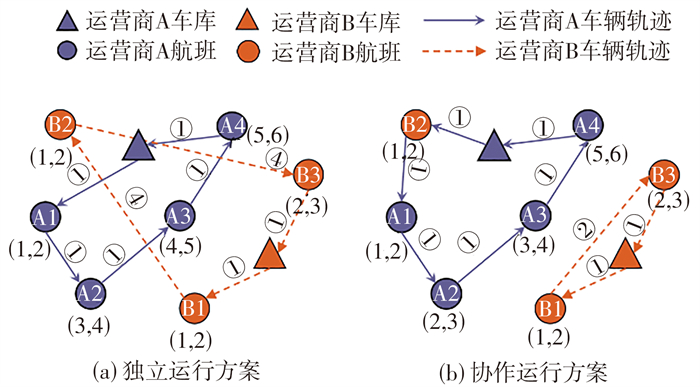
图 2 机场运营商独立与协作模式的示例
Figure 2. Examples of independent and collaborative models for airport operators

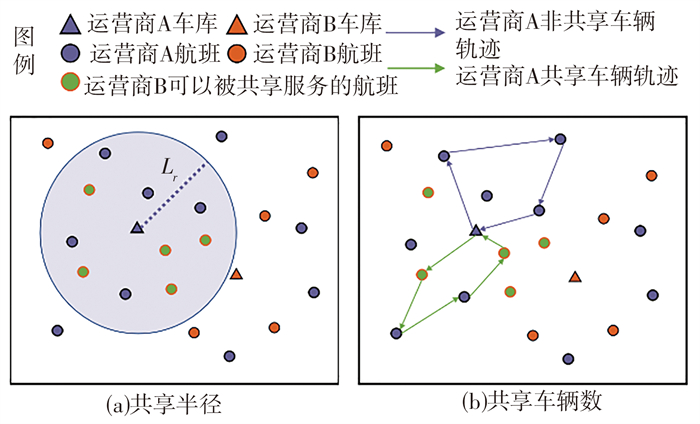
图 6 共享参数对协作效用的影响
Figure 6. Effects of sharing parameters on the utility of cooperation

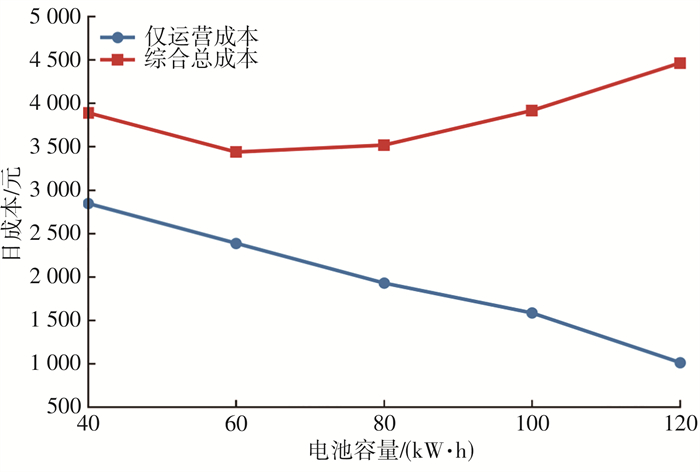
图 7 OC模式下不同电池容量的成本曲线
Figure 7. Cost curves for different battery capacities under OC mode
表 1 多运营商协作策略参数
Table 1. Multi-operator collaboration strategy parameters
参数类别 参数 含义 共享参数 $ {L}_{r}, r\in R $ 运营商r的最大协作半径 $ {n}_{r}^{{}^{}}, r\in R $ 运营商r可提供的共享车辆数  下载: 导出CSV
表 2 运营商信息
Table 2. Operator information
运营商 1 2 3 航班数 35 11 14 车辆数 3 2 2 最大共享范围/km 1.5 1.5 1.5 共享车辆数 3 2 2
下载: 导出CSV
表 3 电动摆渡车信息
Table 3. Electric shuttle bus information
参数 值 电量/(kW·h) 50 电量消耗速率/(kW·h·m-1) 0.8 充电速率/(kW·h·min-1) 0.2 最小电量阈值/% 0.3 服务时间/min 3 移动速率/(km·h-1) 30 完成充电比率/% 95
下载: 导出CSV
表 4 算例设置
Table 4. Study settings
分组 算例描述的高峰时段 包含时间/h 航班数 Ⅰ 7:00~8:00 1 18 Ⅱ 6:00~9:00 3 48 Ⅲ 10:00~13:00 15 10 Ⅳ 整日 24 60
下载: 导出CSV
表 5 改进遗传、遗传算法、CPLEX在求解多运营商独立运行模型的对比
Table 5. Comparison of improved genetic algorithm, genetic algorithm and CPLEX in solving multi-operator independent operation model
场景-车辆数 日运行成本/元 日延误时间/s 计算时间/s IGA GA CPLEX IGA GA CPLEX IGA GA CPLEX Ⅰ-4 2 469 3 595 2 448 1 10 5 7 4 149 Ⅰ-7 2 278 3 487 2 260 0 3 2 9 8 232 Ⅰ-10 2 027 4 689 2 011 0 3 0 9 6 217 Ⅱ-4 4 906 6 861 4 949 17 46 26 57 49 618 Ⅱ-7 3 685 4 248 3 705 3 19 8 63 58 679 Ⅱ-10 3 206 4 405 3 183 0 15 4 249 212 2 478 Ⅲ-4 8 885 11 757 43 93 258 237 Ⅲ-7 5 094 7 364 6 49 297 255 Ⅲ-10 4 170 8 515 0 23 305 288 Ⅳ-4 9 986 44 218 49 128 974 876 Ⅳ-7 5 905 30 481 10 85 1 006 989 Ⅳ-10 6 222 18 663 1 50 1 320 975
下载: 导出CSV
表 6 改进遗传、遗传算法、CPLEX在求解多运营商合作运行模型的对比
Table 6. Comparison of improved genetic algorithm, genetic algorithm and CPLEX in solving multi-operator cooperative operation model
场景-车辆数 日运行成本/元 日延误时间/s 计算时间/s IGA GA CPLEX IGA GA CPLEX IGA GA CPLEX Ⅰ-4 1 930 2 818 1 875 0 8 5 6 4 157 Ⅰ-7 867 1 769 815 0 3 1 10 9 241 Ⅰ-10 1 223 3 645 1 194 0 1 1 9 7 224 Ⅱ-4 2 018 3 529 1 988 0 45 17 51 47 632 Ⅱ-7 1 197 1 937 1 239 0 15 9 59 60 681 Ⅱ-10 1 469 2 344 1 512 0 7 2 249 213 2 365 Ⅲ-4 3 533 5 164 9 86 261 249 Ⅲ-7 1 927 3 762 0 25 276 242 Ⅲ-10 1 012 3 145 0 16 289 301 Ⅳ-4 4 475 27 298 15 131 1 120 965 Ⅳ-7 2 070 12 213 0 80 1 229 1 267 Ⅳ-10 1 666 10 329 0 43 1 320 1 388
下载: 导出CSV
表 7 运营商分摊与补偿结果对照(场景Ⅰ)
Table 7. Comparison of operator sharing and compensation results (scene Ⅰ)
场景-
车辆数运营商 资源贡献度 结果收益份额 协同红利份额 侧支付/元 净收益/元 Ⅰ-4 1 0.18 0.57 0.37 -96.02 139.11 2 0.36 0.43 0.39 -31.40 146.20 3 0.47 -0.10 0.18 109.18 68.75 Ⅰ-7 1 0.14 0.48 0.31 -75.37 136.97 2 0.36 0.42 0.39 -13.72 173.25 3 0.50 0.10 0.30 89.09 132.05 Ⅰ-10 1 0.11 0.44 0.28 -80.68 131.28 2 0.36 0.40 0.38 -10.85 181.38 3 0.54 0.15 0.34 91.54 164.21
下载: 导出CSV
表 8 车辆充电时间的目标函数结果
Table 8. Results of the objective function as affected by charging time
充电时间/min 日OS成本/元 日OC成本/元 $ \mathrm{\Delta }{f}_{1} $/% 日OS延误/s 日OC延误/s $ \mathrm{\Delta }{f}_{2} $/% 20 4 275 1 486 65.24 0 0 0.00 30 4 684 1 707 63.56 2 0 100.00 45 5 094 1 927 62.17 6 0 100.00 60 5 503 2 148 60.97 12 2 83.33 90 6 322 2 589 59.05 25 8 68.00
下载: 导出CSV
表 9 车辆续航能力的目标函数结果
Table 9. Results of the objective function as affected by the vehicle range capacity
电池容量/(kW·h) 日OS运营成本/元 日OC运营成本/元 日OC综合成本/元 $ \mathrm{\Delta }{f}_{1} $/% 日OS延误/s 日OC延误/s $ \mathrm{\Delta }{f}_{2} $/% 40 6 832 2 845 3 890 58.36 15 3 80.00 60 5 963 2 386 3 438 60.00 10 1 90.00 80 5 094 1 927 3 518 62.17 6 0 100.00 100 4 612 1 583 3 916 65.68 2 0 100.00 120 4 170 1 012 4 464 75.73 0 0 0.00
下载: 导出CSV
表 10 车辆数量的目标函数结果
Table 10. Results of the objective function as affected by the number of vehicles
车辆总数 日OS成本/元 日OC成本/元 $ \mathrm{\Delta }{f}_{1} $/% 日OS延误/s 日OC延误/s $ \mathrm{\Delta }{f}_{2} $/% 4 8 885 3 533 60.24 43 9 79.07 5 7 642 2 986 60.92 28 5 82.14 6 6 368 2 457 61.41 15 2 86.67 7 5 094 1 927 62.17 6 0 100.00 8 4 632 1 470 68.26 3 0 100.00 9 4 401 1 241 71.80 1 0 100.00 10 4 170 1 012 75.73 0 0 0.00
下载: 导出CSV
表 11 旅客数量的目标函数结果
Table 11. Results of the objective function as affected by the number of travelers
平均旅客数/人 日OS成本/元 日OC成本/元 $ \mathrm{\Delta }{f}_{1} $/% 日OS延误/s 日OC延误/s $ \mathrm{\Delta }{f}_{2} $/% 80 3 854 1 545 59.91 0 0 0.00 120 4 474 1 736 61.20 2 0 100.00 150 5 094 1 927 62.17 6 0 100.00 180 5 714 2 118 62.93 12 2 83.33 220 6 334 2 309 63.55 20 5 75.00
下载: 导出CSV
-
[1] 马骏驰, 张源, 段宗涛, 等. 考虑充电需求的电动汽车行为策略研究综述[J]. 交通运输工程学报, 2024, 24(6): 66-79. doi: 10.19818/j.cnki.1671-1637.2024.06.004MA Jun-chi, ZHANG Yuan, DUAN Zong-tao, et al. Research review on behavior strategies of electric vehicles considering charging demands[J]. Journal of Traffic and Transportation Engineering, 2024, 24(6): 66-79. doi: 10.19818/j.cnki.1671-1637.2024.06.004 [2] 包丹文, 陈卓, 姚馨宇, 等. 基于混合策略的机坪车辆主动式实时调度方法[J]. 交通运输工程学报, 2024, 24(3): 251-265. doi: 10.19818/j.cnki.1671-1637.2024.03.018BAO Dan-wen, CHEN Zhuo, YAO Xin-yu, et al. Pro-active real-time scheduling approach of apron vehicles based on mixed strategy[J]. Journal of Traffic and Transportation Engineering, 2024, 24(3): 251-265. doi: 10.19818/j.cnki.1671-1637.2024.03.018 [3] BAO D, CHEN Z, KANG D. Proactive real-time scheduling method for apron service vehicles based on mixed strategies[J]. Computers & Industrial Engineering, 2024, 192: 110182. [4] 黄虹鑫, 胡力群, 张懿璞, 等. 不同运行模式下的交通自洽能源系统架构配置优化[J]. 交通运输工程学报, 2024, 24(5): 23-39. doi: 10.19818/j.cnki.1671-1637.2024.05.003HUANG Hong-xin, HU Li-qun, ZHANG Yi-pu, et al. Configuration optimization for transportation self-consistent energy system architectures under different operation modes[J]. Journal of Traffic and Transportation Engineering, 2024, 24(5): 23-39. doi: 10.19818/j.cnki.1671-1637.2024.05.003 [5] 郝雪丽, 赵美瑄, 裴莉莉, 等. 基于改进Pareto算法的风/光/氢蓄储公路微电网调度决策优化[J]. 交通运输工程学报, 2024, 24(4): 71-82. doi: 10.19818/j.cnki.1671-1637.2024.04.006HAO Xue-li, ZHAO Mei-xuan, PEI Li-li, et al. Optimization on scheduling decision-making for wind/solar/hydrogen storage highway microgrid based on improved Pareto algorithm[J]. Journal of Traffic and Transportation Engineering, 2024, 24(4): 71-82. doi: 10.19818/j.cnki.1671-1637.2024.04.006 [6] ÖNER N, GULTEKIN H, KOC C. The airport shuttle bus scheduling problem[J]. International Journal of Production Research, 2021, 59(24): 7400-7422. doi: 10.1080/00207543.2020.1841317 [7] WU M, YU C H, MA W J, et al. Joint optimization of timetabling, vehicle scheduling, and ride-matching in a flexible multi-type shuttle bus system[J]. Transportation Research Part C: Emerging Technologies, 2022, 139: 103657. doi: 10.1016/j.trc.2022.103657 [8] WEI M, YANG C X, LIU T. An integrated multi-objective optimization for dynamic airport shuttle bus location, route design and departure frequency setting problem[J]. International Journal of Environmental Research and Public Health, 2022, 19(21): 14469. doi: 10.3390/ijerph192114469 [9] WANG Y Q, SHANG P. Shuttle bus rerouting and rescheduling problem considering daily demand fluctuation[J]. Mathematical Problems in Engineering, 2022, 2022: 2917240. [10] WEI M, YANG C X, SUN B, et al. A multi-objective optimization model for green demand responsive airport shuttle scheduling with a stop location problem[J]. Electronic Research Archive, 2023, 31(10): 6363-6383. doi: 10.3934/era.2023322 [11] PENG J L, SHANGGUAN W, ZHANG L, et al. An optimal scheduling method using multi-agent A* for autonomous shuttle bus [C]//IEEE. 2021 40th Chinese Control Conference (CCC). New York: IEEE, 2021: 6040-6045. [12] SIGLER D, WANG Q C, LIU Z C, et al. Route optimization for energy efficient airport shuttle operations—A case study from Dallas Fort Worth International Airport[J]. Journal of Air Transport Management, 2021, 94: 102077. doi: 10.1016/j.jairtraman.2021.102077 [13] GUO Z K, LAI C S, LUK P, et al. Techno-economic assessment of wireless charging systems for airport electric shuttle buses[J]. Journal of Energy Storage, 2023, 64: 107123. doi: 10.1016/j.est.2023.107123 [14] AKINCILAR A. A methodology for shuttle scheduling in airports that ensures mitigating arriving passenger congestion under uncertain demand[J]. IEEE Intelligent Transportation Systems Magazine, 2022, 14(2): 105-114. doi: 10.1109/MITS.2021.3049359 [15] FENG Y F, CAO Z C, ZHANG S L. Shuttle bus timetable adjustment in response to behind-schedule commuter railway disturbance[J]. Sustainability, 2022, 14(24): 16708. doi: 10.3390/su142416708 [16] BASSO F, IBARRA G, PEZOA R, et al. Horizontal collaboration in the wine supply chain planning: A Chilean case study[J]. Journal of the Operational Research Society, 2024, 75(1): 67-84. doi: 10.1080/01605682.2023.2174457 [17] GALKIN A, KUSH Y, ROSLAVTSEV D, et al. Modeling horizontal collaboration efficiency of several supply chains[J]. SHS Web of Conferences, 2021, 92: 06008. doi: 10.1051/shsconf/20219206008 [18] SAFFARI H, ABBASI M, GHEIDAR-KHELJANI J. A robust, sustainable, resilient, and responsive model for forward/reverse logistics network design with a new approach based on horizontal collaboration[J]. Environment, Development and Sustainability, 2025, 27(10): 23439-23482. [19] DENG S J, YUAN Y Y, WANG Y, et al. Collaborative multicenter logistics delivery network optimization with resource sharing[J]. PLoS One, 2020, 15(11): e0242555. doi: 10.1371/journal.pone.0242555 [20] JUSTIANI S, WIBOWO B S. The economic and environmental benefits of collaborative pick-up in urban delivery systems[J]. LOGI—Scientific Journal on Transport and Logistics, 2022, 13(1): 245-256. [21] HACARDIAUX T, DEFRYN C, TANCREZ J S, et al. Balancing partner preferences for logistics costs and carbon footprint in a horizontal cooperation[J]. OR Spectrum, 2022, 44(1): 121-153. doi: 10.1007/s00291-021-00651-y [22] EIRINAKIS P, MOURTOS I, ZAMPOU E. Random serial dictatorship for horizontal collaboration in logistics[J]. Omega, 2022, 111: 102662. doi: 10.1016/j.omega.2022.102662 [23] ANGELELLI E, MORANDI V, SPERANZA M G. Optimization models for fair horizontal collaboration in demand-responsive transportation[J]. Transportation Research Part C: Emerging Technologies, 2022, 140: 103725. doi: 10.1016/j.trc.2022.103725 [24] ZHANG W Y, CHEN Z X, ZHANG S, et al. Composite multi-objective optimization on a new collaborative vehicle routing problem with shared carriers and depots[J]. Journal of Cleaner Production, 2020, 274: 122593. doi: 10.1016/j.jclepro.2020.122593 [25] ZHOU F T, ARVIDSSON A, WU J M, et al. Collaborative electric vehicle routing with meet points[J]. Communications in Transportation Research, 2024, 4: 100135. doi: 10.1016/j.commtr.2024.100135 [26] BAO D W, ZHOU J Y, ZHANG Z Q, et al. Mixed fleet scheduling method for airport ground service vehicles under the trend of electrification[J]. Journal of Air Transport Management, 2023, 108: 102379. doi: 10.1016/j.jairtraman.2023.102379 [27] BAO D W, ZHOU J Y, KANG D, et al. Optimization model for electric aircraft tow tractors scheduling under operator cooperation[J]. Transportation Research Part C: Emerging Technologies, 2025, 172: 105032. doi: 10.1016/j.trc.2025.105032 [28] MENIZ B, TIRYAKI F. Genetic algorithm optimization with selection operator decider[J]. Arabian Journal for Science and Engineering, 2025, 50(10): 6931-6941. doi: 10.1007/s13369-024-09068-5 [29] LEI L H, LIU N J, ZHOU J. Nonlinear function optimization based on adaptive genetic algorithm [C]//ACM. Proceedings of the 4th International Conference on Computer Science and Application Engineering. New York: ACM, 2020: 1-8. [30] WANG C F, LIU K, SHEN P P. A novel genetic algorithm for global optimization[J]. Acta Mathematicae Applicatae Sinica, English Series, 2020, 36(2): 482-491. doi: 10.1007/s10255-020-0930-7 [31] DU M Y, YU Q D, JIA F, et al. Modified genetic algorithm for solving function optimization problems [C]//IEEE. 2023 2nd International Conference on Artificial Intelligence, Human-computer Interaction and Robotics (AIHCIR). New York: IEEE, 2024: 516-520. [32] PRAVESJIT S, LONGPRADIT P, KANTAWONG K, et al. An improvement of genetic algorithm with Rao algorithm for optimization problems [C]//IEEE. 2021 2nd International Conference on Big Data Analytics and Practices (IBDAP). New York: IEEE, 2021: 72-75. [33] PEREA F R P, CHEN J, WEISZER M, et al. Airport ground movement optimization revisited: Coupling airport runway spacing to multi-objective routing and scheduling through genetic algorithms [C]//IEEE. 2023 IEEE Symposium Series on Computational Intelligence (SSCI). New York: IEEE, 2024: 200-206. [34] JIANG H, ZHANG J, ZHANG H Y, et al. Multi-objective optimization of airport baggage transport vehicles'scheduling based on improved genetic algorithm[J]. SAE Technical Papers, 2023-1-7090. [35] HU R, WANG D Y, FENG H L, et al. Joint gate-runway scheduling considering carbon emissions, airport noise and ground-air coordination[J]. Journal of Air Transport Management, 2024, 116: 102555. doi: 10.1016/j.jairtraman.2024.102555 [36] ZHU Z N, LI X, CHEN H Y, et al. An effective and robust genetic algorithm with hybrid multi-strategy and mechanism for airport gate allocation[J]. Information Sciences, 2024, 654: 119892. doi: 10.1016/j.ins.2023.119892 [37] GUEDAN-PECKER F, RAMIREZ-ATENCIA C. Airport take-off and landing optimization through genetic algorithms[J]. Expert Systems, 2024, 41(8): e13565. doi: 10.1111/exsy.13565 [38] RAEESI R, ZOGRAFOS K G. The electric vehicle routing problem with time windows and synchronised mobile battery swapping[J]. Transportation Research Part B: Methodological, 2020, 140: 101-129. doi: 10.1016/j.trb.2020.06.012 [39] DING X S, JIAN S S. Revenue sharing and resource allocation for cooperative multimodal transport systems[J]. Transportation Research Part C: Emerging Technologies, 2024, 164: 104666. doi: 10.1016/j.trc.2024.104666 [40] American Public Transportation Association (APTA). Impacts of spare ratio rules on vehicle availability[Z]. Washington DC: American Public Transportation Association, 2025. -



计量
- 文章访问数: 10
- HTML全文浏览量: 7
- PDF下载量: 2
- 被引次数: 0
