


Population-based structural health monitoring of bridges: Review and challenges
-
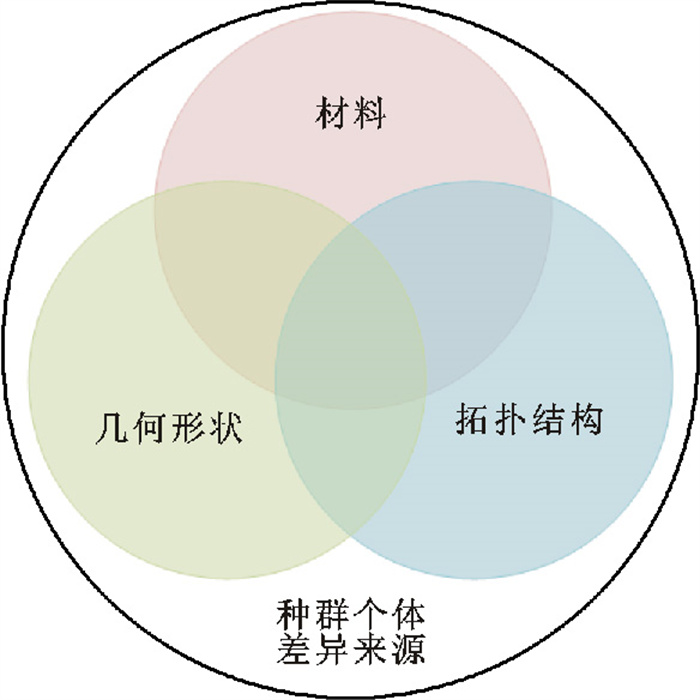
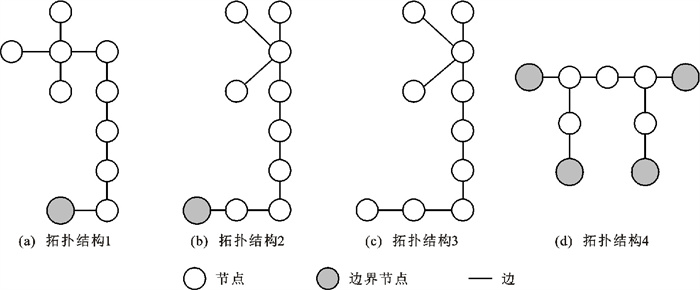
摘要: 为克服桥梁结构健康监测(BSHM)领域面临的数据缺乏、标签缺失、运营环境差异化大以及监测计算成本高等现实挑战,对基于种群的结构健康监测(PBSHM)框架进行了系统性综述与总结。通过分析近年来的相关文献,对PBSHM的基础概念进行了简述,从几何、材料与拓扑3个方面阐述了不同结构种群类型的定义,包括同质同群和异质种群,并总结了PBSHM拟解决的关键问题;从结构相似性度量、不同种群类型下的知识迁移方法及其运用方面,对PBSHM领域的研究现状进行了回顾与分析,总结了该框架下的应用场景与解决思路,分析了不同技术方法的功能与联系;针对BSHM领域面临的工程实际问题,讨论了桥梁PBSHM存在的挑战与潜在解决思路。研究结果表明:结构种群是PBSHM框架的基础,利用桥梁结构力学行为相似性和数据分布相似性能有效判断桥梁种群成员之间的知识可迁移性;显式迁移方法在桥梁结构群的异常监测和特征分布对齐方面表现出良好的应用效果,而基于深度神经网络模型的隐式迁移方法具有更强的适应性,可自动提取更具表征力的特征,满足BSHM实际应用中的端到端需求;基于知识迁移技术,PBSHM框架在处理桥梁结构健康监测任务中的复杂运营条件差异与数据不平衡的影响、损伤识别、数据预测与生成、特征对齐与归一化等方面具有巨大潜力。Abstract: To solve the practical challenges faced in bridge structural health monitoring (BSHM), such as data scarcity, label deficiency, large operational environment variations, and high monitoring computational costs, the framework of population-based structural health monitoring (PBSHM) was systematically reviewed and summarized. A brief overview of the fundamental concepts of PBSHM was provided by thoroughly analyzing relevant studies reported in recent years. The definitions of different structural population types, including homogeneous populations and heterogeneous populations, were elaborated on from three perspectives: geometry, material, and topology. Key issues that PBSHM aims to solve were also summarized. Research status in the field of PBSHM was reviewed and analyzed in detail from two aspects: structural similarity measurement, and knowledge transfer methods and applications under different population types. Specific application scenarios and solution approaches under this framework were summarized, and the functions and connections of different technical methods were analyzed. In light of the practical engineering problems faced in the field of BSHM, the challenges and potential solutions for PBSHM of bridges were discussed. Review results indicate that structural populations form the basis of the PBSHM framework. Utilizing indicators of structural mechanical behavior similarity and data distribution similarity can effectively determine the knowledge transferability among bridge population members. Explicit transfer methods show good performance in anomaly monitoring and feature alignment for bridge structural populations, while implicit transfer methods based on deep neural network models exhibit stronger adaptability, which can automatically extract more representative features, meeting the end-to-end requirements in practical BSHM applications. Based on leveraging knowledge transfer technology, the PBSHM framework shows great potential in addressing issues such as differences in complex operational conditions, data imbalance impacts, damage identification, data prediction and generation, feature alignment, and normalization in bridge structural health monitoring tasks.
-
Key words:
- bridge engineering /
- structural health monitoring /
- review /
- knowledge transfer /
- structural population
-

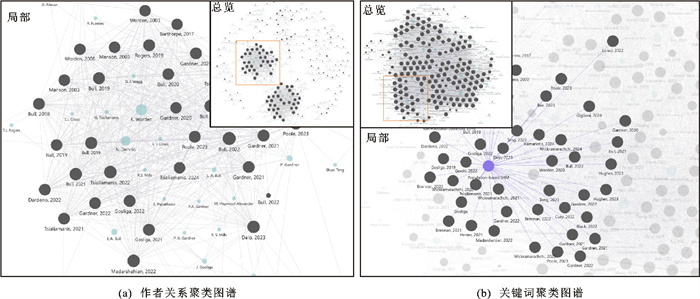
图 2 作者关系与关键词聚类图谱
Figure 2. Clustering network maps of author relationships and keywords


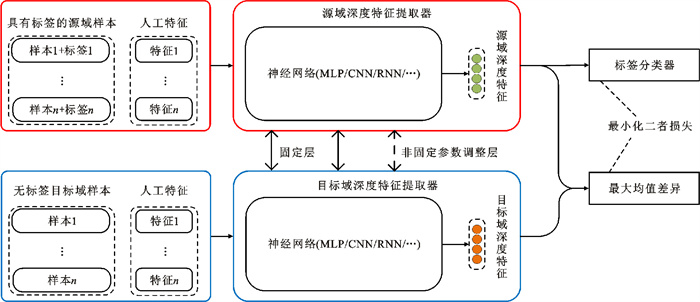
图 6 深度领域自适应方法神经网络架构
Figure 6. Neural network architecture of deep domain adaptation method

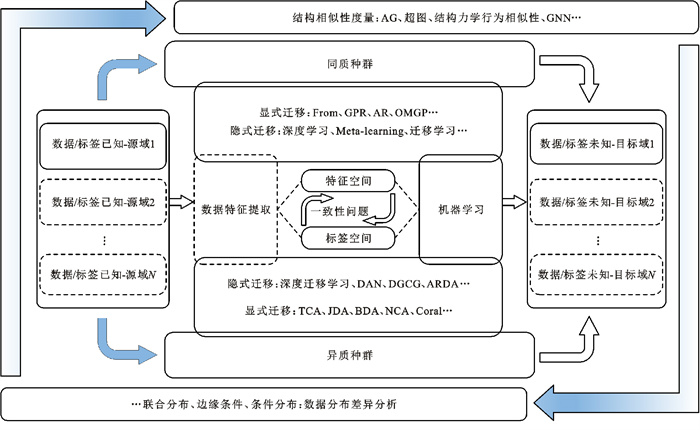
图 7 基于种群的结构健康监测总体思路与框架
Figure 7. General approach and framework of structural health monitoring based on population
表 1 同质种群Form显式迁移
Table 1. Explicit transfer of the form in homogeneous population
预测模型 Form特征 损伤指标 应用场景 高斯过程回归 频响函数 MSD 多振子结构损伤识别[19] 频响函数 MSD 多振子结构损伤识别[47] 运行功率 NMSE、MSLL 风力电机异常检测[53] 固有频率 95% Confidence Interval 桥梁结构损伤识别[51] 运营风速 NMSE 环境影响因素归一化[54] 高斯过程重叠混合模型 频响函数 SML 直升机旋翼叶片试验结构损伤识别[49] 频响函数 SML 直升机旋翼叶片试验结构损伤识别[50] 监督主成分分析多模型自回归方法 加速度响应 Euclidean Norm 无人机旋翼复合悬臂叶片损伤识别[16] 无监督随机系数高斯混合自回归模型 加速度响应 MSD、NLL 无人机旋翼复合悬臂叶片损伤识别[17] 无监督多模型统计时间序列类型方法 频响函数 L2范数 无人机旋翼复合悬臂叶片异常诊断[18] 动态谐波回归方法 结构应变 RMSE、MAE、MAPE 实际桥梁结构损伤识别[52] 分层贝叶斯建模 PLL 工程基础设施数据建模[55]  下载: 导出CSV
表 2 异质种群显式迁移
Table 2. Explicit transfer for the heterogeneous population
应用场景 特征 对象 涉及的方法与手段 跨域损伤分类 固有频率与阻尼比 数值框架模型、试验框架模型 TCA、JDA、ARTL[14] 固有频率 数值剪切模型 JDA[21] 频响函数 直升机机翼结构 TCA、BDA[38] 固有频率 实际桥梁结构 TCA、JDA、MIDA[65] 固有频率 数值桥梁模型、实际桥梁结构 TCA[66] 固有正交模态 数值桥梁模型、实际桥梁结构 JDA-kernel[67] 频响函数 飞机机翼结构 TCA[69] 传递率函数 飞机机翼结构 KBTL[70] 固有频率 数值框架模型、框架试验模型 KBTL[71] 固有频率 钢格桅杆结构 M-JDA[72] 跨域损伤检测 频响函数 飞机尾翼结构 TCA[73] 频响函数 飞机尾翼结构 KBTL[74] 固有频率 数值框架结构、试验框架结构 TCA、GPR[75] 跨领域非监督聚类 固有频率 实际桥梁结构 DA-GMM[68] 特征对齐与归一化 固有频率 数值桥梁模型、实际桥梁结构 JDA、NCA[40] 固有频率 数值框架模型、实际桥梁结构、多自由度振子模型 N标准化、A标准化、CORAL、NCA、NCORAL[64] 固有频率 实际桥梁结构 NCA[76]
下载: 导出CSV
表 3 两座桥梁的模态振型相似性结果
Table 3. Modal shape similarity results of two bridges
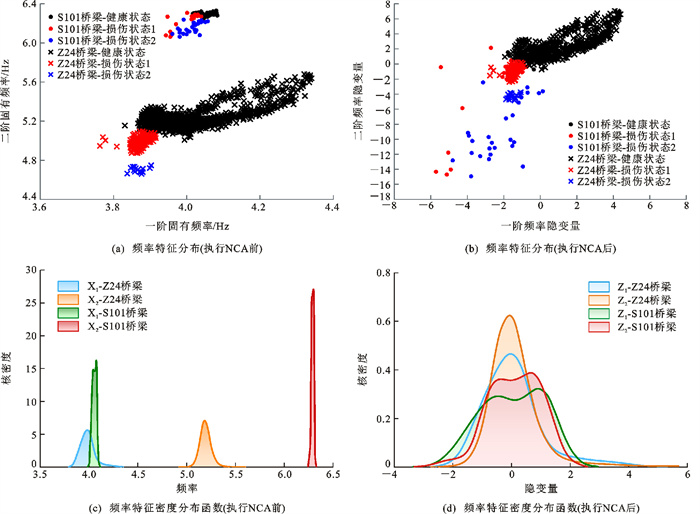
模态阶次 模态振型类型 固有频率/Hz 交叉模态保证率 Z24桥梁 S101桥梁 1 对称弯曲模态 3.851 4.042 0.98 2 横向/扭转模态 4.911 6.280 0.85 3 非对称弯曲模态 9.772 9.713 0.58
下载: 导出CSV
表 4 隐式迁移下同质种群问题及其解决方案
Table 4. Homogeneous population problems under implicit transfer and related solutions
问题场景 对象 知识迁移策略 基于通用模型的结构行为预测 试验铝板结构 Meta-learning[88-89] 结构动力学方程 Meta-learning[87] 钢混桥梁结构、桥墩 TL-GPRSM[90] 壳单元结构 TL-VFSM[91] 数据增强的损伤分类模型泛化 试验桁架桥梁、实际桁架桥梁 预训练微调[79] 机械滚动轴承 DG[84] 数值桁架桥、试验桁架模型 CNN[86] 不同运营条件下特征对齐与归一化/损伤分类 机械滚动轴承数据集 DCTLN[13] 3种不同的机械结构数据集 JDA、MIDA、CDA[15] 机械滚动轴承数据集 BARTL[62] MBDA-SAE[80] 预训练微调[81] SAE-DTL[82] DACNN[85] WDCNN、Adaptive BN[92] 多层多核最大均值差异、DANN[93] 对称协同训练框架[94]
下载: 导出CSV
表 5 隐式迁移下异质种群问题及其解决方案
Table 5. Heterogeneous population problems and related solutions under implicit transfer
问题场景 对象 知识迁移手段 不同结构下跨域损伤分类 多层建筑框架结构 PhyMDAN[96] 2座不同的实际桥梁、数值桥梁模型 SADTLN[95] 2座不同的实际桥梁、数值桥梁模型 MDADTL[98] 2座不同的实际桥梁、数值桥梁模型 MSADTL[99] 数值简支梁模型、试验悬臂梁结构 RADA[102] 基于模型更新的结构损伤检测 多层框架结构、实际桥梁结构 TDNN[97] 数值简支梁、试验简支梁 DAN[100] 数值框架结构、框架试验模型 ARTL、MBU[104] 不同结构/状态下跨域数据生成 数值桁架桥梁结构 DGCG[48] 钢框架结构、数值桥梁模型 1-D WDCGAN-GP[83] 数值简支T梁结构 DGCG[103] 钢框架结构 CycleWDCGAN-GP[105] 钢框架结构 Improved-CycleWDCGAN-GP[106]
下载: 导出CSV
表 6 桥梁健康监测公开数据集
Table 6. Public datasets for bridge health monitoring
桥梁结构类型 数据地址链接 KW51 Bridge-钢桁架桥[129] https://zenodo.org/record/3745914 Z24 Bridge-预应力混凝土箱梁[130] https://bwk.kuleuven.be/bwm/z24 Vänersborg Bridge-钢桁架桥[131] https://zenodo.org/records/8300495 Bergsøysund Bridge-钢桁连续浮桥[132] https://zenodo.org/records/8051201 Gjemnessund Bridge-悬索桥[133] https://zenodo.org/records/5979695 Hell Bridge-钢桁架桥[134] https://zenodo.org/records/10507957 Dowling Hall Footbridge-钢桁人行天桥[135] https://engineering.tufts.edu/cee/shm/research/continuous-monitoring-dowling-hall-footbridge 矩形薄板结构-试验模型[136] https://github.com/Smart-Objects/Impact-Events-Dataset
下载: 导出CSV
-
[1] AN Y H, CHATZI E, SIM S H, et al. Recent progress and future trends on damage identification methods for bridge structures[J]. Structural Control and Health Monitoring, 2019, 26(10): e2416. [2] FIGUEIREDO E, BROWNJOHN J. Three decades of stati-stical pattern recognition paradigm for SHM of bridges[J]. Structural Health Monitoring, 2022, 21(6): 3018-3054. doi: 10.1177/14759217221075241 [3] SONY S, DUNPHY K, SADHU A, et al. A systematic review of convolutional neural network-based structural condition assessment techniques[J]. Engineering Structures, 2021, 226: 111347. doi: 10.1016/j.engstruct.2020.111347 [4] AZIMI M, ESLAMLOU A D, PEKCAN G. Data-driven struc-tural health monitoring and damage detection through deep learning: State-of-the-art review[J]. Sensors, 2020, 20(10): 2778. doi: 10.3390/s20102778 [5] FLAH M, NUNEZ I, BEN CHAABENE W, et al. Machine learning algorithms in civil structural health monitoring: A systematic review[J]. Archives of Computational Methods in Engineering, 2021, 28(4): 2621-2643. doi: 10.1007/s11831-020-09471-9 [6] MORAVVEJ M, EL-BADRY M. Reference-free vibration-based damage identification techniques for bridge structural health monitoring: A critical review and perspective[J]. Sensors, 2024, 24(3): 876. doi: 10.3390/s24030876 [7] SUN L M, SHANG Z Q, XIA Y, et al. Review of bridge structural health monitoring aided by big data and artificial intelligence: From condition assessment to damage detection[J]. Journal of Structural Engineering, 2020, 146(5): 04020073. doi: 10.1061/(ASCE)ST.1943-541X.0002535 [8] ZHANG Y, YUEN K V. Review of artificial intelligence-ba-sed bridge damage detection[J]. Advances in Mechanical Engineering, 2022, 14(9): 16878132221122770. doi: 10.1177/16878132221122770 [9] PAN S J, YANG Q. A survey on transfer learning[J]. IEEE Transactions on Knowledge and Data Engineering, 2009, 22(10): 1345-1359. [10] ZHUANG F Z, QI Z Y, DUAN K Y, et al. A comprehen-sive survey on transfer learning[J]. Proceedings of the IEEE, 2020, 109(1): 43-76. [11] WANG J D, LAN C L, LIU C, et al. Generalizing to unseen domains: A survey on domain generalization[J]. IEEE Tran-sactions on Knowledge and Data Engineering, 2023, 35(8): 8052-8072. [12] ZHU Y C, ZHUANG F Z, WANG J D, et al. Deep subdo-main adaptation network for image classification[J]. IEEE Transactions on Neural Networks and Learning Systems, 2021, 32(4): 1713-1722. doi: 10.1109/TNNLS.2020.2988928 [13] GUO L, LEI Y G, XING S B, et al. Deep convolutional transfer learning network: A new method for intelligent fault diagnosis of machines with unlabeled data[J]. IEEE Tran-sactions on Industrial Electronics, 2019, 66(9): 7316-7325. doi: 10.1109/TIE.2018.2877090 [14] GARDNER P, LIU X, WORDEN K. On the application of domain adaptation in structural health monitoring[J]. Mecha-nical Systems and Signal Processing, 2020, 138: 106550. doi: 10.1016/j.ymssp.2019.106550 [15] HAN T, LIU C, YANG W G, et al. Deep transfer network with joint distribution adaptation: A new intelligent fault diagnosis framework for industry application[J]. ISA Tran-sactions, 2020, 97: 269-281. doi: 10.1016/j.isatra.2019.08.012 [16] VAMVOUDAKIS-STEFANOU K, SAKELLARIOU J, FASSOIS S. On the use of unsupervised response-only vibration-based damage detection methods for a population of composite structures[C]//EWSHM. Proceedings of the 8th European Workshop on Structural Health Monitoring. Berlin: EWSHM, 2016: 2822-2831. [17] VAMVOUDAKIS-STEFANOU K J, FASSOIS S D. Vibra-tion-based damage detection for a population of nominally identical structures via Random Coefficient Gaussian Mixture AR model based methodology[J]. Procedia Engineering, 2017, 199: 1888-1893. doi: 10.1016/j.proeng.2017.09.123 [18] VAMVOUDAKIS-STEFANOU K J, SAKELLARIOU J S, FASSOIS S D. Vibration-based damage detection for a popu-lation of nominally identical structures: Unsupervised multiple model(MM) statistical time series type methods[J]. Mechanical Systems and Signal Processing, 2018, 111: 149-171. doi: 10.1016/j.ymssp.2018.03.054 [19] BULL L A, GARDNER P A, GOSLIGA J, et al. Founda-tions of population-based SHM, part I: Homogeneous popu-lations and forms[J]. Mechanical Systems and Signal Processing, 2021, 148: 107141. doi: 10.1016/j.ymssp.2020.107141 [20] GOSLIGA J, GARDNER P A, BULL L A, et al. Founda-tions of population-based SHM, part Ⅱ: Heterogeneous populations-graphs, networks, and communities[J]. Mechanical Systems and Signal Processing, 2021, 148: 107144. doi: 10.1016/j.ymssp.2020.107144 [21] GARDNER P, BULL L A, GOSLIGA J, et al. Foundations of population-based SHM, part Ⅲ: Heterogeneous popula-tions-mapping and transfer[J]. Mechanical Systems and Signal Processing, 2021, 149: 107142. doi: 10.1016/j.ymssp.2020.107142 [22] WORDEN K, BULL L A, GARDNER P, et al. A brief intro-duction to recent developments in population-based structural health monitoring[J]. Frontiers in Built Environment, 2020, 6: 146. doi: 10.3389/fbuil.2020.00146 [23] GUO Y, ZHANG J D, SUN B, et al. Adversarial deep transfer learning in fault diagnosis: Progress, challenges, and future prospects[J]. Sensors, 2023, 23(16): 7263. doi: 10.3390/s23167263 [24] GARDNER P, BULL L A, GOSLIGA J, et al. A popula-tion-based SHM methodology for heterogeneous structures: Transferring damage localisation knowledge between different aircraft wings[J]. Mechanical Systems and Signal Processing, 2022, 172: 108918. doi: 10.1016/j.ymssp.2022.108918 [25] TSIALIAMANIS G, MYLONAS C, CHATZI E, et al. Foun-dations of population-based SHM, part Ⅳ: The geometry of spaces of structures and their feature spaces[J]. Mechanical Systems and Signal Processing, 2021, 157: 107692. doi: 10.1016/j.ymssp.2021.107692 [26] BULL L A, GARDNER P A, GOSLIGA J, et al. Towards population-based structural health monitoring, part Ⅰ: Homogeneous populations and forms[M]. Berlin: Springer, 2021. [27] GARDNER P, BULL L A, GOSLIGA J, et al. Towards popu-lation-based structural health monitoring, part Ⅳ: Hetero-geneous populations, transfer and mapping[M]. Berlin: Springer, 2021. [28] YAO S Y, KANG Q, ZHOU M C, et al. A survey of transfer learning for machinery diagnostics and prognostics[J]. Arti-ficial Intelligence Review, 2023, 56(4): 2871-2922. doi: 10.1007/s10462-022-10230-4 [29] WICKRAMARACHCHI C T, POOLE J, CROSS E J, et al. On aspects of geometry in SHM and population-based SHM[M]. Berlin: Springer, 2022. [30] WANG Z R, DAI Z H, PÓCZOS B, et al. Characterizing and avoiding negative transfer[C]//IEEE. 2019 IEEE/CVF Conference on Computer Vision and Pattern Recognition(CVPR). New York: IEEE, 2019: 11285-11294. [31] HUGHES A J, POOLE J, DERVILIS N, et al. A decision framework for selecting information-transfer strategies in population-based SHM[J/OL]. arXiv, 2023, https://doi.org/10.48550/arXiv.2307.06978 .[32] BUNCE A, HESTER D, WORDEN K, et al. PBSHM-gui-dance for ensuring quality when creating an IE model for a bridge[C]//CUNHA Á, CAETANO E. Proceedings of the 10th International Conference on Structural Health Moni-toring of Intelligent Infrastructure. Porto: ISHMⅡ, 2021: 1789-1795. [33] GOSLIGA J, GARDNER P, BULL L A, et al. Towards popu-lation-based structural health monitoring, part Ⅱ: Hetero-geneous populations and structures as graphs[M]. Berlin: Springer, 2021. [34] GOSLIGA J, GARDNER P, BULL L A, et al. Towards popu-lation-based structural health monitoring, part Ⅲ: Graphs, networks and communities[M]. Berlin: Springer, 2021. [35] DELO G, BUNCE A, CROSS E J, et al. When is a bridge not an aeroplane? Part Ⅱ: A population of real structures[C]//Springer. European Workshop on Structural Health Moni-toring. Berlin: Springer, 2022: 965-974. [36] BRENNAN D S, GOSLIGA J, GARDNER P, et al. On the application of population-based structural health monitoring in aerospace engineering[J]. Frontiers in Robotics and AI, 2022, 9: 840058. doi: 10.3389/frobt.2022.840058 [37] GOSLIGA J, HESTER D, WORDEN K, et al. On popula-tion-based structural health monitoring for bridges[J]. Mechanical Systems and Signal Processing, 2022, 173: 108919. doi: 10.1016/j.ymssp.2022.108919 [38] POOLE J, GARDNER P, HUGHES A J, et al. Physics-informed transfer learning in PBSHM: A case study on experimental helicopter blades[C]//FARHANGDOUST S, GUEMES A, CHANG F K. Proceedings of the 14th Inter-national Workshop on Structural Health Monitoring. Lanca-ster: DEStech Publications, Inc., 2023: 236-267. [39] POOLE J, GARDNER P, DERVILIS N, et al. Towards physics-based metrics for transfer learning in dynamics[C]//MADARSHAHIAN R, HEMEZ F. Conference Proceedings of the Society for Experimental Mechanics Series. Berlin: Springer, 2023: 73-82. [40] GIGLIONI V, POOLE J, VENANZI I, et al. A domain adapta-tion approach to damage classification with an application to bridge monitoring[J]. Mechanical Systems and Signal Proce-ssing, 2024, 209: 111135. doi: 10.1016/j.ymssp.2024.111135 [41] WICKRAMARACHCHI C T, LEAHY W, WORDEN K, et al. On metrics assessing the information content of datasets for population-based structural health monitoring[C]//RIZZO P, MILAZZO A. European Workshop on Structural Health Monitoring. Berlin: Springer, 2021: 494-504. [42] WICKRAMARACHCHI C T, MAGUIRE E, CROSS E J, et al. Measuring data similarity in population-based struc-tural health monitoring using distance metrics[J]. Structural Health Monitoring, 2024, 23(4): 2609-2635. doi: 10.1177/14759217231207526 [43] BRENNAN D S, ROGERS T J, CROSS E J, et al. Calcu-lating structure similarity via a graph neural network in population-based structural health monitoring: Part Ⅱ[C]//NOH H Y, WHELAN M, HARVEY P S. Proceedings of the 41st IMAC, A Conference and Exposition on Structural Dynamics 2023. Berlin: Springer, 2023: 151-158. [44] TSIALIAMANIS G, MYLONAS C, CHATZI E N, et al. On an application of graph neural networks in population-based SHM[C]//MADARSHAHIAN R, HEMEZ F. Proceedings of the 39th IMAC, A Conference and Exposition on Structural Dynamics 2021. Berlin: Springer, 2021: 47-63. [45] DELO G, SURACE C, WORDEN K, et al. On the influence of structural attributes for assessing similarity in popula-tion-based structural health monitoring[C]//FARHANGDOUST S, GUEMES A, CHANG F K. Proceedings of the 14th International Workshop on Structural Health Monitoring. Lancaster: DEStech Publications, Inc., 2023: 1553-1562. [46] OZDAGLI A, KOUTSOUKOS X. Domain adaptation for structural fault detection under model uncertainty[J]. International Journal of Prognostics and Health Management, 2021, 12(2): 29-48. [47] BULL L, ROGERS T, DERVILIS N, et al. A Gaussian process form for population-based structural health monitoring[C]//WAHAB M A. Proceedings of the 13th International Confe-rence on Damage Assessment of Structures. Berlin: Spring-er, 2019: 47-63. [48] LULECI F, CATBAS F N. Structural state translation: Condition transfer between civil structures using domain-generalization for structural health monitoring[J/OL]. arXiv, 2022, http://arxiv.org/abs/2212.14048 .[49] DARDENO T A, BULL L A, DERVILIS N, et al. A gene-ralised form for a homogeneous population of structures using an overlapping mixture of Gaussian processes[J/OL]. arXiv, 2022, http://arxiv.org/abs/2206.11683 .[50] DARDENO T A, BULL L A, MILLS R S, et al. Modelling variability in vibration-based PBSHM via a generalised population form[J]. Journal of Sound and Vibration, 2022, 538: 117227. doi: 10.1016/j.jsv.2022.117227 [51] DA SILVA S, FIGUEIREDO E, MOLDOVAN I. Damage detection approach for bridges under temperature effects using Gaussian process regression trained with hybrid data[J]. Journal of Bridge Engineering, 2022, 27(11): 04022107. doi: 10.1061/(ASCE)BE.1943-5592.0001949 [52] BUCKLEY T, PAKRASHI V, GHOSH B. A dynamic har-monic regression approach for bridge structural health moni-toring[J]. Structural Health Monitoring, 2021, 20(6): 3150-3181. doi: 10.1177/1475921720981735 [53] LIN W J, WORDEN K, MAGUIRE A E, et al. A mapping method for anomaly detection in a localized population of structures[J]. Data-centric Engineering, 2022, 3: e25. doi: 10.1017/dce.2022.25 [54] LIN W, WORDEN K, EOGHAN MAGUIRE A, et al. Towards population-based structural health monitoring, Part Ⅶ: EOV Fields-Environmental Mapping[C]//DILWORTH B, MAINS M. Proceedings of the 38th IMAC, A Conference and Exposition on Structural Dynamics 2020. Berlin: Springer, 2021: 297-304. [55] BULL L A, DI FRANCESCO D, DHADA M, et al. Hierar-chical Bayesian modeling for knowledge transfer across engineering fleets via multitask learning[J]. Computer-aided Civil and Infrastructure Engineering, 2023, 38(7): 821-848. doi: 10.1111/mice.12901 [56] DA SILVA S, YANO M O, GONSALEZ-BUENO C G. Transfer component analysis for compensation of temperature effects on the impedance-based structural health monitoring[J]. Journal of Nondestructive Evaluation, 2021, 40(3): 64. doi: 10.1007/s10921-021-00794-6 [57] GARDNER P, BULL L A, DERVILIS N, et al. Overcom-ing the problem of repair in structural health monitoring: Metric-informed transfer learning[J]. Journal of Sound and Vibration, 2021, 510: 116245. doi: 10.1016/j.jsv.2021.116245 [58] LIN Q G, CI T Y, WANG L B, et al. Transfer learning for improving seismic building damage assessment[J]. Remote Sensing, 2022, 14(1): 201. doi: 10.3390/rs14010201 [59] PAN Q Y, BAO Y Q, LI H. Transfer learning-based data anomaly detection for structural health monitoring[J]. Struc-tural Health Monitoring, 2023, 22(5): 3077-3091. doi: 10.1177/14759217221142174 [60] RITTO T G, WORDEN K, WAGG D J, et al. A transfer learning-based digital twin for detecting localised torsional friction in deviated wells[J]. Mechanical Systems and Signal Processing, 2022, 173: 109000. doi: 10.1016/j.ymssp.2022.109000 [61] ZHOU X, SBARUFATTI C, GIGLIO M, et al. A fuzzy-set-based joint distribution adaptation method for regression and its application to online damage quantification for structural digital twin[J]. Mechanical Systems and Signal Processing, 2023, 191: 110164. doi: 10.1016/j.ymssp.2023.110164 [62] HU Q, SI X S, QIN A S, et al. Balanced adaptation regu-larization based transfer learning for unsupervised cross-domain fault diagnosis[J]. IEEE Sensors Journal, 2022, 22(12): 12139-12151. doi: 10.1109/JSEN.2022.3174396 [63] ZHANG Z W, CHEN H H, LI S M, et al. A novel geodesic flow kernel based domain adaptation approach for intelligent fault diagnosis under varying working condition[J]. Neuro-computing, 2020, 376: 54-64. [64] POOLE J, GARDNER P, DERVILIS N, et al. On statistic alignment for domain adaptation in structural health moni-toring[J]. Structural Health Monitoring, 2023, 22(3): 1581-1600. doi: 10.1177/14759217221110441 [65] OMORI YANO M, FIGUEIREDO E, DA SILVA S, et al. Foundations and applicability of transfer learning for structural health monitoring of bridges[J]. Mechanical Sys-tems and Signal Processing, 2023, 204: 110766. doi: 10.1016/j.ymssp.2023.110766 [66] FIGUEIREDO E, OMORI YANO M, DA SILVA S, et al. Transfer learning to enhance the damage detection perfor-mance in bridges when using numerical models[J]. Journal of Bridge Engineering, 2023, 28: 04022134. doi: 10.1061/(ASCE)BE.1943-5592.0001979 [67] ARDANI S, EFTEKHAR AZAM S, LINZELL D G. Bridge health monitoring using proper orthogonal decomposition and transfer learning[J]. Applied Sciences, 2023, 13(3): 1935. doi: 10.3390/app13031935 [68] GARDNER P, BULL L A, DERVILIS N, et al. Domain-adapted Gaussian mixture models for population-based structural health monitoring[J]. Journal of Civil Structural Health Monitoring, 2022, 12(6): 1343-1353. doi: 10.1007/s13349-022-00565-5 [69] BULL L A, GARDNER P A, DERVILIS N, et al. Trans-ferring damage detectors between tailplane experiments[C]//MADARSHAHIAN R, HEMEZ F. Conference Proceedings of the Society for Experimental Mechanics Series. Berlin: Springer, 2021: 199-211. [70] GARDNER P A, BULL L A, DERVILIS N, et al. On the application of heterogeneous transfer learning to population-based structural health monitoring[C]//MADARSHAHIAN R, HEMEZ F. Proceedings of the 39th IMAC, A Conference and Exposition on Structural Dynamics 2021. Berlin: Springer, 2021: 87-98. [71] GARDNER P, BULL L A, DERVILIS N, et al. On the application of kernelised Bayesian transfer learning to popu-lation-based structural health monitoring[J]. Mechanical Sys-tems and Signal Processing, 2022, 167: 108519. doi: 10.1016/j.ymssp.2021.108519 [72] WICKRAMARACHCHI C T, GARDNER P, POOLE J, et al. Damage localisation using disparate damage states via domain adaptation[J]. Data-centric Engineering, 2024, 5: e3. doi: 10.1017/dce.2023.29 [73] BULL L A, GARDNER P A, DERVILIS N, et al. On the transfer of damage detectors between structures: An expe-rimental case study[J]. Journal of Sound and Vibration, 2021, 501: 116072. doi: 10.1016/j.jsv.2021.116072 [74] BULL L A, GARDNER P, DERVILIS N, et al. Automated Feature Extraction for Damage Detection: A Pseudo-fault Framework for Population-based SHM[C]//CUNHA A, CAETANO E. Proceedings of the 10th International Conference on Structural Health Monitoring of Intelligent Infrastructure(SHMⅡ-10). Belfast: Queen's University Belfast, 2021: 655-662. [75] OMORI YANO M, DA SILVA S, FIGUEIREDO E, et al. Damage quantification using transfer component analysis com-bined with Gaussian process regression[J]. Structural Health Monitoring, 2023, 22(2): 1290-1307. doi: 10.1177/14759217221094500 [76] GIGLIONI V, POOLE J, VENANZI I, et al. On the use of domain adaptation techniques for bridge damage detection in a changing environment[J]. CE/Papers, 2023, 6(5): 975-980. doi: 10.1002/cepa.2143 [77] LI W H, HUANG R Y, LI J P, et al. A perspective survey on deep transfer learning for fault diagnosis in industrial scenarios: Theories, applications and challenges[J]. Mecha-nical Systems and Signal Processing, 2022, 167: 108487. doi: 10.1016/j.ymssp.2021.108487 [78] YU F C, XIU X C, LI Y H. A survey on deep transfer learning and beyond[J]. Mathematics, 2022, 10(19): 3619. doi: 10.3390/math10193619 [79] TENG S, CHEN X D, CHEN G F, et al. Structural damage detection based on transfer learning strategy using digital twins of bridges[J]. Mechanical Systems and Signal Processing, 2023, 191: 110160. doi: 10.1016/j.ymssp.2023.110160 [80] CAO N, JIANG Z N, GAO J J, et al. Bearing state recog-nition method based on transfer learning under different working conditions[J]. Sensors, 2020, 20(1): 234. doi: 10.1109/JSEN.2019.2942639 [81] ZHANG R, TAO H Y, WU L F, et al. Transfer learning with neural networks for bearing fault diagnosis in changing working conditions[J]. IEEE Access, 2017, 5: 14347-14357. doi: 10.1109/ACCESS.2017.2720965 [82] WEN L, GAO L, LI X Y. A new deep transfer learning based on sparse auto-encoder for fault diagnosis[J]. IEEE Transactions on Systems, Man, and Cybernetics: Systems, 2019, 49(1): 136-144. doi: 10.1109/TSMC.2017.2754287 [83] LULECI F, CATBAS F N, AVCI O. Generative adversarial networks for labeled acceleration data augmentation for structural damage detection[J]. Journal of Civil Structural Health Monitoring, 2023, 13(1): 181-198. doi: 10.1007/s13349-022-00627-8 [84] LI X, ZHANG W, MA H, et al. Domain generalization in rotating machinery fault diagnostics using deep neural networks[J]. Neurocomputing, 2020, 403: 409-420. doi: 10.1016/j.neucom.2020.05.014 [85] ZHANG B, LI W, LI X L, et al. Intelligent fault diagnosis under varying working conditions based on domain adaptive convolutional neural networks[J]. IEEE Access, 2018, 6: 66367-66384. doi: 10.1109/ACCESS.2018.2878491 [86] TENG S, CHEN X D, CHEN G F, et al. Structural damage detection based on convolutional neural networks and population of bridges[J]. Measurement, 2022, 202: 111747. doi: 10.1016/j.measurement.2022.111747 [87] CHENG M H, DANG C, FRANGOPOL D M, et al. Trans-fer prior knowledge from surrogate modelling: A meta-learn-ing approach[J]. Computers & Structures, 2022, 260: 106719. [88] TSIALIAMANIS G, DERVILIS N, WAGG D J, et al. A Meta-learning approach to population-based modelling of structures[J/OL]. arXiv, 2023, http://arxiv.org/abs/2302.07980 .[89] TSIALIAMANIS G, SBARUFATTI C, DERVILIS N, et al. On a meta-learning population-based approach to damage prognosis[J]. Mechanical Systems and Signal Processing, 2024, 209: 111119. doi: 10.1016/j.ymssp.2024.111119 [90] SAIDA T, NISHIO M. Transfer learning Gaussian process regression surrogate model with explainability for structural reliability analysis under variation in uncertainties[J]. Com-puters & Structures, 2023, 281: 107014. [91] ZHANG W, PENG G L, LI C H, et al. A new deep learning model for fault diagnosis with good anti-noise and domain adaptation ability on raw vibration signals[J]. Sensors, 2017, 17(2): 425. doi: 10.3390/s17020425 [92] TIAN K, LI Z C, ZHANG J X, et al. Transfer learning based variable-fidelity surrogate model for shell buckling prediction[J]. Composite Structures, 2021, 273: 114285. doi: 10.1016/j.compstruct.2021.114285 [93] LI X, ZHANG W, DING Q, et al. Multi-layer domain adaptation method for rolling bearing fault diagnosis[J]. Signal Processing, 2019, 157: 180-197. doi: 10.1016/j.sigpro.2018.12.005 [94] YU K, HAN H Z, FU Q, et al. Symmetric co-training based unsupervised domain adaptation approach for intelligent fault diagnosis of rolling bearing[J]. Measurement Science and Technology, 2020, 31(11): 115008. doi: 10.1088/1361-6501/ab9841 [95] XIAO H T, DONG L M, WANG W J, et al. Distribution sub-domain adaptation deep transfer learning method for bridge structure damage diagnosis using unlabeled data[J]. IEEE Sensors Journal, 2022, 22(15): 15258-15272. doi: 10.1109/JSEN.2022.3186885 [96] XU S S, NOH H Y. PhyMDAN: Physics-informed knowledge transfer between buildings for seismic damage diagnosis through adversarial learning[J]. Mechanical Systems and Sig-nal Processing, 2021, 151: 107374. doi: 10.1016/j.ymssp.2020.107374 [97] TRONCI E M, BEIGI H, BETTI R, et al. A damage assess-ment methodology for structural systems using transfer learning from the audio domain[J]. Mechanical Systems and Signal Processing, 2023, 195: 110286. doi: 10.1016/j.ymssp.2023.110286 [98] XIAO H T, OGAI H, WANG W J. Multi-channel domain adaptation deep transfer learning for bridge structure damage diagnosis[J]. IEEE Transactions on Electrical and Electronic Engineering, 2022, 17(11): 1637-1647. doi: 10.1002/tee.23671 [99] XIAO H T, OGAI H, WANG W J. A new deep transfer learning method for intelligent bridge damage diagnosis based on Muti-channel sub-domain adaptation[J]. Structure and Infrastructure Engineering, 2024, 20(12): 1994-2009. doi: 10.1080/15732479.2023.2167214 [100] LIN Y Z, NIE Z H, MA H W. Dynamics-based cross-domain structural damage detection through deep transfer learning[J]. Computer-aided Civil and Infrastructure Engineering, 2022, 37(1): 24-54. doi: 10.1111/mice.12692 [101] LULECI F, CATBAS F N, AVCI O. A literature review: Generative adversarial networks for civil structural health monitoring[J]. Frontiers in Built Environment, 2022, 8: 1027379. doi: 10.3389/fbuil.2022.1027379 [102] WANG X Y, XIA Y. Knowledge transfer for structural dam-age detection through re-weighted adversarial domain adap-tation[J]. Mechanical Systems and Signal Processing, 2022, 172: 108991. doi: 10.1016/j.ymssp.2022.108991 [103] LULECI F, NECATI CATBAS F. Condition transfer between prestressed bridges using structural state translation for structural health monitoring[J]. AI in Civil Engineering, 2023, 2(1): 7. doi: 10.1007/s43503-023-00016-0 [104] ZHANG Z M, SUN C, GUO B B. Transfer-learning guided Bayesian model updating for damage identification considering modeling uncertainty[J]. Mechanical Systems and Signal Pro-cessing, 2022, 166: 108426. doi: 10.1016/j.ymssp.2021.108426 [105] LULECI F, CATBAS F N, AVCI O. CycleGAN for Unda-maged-to-damaged Domain Translation for Structural Health Monitoring and Damage Detection[J/OL]. arXiv, 2022, http://arxiv.org/abs/2202.07831 .[106] LULECI F, AVCI O, CATBAS F N. Improved undamaged-to-damaged acceleration response translation for Structural Health Monitoring[J]. Engineering Applications of Artificial Intelligence, 2023, 122: 106146. doi: 10.1016/j.engappai.2023.106146 [107] REULAND Y, GARCIA-RAMONDA L, MARTAKIS P, et al. A full-scale case study of vibration-based structural health monitoring of bridges: Prospects and open challenges[J]. CE/Papers, 2023, 6(5): 329-336. doi: 10.1002/cepa.2001 [108] BROWNJOHN J M W, KRIPAKARAN P, HARVEY B, et al. Structural health monitoring of short to medium span bridges in the United Kingdom[J]. Structural Monitoring and Maintenance, 2016, 3(3): 259-276. doi: 10.12989/smm.2016.3.3.259 [109] MIYAMOTO A, KIVILUOMA R, YABE A. Frontier of continuous structural health monitoring system for short & medium span bridges and condition assessment[J]. Frontiers of Structural and Civil Engineering, 2019, 13(3): 569-604. doi: 10.1007/s11709-018-0498-y [110] ENTEZAMI A, SARMADI H, BEHKAMAL B, et al. Big data analytics and structural health monitoring: A statistical pattern recognition-based approach[J]. Sensors, 2020, 20(8): 2328. doi: 10.3390/s20082328 [111] WU R T, JAHANSHAHI M R. Data fusion approaches for structural health monitoring and system identification: Past, present, and future[J]. Structural Health Monitoring, 2020, 19(2): 552-586. doi: 10.1177/1475921718798769 [112] BUCKLEY T, GHOSH B, PAKRASHI V. A feature extrac-tion & selection benchmark for structural health monitoring[J]. Structural Health Monitoring, 2023, 22(3): 2082-2127. doi: 10.1177/14759217221111141 [113] AVCI O, ABDELJABER O, KIRANYAZ S, et al. A review of vibration-based damage detection in civil structures: From traditional methods to machine learning and deep learning applications[J]. Mechanical Systems and Signal Processing, 2021, 147: 107077. doi: 10.1016/j.ymssp.2020.107077 [114] WILSON G, COOK D J. A survey of unsupervised deep do-main adaptation[J]. ACM Transactions on Intelligent Sys-tems and Technology, 2020, 11(5): 1-46. [115] TOH G, PARK J. Review of vibration-based structural heal-th monitoring using deep learning[J]. Applied Sciences, 2020, 10(5): 1680. doi: 10.3390/app10051680 [116] MALEKLOO A, OZER E, ALHAMAYDEH M, et al. Machine learning and structural health monitoring overview with emerging technology and high-dimensional data source high-lights[J]. Structural Health Monitoring, 2022, 21(4): 1906-1955. doi: 10.1177/14759217211036880 [117] BULL L A, ROGERS T J, WICKRAMARACHCHI C, et al. Probabilistic active learning: an online framework for struc-tural health monitoring[J]. Mechanical Systems and Signal Processing, 2019, 134: 106294. doi: 10.1016/j.ymssp.2019.106294 [118] BULL L A, WORDEN K, DERVILIS N. Towards semi-su-pervised and probabilistic classification in structural health monitoring[J]. Mechanical Systems and Signal Processing, 2020, 140: 106653. doi: 10.1016/j.ymssp.2020.106653 [119] DAY O, KHOSHGOFTAAR T M. A survey on heterogeneous transfer learning[J]. Journal of Big Data, 2017, 4(1): 29. doi: 10.1186/s40537-017-0089-0 [120] WANG T Y, HUAN J, ZHU M. Instance-based deep trans-fer learning[C]//IEEE. 2019 IEEE Winter Conference on Applications of Computer Vision(WACV). New York: IEEE, 2019: 367-375. [121] REN H, LIU W Y, SHAN M C, et al. A new wind turbine health condition monitoring method based on VMD-MPE and feature-based transfer learning[J]. Measurement, 2019, 148: 106906. doi: 10.1016/j.measurement.2019.106906 [122] SHAN X X, LU Y, LI Q L, et al. Model-based transfer learning and sparse coding for partial face recognition[J]. IEEE Transactions on Circuits and Systems for Video Technology, 2021, 31(11): 4347-4356. doi: 10.1109/TCSVT.2020.3047140 [123] NIU S T, LIU Y X, WANG J, et al. A decade survey of transfer learning(2010-2020)[J]. IEEE Transactions on Artificial Intelligence, 2020, 1(2): 151-166. doi: 10.1109/TAI.2021.3054609 [124] RIZVI S H M, ABBAS M. From data to insight, enhancing structural health monitoring using physics-informed machine learning and advanced data collection methods[J]. Engi-neering Research Express, 2023, 5(3): 032003. doi: 10.1088/2631-8695/acefae [125] ZHANG M T, GUO T, ZHANG G D, et al. Physics-infor-med deep learning for structuralvibration identification and its application on a benchmark structure[J]. Philosophical Tran-sactions Series A: Mathematical, Physical, and Engineering Sciences, 2024, 382(2264): 20220400. [126] DI LORENZO D, CHAMPANEY V, MARZIN J Y, et al. Physics informed and data-based augmented learning in structural health diagnosis[J]. Computer Methods in Applied Mechanics and Engineering, 2023, 414: 116186. doi: 10.1016/j.cma.2023.116186 [127] ZINNO R, HAGHSHENAS S S, GUIDO G, et al. Artificial intelligence and structural health monitoring of bridges: A review of the state-of-the-art[J]. IEEE Access, 2022, 10: 88058-88078. doi: 10.1109/ACCESS.2022.3199443 [128] WANG X P, ZHAO Q Z, XI R J, et al. Review of bridge structural health monitoring based on GNSS: From displa-cement monitoring to dynamic characteristic identification[J]. IEEE Access, 2021, 9: 80043-80065. doi: 10.1109/ACCESS.2021.3083749 [129] MAES K, LOMBAERT G. Monitoring railway bridge KW51 before, during, and after retrofitting[J]. Journal of Bridge Engineering, 2021, 26(3): 04721001. doi: 10.1061/(ASCE)BE.1943-5592.0001668 [130] REYNDERS E, ROECK G. Continuous vibration monitoring and progressive damage testing on the Z24 bridge[M]. Encyclopedia of Structural Health Monitoring. New York: Wiley, 2008. [131] MENGHINI A, LEANDER J, CASTIGLIONI C A. A local response function approach for the stress investigation of a centenarian steel railway bridge[J]. Engineering Structures, 2023, 286: 116116. doi: 10.1016/j.engstruct.2023.116116 [132] KVÅLE K A, FENERCI A, PETERSEN Ø W, et al. Data set from long-term wave, wind, and response monitoring of the Bergsøysund Bridge[J]. Journal of Structural Engineering, 2023, 149(9): 04723002. doi: 10.1061/JSENDH.STENG-12095 [133] FENERCI A, KVÅLE K A, PETERSEN Ø W, et al. Data set from long-term wind and acceleration monitoring of the hardanger bridge[J]. Journal of Structural Engineering, 2021, 147(5): 04721003. doi: 10.1061/(ASCE)ST.1943-541X.0002997 [134] SVENDSEN B T, FRØSETH G T, ØISETH O, et al. A data-based structural health monitoring approach for damage detection in steel bridges using experimental data[J]. Journal of Civil Structural Health Monitoring, 2022, 12(1): 101-115. doi: 10.1007/s13349-021-00530-8 [135] KODY A, LI X, MOAVENI B. Identification of physically simulated damage on a footbridge based on ambient vibration data[C]//ASCE. Structures Congress 2013. New York: ASCE, 2013: 352-362. [136] KATSIDIMAS I, KOTZAKOLIOS T, NIKOLETSEAS S, et al. Impact events for structural health monitoring of a plastic thin plate: Dataset[C]//ACM. Proceedings of the 20th ACM Conference on Embedded Networked Sensor Sys-tems. New York: ACM, 2022: 1020-1025. -

计量
- 文章访问数: 120
- HTML全文浏览量: 37
- PDF下载量: 23
- 被引次数: 0
