


Dynamic load predictive model for aircraft taxiing excitation and landing impact
-
摘要: 为准确预估飞机对机场跑道的动载作用,本文利用ADAMS/Aircraft建立了7种代表性民用机型的全机足尺虚拟样机模型;开展飞机多态地面运动仿真,包括起飞阶段在不同滑跑速度、跑道平整度条件下的滑跑激振,降落阶段在不同下沉速度、仰角下的着陆冲击;计算得到不同工况下的动载系数,并揭示了多因素的影响规律;通过力学推导和回归分析建立动载系数预估模型,以滑跑激振动载系数的平均值和3倍标准差之和作为上限值,分析了滑跑激振和着陆冲击的最不利情况。研究结果表明:飞机滑跑激振的动载系数服从正态分布,平均值随滑跑速度增大而减小,标准差随平整度和滑跑速度的增大而增大,动载系数平均值和标准差预估模型的拟合精度分别高于0.997和0.948;最不利情况下的飞机敏感速度和最大动载系数随平整度劣化程度加剧而增加,在升力和跑道不平整共同作用下,飞机滑跑时的最大动载大于静载;飞机着陆冲击的动载系数峰值随下沉速度增大而显著增大,随仰角增大而略有减小,着陆冲击动载系数峰值预估模型的拟合精度高于0.971;由于飞机最大着陆质量小于最大起飞质量,飞机正常着陆时的最大冲击动载小于起飞滑跑时的最大动载,但飞机接近限制下沉速度时的最大冲击动载高于滑跑最大动载,分析最不利情况时需同时考虑。本文建立的飞机动载预估模型可为跑道设计分析提供更合理的荷载参数。Abstract: To accurately predict the dynamic load effect of the aircraft on the airport runway, full-scale virtual prototype models of seven representative civil aircraft types were developed using ADAMS/Aircraft. Multi-state ground movement simulations of the aircraft were conducted, including the taxiing excitation under different taxiing speeds and runway roughness conditions during the takeoff stage, and the landing impact under different sink rates and pitch angles during the landing stage. Dynamic load coefficients under different conditions were calculated, and the influence rules of multiple factors were revealed. A predictive model for the dynamic load coefficient was established through mechanical derivation and regression analysis. The sum of the mean value and three times the standard deviation of the dynamic load coefficient of taxiing excitation was taken as the upper limit value, and the most unfavorable conditions of taxiing excitation and landing impact were analyzed. Research results indicate that the dynamic load coefficient of aircraft taxiing excitation follows a normal distribution. The mean value decreases with the increase of taxiing speed, and the standard deviation increases with the increase of runway roughness and taxiing speed. The fitting accuracies of the predictive models for the mean value and standard deviation of the dynamic load coefficient are higher than 0.997 and 0.948, respectively. Under the most unfavorable condition, the sensitive speed and the maximum dynamic load coefficient of the aircraft increase with the aggravation of the deterioration degree of runway roughness. Under the combined action of lift and runway unevenness, the maximum dynamic load during aircraft taxiing is greater than the static load. The peak value of the dynamic load coefficient of aircraft landing impact significantly increases with the increase of sink rate and slightly decreases with the increase of pitch angle. The fitting accuracy of the predictive model for the peak value of the dynamic load coefficient of landing impact is higher than 0.971. Because the maximum landing weight of the aircraft is less than the maximum takeoff weight, the maximum impact dynamic load during normal landing is less than the maximum dynamic load during takeoff taxiing. However, when the aircraft approaches the limit sink rate, the maximum impact dynamic load is higher than the maximum dynamic load of taxiing. Thus, it is necessary to consider them simultaneously when analyzing the most unfavorable condition. The established predictive model for aircraft dynamic loads can provide more reasonable load parameters for runway design and analysis.
-

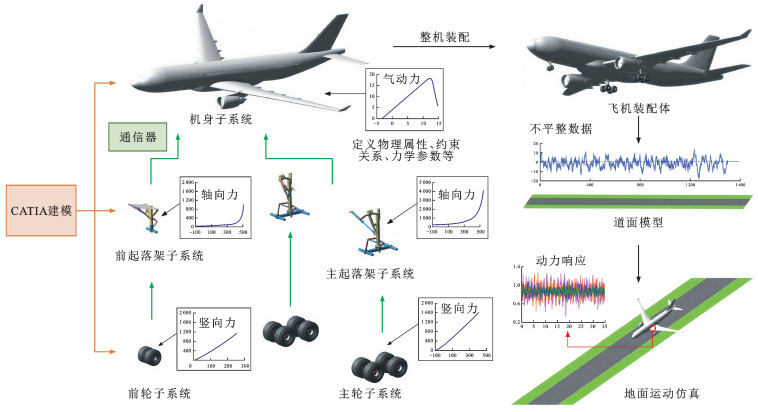
图 1 ADAMS/Aircraft的虚拟样机建模和仿真流程
Figure 1. Virtual prototype modeling and simulation process using ADAMS/Aircraft

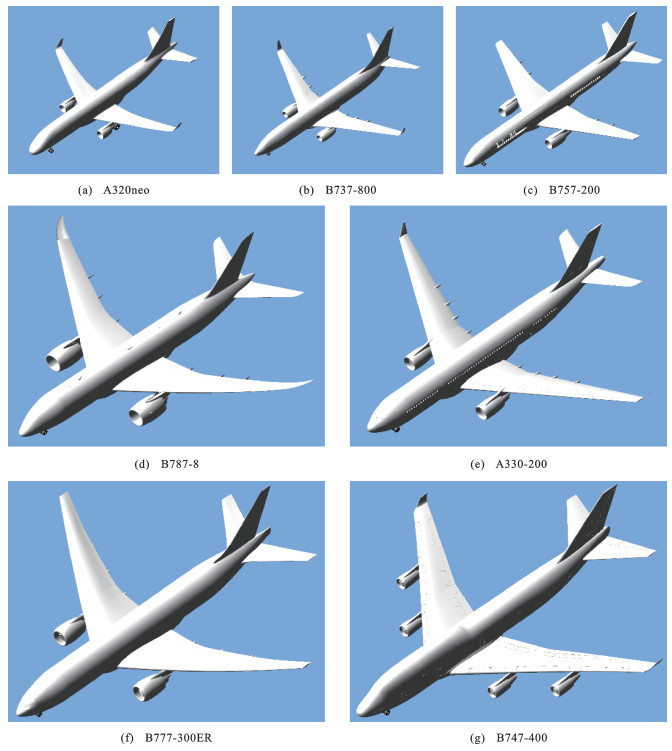
图 2 飞机虚拟样机的三维几何模型
Figure 2. Three-dimensional geometric model of aircraft virtual prototype

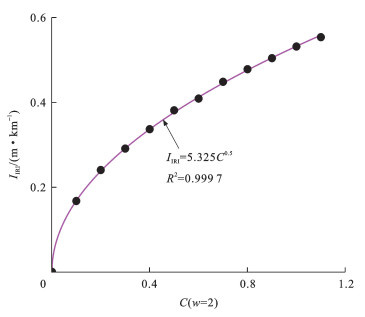
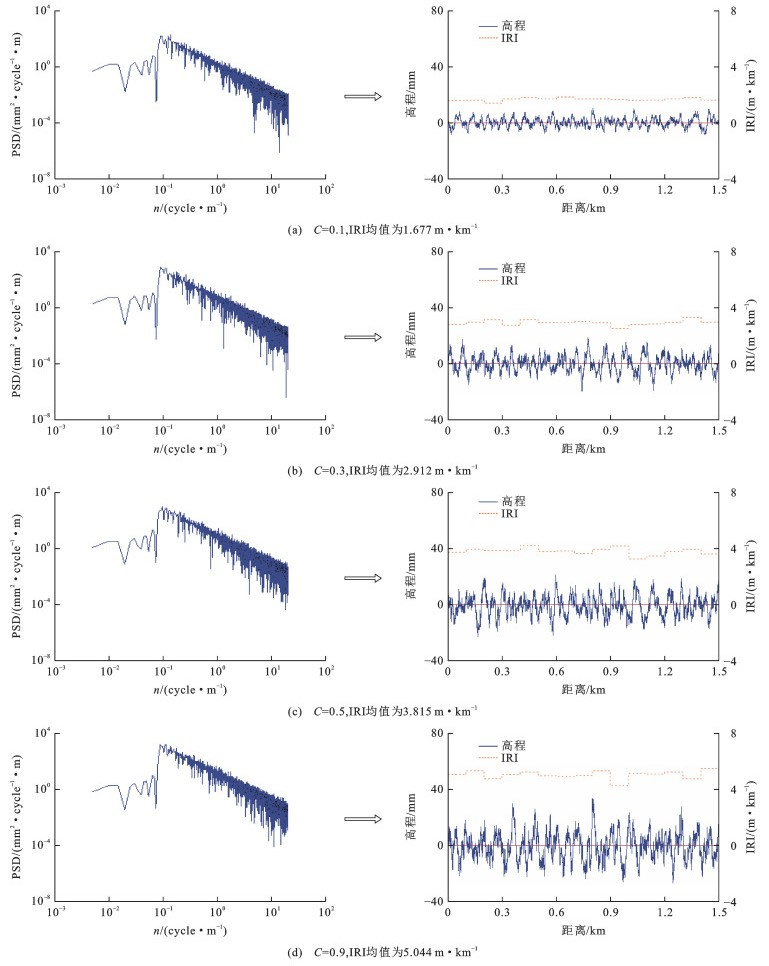
图 7 不同平整度的跑道随机高程、IRI和PSD
Figure 7. Pavement random altitude, IRI, and PSD for different levels of roughness

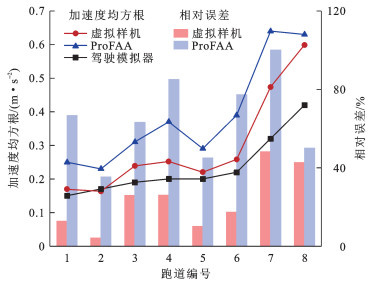
图 8 基于不同仿真技术的B737-800驾驶舱加速度均方根和相对误差
Figure 8. Root mean square acceleration and relative error of B737-800 cockpit based on different simulation techniques

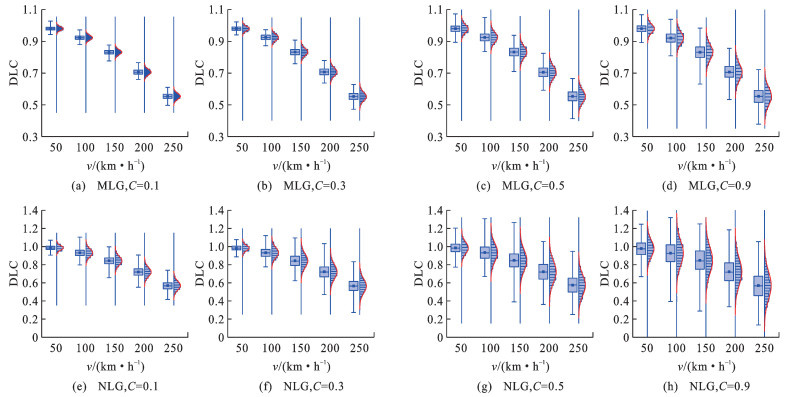
图 9 B737-800滑跑动载系数的统计分布结果
Figure 9. Statistical distribution result of dynamic load coefficient of B737-800 during taxiing

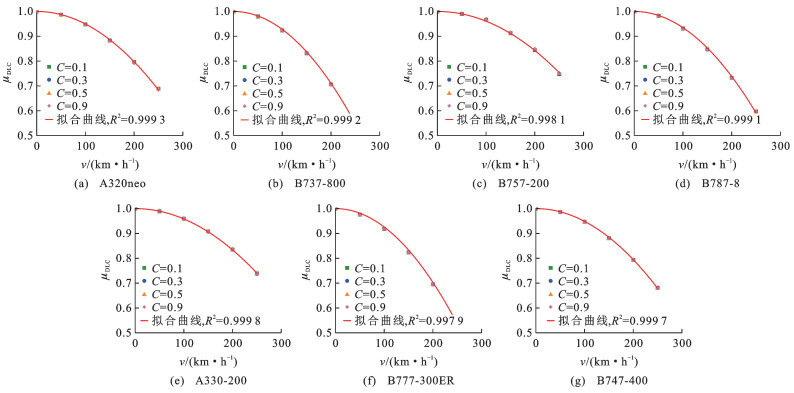
图 10 飞机滑跑动载系数的平均值及拟合曲线
Figure 10. Mean values and its fitting curves of dynamic load coefficient during aircraft taxiing

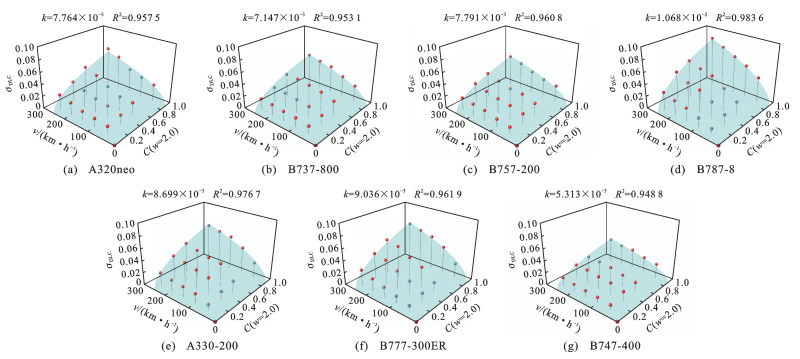
图 11 飞机滑跑动载系数的标准差及拟合曲线
Figure 11. Standard deviations and its fitting curves of dynamic load coefficient during aircraft taxiing

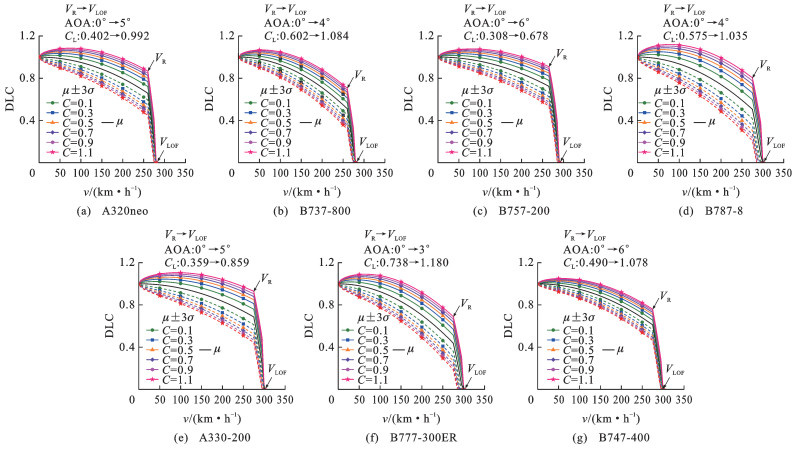
图 12 飞机滑跑起飞过程中的动载系数变化
Figure 12. Variation of dynamic load coefficient during aircraft taxiing and take-off

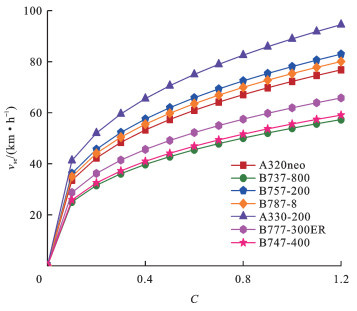
图 13 不同平整度下的飞机滑跑敏感速度
Figure 13. Aircraft taxiing sensitive speed under different pavement roughness level

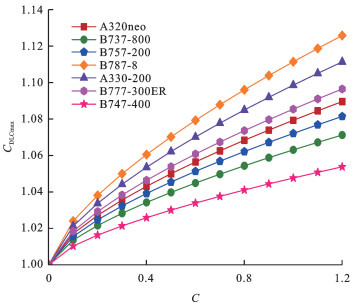
图 14 不同平整度下的飞机滑跑最大动载系数
Figure 14. Maximum dynamic load coefficients during aircraft taxiing under different pavement roughness level

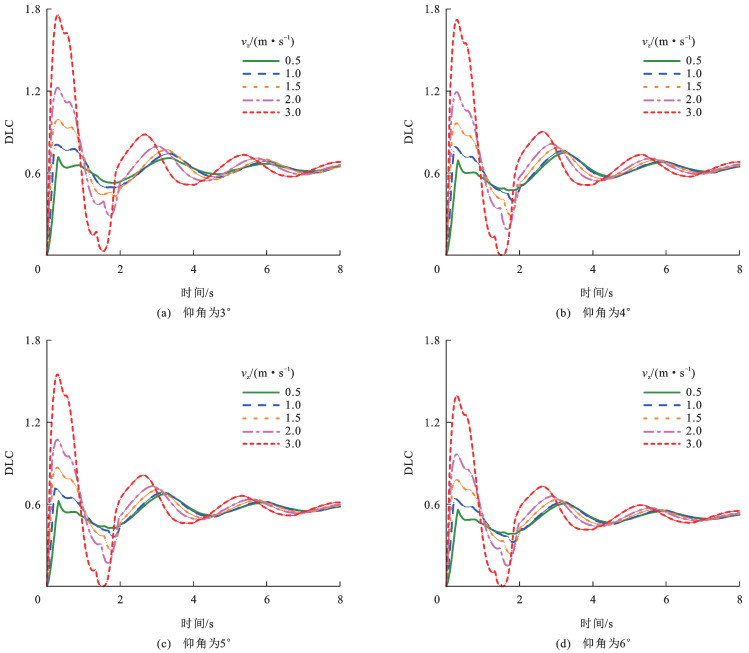
图 15 飞机着陆过程中的动载系数变化
Figure 15. Dynamic load coefficient variation during aircraft landing

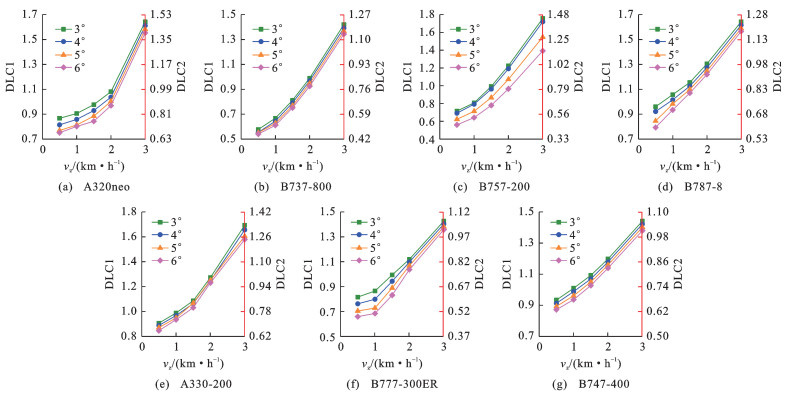
图 16 飞机在不同下沉速度和仰角下着陆的最大动载系数
Figure 16. Maximum dynamic load coefficients during aircraft landing under different sink rate and pitch angle

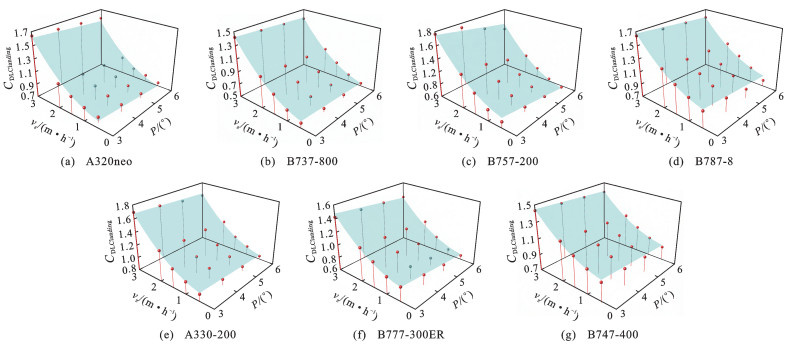
图 17 飞机着陆冲击的动载系数峰值及拟合面
Figure 17. Dynamic load coefficients during aircraft landing and its fitting surface
表 1 典型飞机的主要几何特征
Table 1. Main geometric characteristics of typical aircraft
机型 机长/ m 翼展/ m 高度/ m 机身底部与地面距离/m 前起落架与机头距离/m 前起落架轮距/m 前轮直径/m 前-主起落架间距/m 主起落架横向间距/m 主起落架个数 主起落架构型 主起落架轮距/m 主轮直径/m 横向 纵向 A320neo 37.57 35.80 11.98 1.72 16.64 0.50 0.60 12.64 7.59 2 单轴双轮 0.93 0.92 B737-800 40.67 35.79 12.55 1.52 4.09 0.41 0.69 15.60 5.72 2 单轴双轮 0.86 1.10 B757-200 47.32 38.05 13.49 2.24 5.89 0.61 0.79 18.29 7.32 2 双轴双轮 0.86 1.14 1.02 B787-8 56.72 60.12 16.92 1.68 5.41 0.73 1.02 22.78 9.80 2 双轴双轮 1.30 1.46 1.27 A330-200 58.82 60.30 17.98 2.03 6.67 0.71 1.05 22.18 10.68 2 双轴双轮 1.40 1.98 1.40 B777-300ER 73.86 64.80 18.24 2.88 5.89 0.78 1.07 31.22 10.97 2 三轴双轮 1.40 前-中轮 1.45 1.27 中-后轮 1.48 B747-400 70.67 64.92 18.8 2.71 7.75 0.91 1.24 机翼处 24.07 11.00 4 双轴双轮 1.12 1.47 1.24 机腹处 27.14 3.84  下载: 导出CSV
表 2 典型飞机的主要质量参数
Table 2. Main mass parameters of typical aircraft
机型 最大质量/kg Cm 重心位置/m 滑行 起飞 着陆 xc zc A320neo 73 900 73 500 66 300 0.940 11.88 3.79 B737-800 79 260 79 004 66 380 0.950 14.82 3.36 B757-200 116 100 115 650 95 250 0.950 17.38 4.25 B787-8 228 383 227 930 172 365 0.913 20.80 4.68 A330-200 233 900 233 000 182 000 0.950 21.07 4.80 B777-300ER 341 100 340 190 251 290 0.936 29.22 5.67 B747-400 397 800 396 893 285 763 0.952 24.37 5.94
下载: 导出CSV
表 3 典型飞机的升力相关参数
Table 3. Lift parameter of typical aircraft
机型 机翼面积/m2 平均气动弦长/m 增升系数 A320neo 143.48 4.54 1.269 B737-800 124.58 3.79 1.606 B757-200 181.25 4.77 1.723 B787-8 324.97 7.52 1.684 A330-200 428.11 8.46 1.331 B777-300ER 427.82 7.02 1.690 B747-400 524.90 8.15 1.673
下载: 导出CSV
表 4 飞机滑跑和着陆仿真工况
Table 4. Aircraft taxiing and landing simulation condition
水平 滑跑 着陆冲击 滑跑速度/ (km·h-1) 平整度 下沉速度/ (m·s-1) 仰角/ (°) C IRI/(m·km-1) 1 50 0.1 1.677 0.5 3 2 100 0.3 2.912 1.0 4 3 150 0.5 3.815 1.5 5 4 200 0.9 5.044 2.0 6 5 250 3.0
下载: 导出CSV
表 5 飞机主起落架动载系数的平均值和标准差
Table 5. Mean values and standard deviations of aircraft MLG dynamic load coefficient
机型 C 不同速度/(km·h-1)下主起落架动载系数的平均值和标准差 50 100 150 200 250 μDLC σDLC μDLC σDLC μDLC σDLC μDLC σDLC μDLC σDLC A320neo 0.1 0.986 7 0.011 4 0.947 6 0.013 5 0.883 2 0.015 3 0.796 5 0.020 4 0.689 3 0.025 2 0.3 0.986 9 0.014 9 0.948 1 0.020 6 0.882 6 0.023 9 0.794 2 0.029 3 0.687 6 0.036 0 0.5 0.986 1 0.022 2 0.947 2 0.023 6 0.882 3 0.032 8 0.794 3 0.044 6 0.687 3 0.051 6 0.9 0.988 3 0.029 1 0.945 8 0.035 2 0.881 8 0.041 9 0.791 3 0.058 0 0.684 5 0.067 1 B737-800 0.1 0.980 2 0.011 9 0.923 4 0.015 0 0.831 7 0.015 9 0.706 0 0.017 8 0.553 5 0.018 6 0.3 0.979 5 0.014 8 0.924 0 0.019 7 0.831 9 0.022 9 0.706 4 0.025 3 0.551 7 0.026 8 0.5 0.980 2 0.025 2 0.925 5 0.032 0 0.832 7 0.035 6 0.705 6 0.038 6 0.553 8 0.039 6 0.9 0.980 8 0.027 7 0.921 3 0.036 9 0.831 9 0.047 7 0.707 1 0.050 9 0.553 6 0.055 9 B757-200 0.1 0.989 8 0.010 4 0.966 7 0.012 9 0.912 1 0.017 6 0.844 6 0.018 6 0.747 0 0.020 3 0.3 0.989 6 0.017 6 0.967 9 0.021 9 0.913 1 0.024 1 0.845 6 0.028 3 0.747 5 0.033 8 0.5 0.990 2 0.021 5 0.967 2 0.028 7 0.913 1 0.029 5 0.846 6 0.035 0 0.749 9 0.041 1 0.9 0.989 3 0.027 7 0.966 8 0.031 5 0.912 4 0.038 2 0.849 7 0.046 5 0.751 5 0.053 2 B787-8 0.1 0.982 5 0.007 7 0.931 5 0.014 7 0.847 3 0.021 1 0.732 9 0.024 5 0.597 2 0.030 1 0.3 0.982 5 0.015 9 0.930 9 0.027 7 0.846 7 0.038 9 0.732 5 0.042 8 0.596 9 0.053 7 0.5 0.982 2 0.023 9 0.931 0 0.037 9 0.846 9 0.051 5 0.733 1 0.056 2 0.597 4 0.063 3 0.9 0.982 9 0.042 1 0.931 2 0.055 7 0.846 7 0.069 6 0.731 5 0.075 9 0.596 3 0.086 4 A330-200 0.1 0.989 3 0.008 1 0.959 4 0.015 3 0.908 2 0.017 1 0.835 3 0.018 9 0.739 0 0.022 3 0.3 0.989 9 0.014 8 0.958 9 0.028 1 0.907 2 0.032 5 0.834 8 0.036 4 0.737 5 0.040 2 0.5 0.989 9 0.018 8 0.959 7 0.039 7 0.908 6 0.042 0 0.836 2 0.046 9 0.739 0 0.052 0 0.9 0.989 4 0.026 1 0.959 6 0.045 3 0.907 1 0.058 1 0.835 1 0.061 6 0.738 0 0.066 5 B777-300ER 0.1 0.976 0 0.006 6 0.918 1 0.011 5 0.823 6 0.016 4 0.695 1 0.021 3 0.546 1 0.027 5 0.3 0.975 6 0.012 3 0.917 8 0.022 8 0.823 3 0.030 8 0.694 3 0.041 3 0.545 2 0.044 8 0.5 0.975 8 0.016 5 0.918 1 0.033 9 0.823 8 0.042 5 0.695 0 0.054 0 0.544 6 0.058 7 0.9 0.975 7 0.025 1 0.918 0 0.047 0 0.822 8 0.058 6 0.694 5 0.063 9 0.544 2 0.069 9 B747-400 0.1 0.986 2 0.007 4 0.947 0 0.009 2 0.881 2 0.010 3 0.793 6 0.011 5 0.680 3 0.013 8 0.3 0.985 9 0.014 7 0.947 7 0.019 5 0.880 9 0.020 9 0.793 6 0.024 0 0.681 8 0.024 4 0.5 0.986 2 0.016 5 0.946 5 0.020 1 0.880 6 0.024 7 0.793 2 0.026 6 0.679 9 0.027 9 0.9 0.986 0 0.023 8 0.947 2 0.027 9 0.879 9 0.034 6 0.794 2 0.035 5 0.680 6 0.040 2
下载: 导出CSV
表 6 飞机动载系数上限值的预估模型
Table 6. Predictive model of upper limit value of aircraft dynamic load coefficient
机型 平整度指标 CDLCul预估模型 R2 A320neo PSD CDLCul=1-6.565×10⁻⁵v2+ 2.362×10⁻²$ \sqrt{C v}$ 0.956 8 IRI CDLCul=1-6.565×10⁻⁵v2+ 4.436×10⁻³IIRI$ \sqrt{v}$ 0.956 5 B737-800 PSD CDLCul=1-9.374×10⁻⁵v2+ 2.174×10⁻²$ \sqrt{C v}$ 0.952 3 IRI CDLCul=1-9.374×10⁻⁵v2+ 4.083×10⁻³IIRI$ \sqrt{v}$ 0.952 1 B757-200 PSD CDLCul=1-5.114×10⁻⁵v2+ 2.066×10⁻²$ \sqrt{C v}$ 0.959 0 IRI CDLCul=1-5.114×10⁻⁵v2+ 3.880×10⁻³IIRI$ \sqrt{v}$ 0.958 7 B787-8 PSD CDLCul=1-8.486×10⁻⁵v2+ 3.250×10⁻²$ \sqrt{C v}$ 0.982 7 IRI CDLCul=1-8.486×10⁻⁵v2+ 6.104×10⁻³IIRI$ \sqrt{v}$ 0.982 4 A330-200 PSD CDLCul=1-5.389×10⁻⁵v2+ 2.647×10⁻²$ \sqrt{C v}$ 0.976 5 IRI CDLCul=1-5.389×10⁻⁵v2+ 4.971×10⁻³IIRI$ \sqrt{v}$ 0.976 2 B777-300ER PSD CDLCul=1-9.638×10⁻⁵v2+ 2.749×10⁻²$ \sqrt{C v}$ 0.959 9 IRI CDLCul=1-9.638×10⁻⁵v2+ 5.163×10⁻³IIRI$ \sqrt{v}$ 0.959 6 B747-400 PSD CDLCul=1-6.664×10⁻⁵v2+ 1.617×10⁻²$ \sqrt{C v}$ 0.948 5 IRI CDLCul=1-6.664×10⁻⁵v2+ 3.036×10⁻³IIRI$ \sqrt{v}$ 0.948 2
下载: 导出CSV
表 7 飞机着陆冲击CDLClanding的预估模型
Table 7. Predictive model of CDLClanding during aircraft landing
机型 回归模型 R2 A320neo CDLClanding=0.092 1vz2-0.037 3P+0.898 5 0.971 2 B737-800 CDLClanding=0.093 7vz2-0.019 7P+0.641 8 0.974 7 B757-200 CDLClanding=0.109 0vz2-0.080 2P+1.002 3 0.983 5 B787-8 CDLClanding=0.079 6vz2-0.036 0P+1.070 3 0.980 3 A330-200 CDLClanding=0.086 0vz2-0.021 3P+0.968 3 0.993 0 B777-300ER CDLClanding=0.093 7vz2-0.043 8P+0.932 4 0.978 1 B747-400 CDLClanding=0.056 6vz2-0.021 4P+0.986 6 0.986 6
下载: 导出CSV
-
[1] 蔡良才, 王海服, 张罗利, 等. 基于累积损伤的机场道面剩余寿命预测模型[J]. 交通运输工程学报, 2014, 14(4): 1-6. doi: 10.3969/j.issn.1671-1637.2014.04.001CAI Liang-cai, WANG Hai-fu, ZHANG Luo-li, et al. Prediction model of remaining life for airport pavement based on cumulative damage[J]. Journal of Traffic and Transportation Engineering, 2014, 14(4): 1-6. doi: 10.3969/j.issn.1671-1637.2014.04.001 [2] LOPRENCIPE G, ZOCCALI P. Comparison of methods for evaluating airport pavement roughness[J]. International Journal of Pavement Engineering, 2019, 20(7): 782-791. doi: 10.1080/10298436.2017.1345554 [3] HOU T X, LIU S F, LING J M, et al. Vibration response law of aircraft taxiing under random roughness excitation[J]. Applied Sciences, 2023, 13(13): 7386. doi: 10.3390/app13137386 [4] 孟宪锋, 罗萌, 江辉, 等. 飞机着陆数值仿真及机场道面动载特性研究[J]. 振动与冲击, 2024, 43(1): 308-318.MENG Xian-feng, LUO Meng, JIANG Hui, et al. Numerical simulation of aircraft landing and dynamic load characteristics of airport pavement[J]. Journal of Vibration and Shock, 2024, 43(1): 308-318. [5] 罗萌. 飞机着陆冲击数值仿真及道面动载响应特性研究[D]. 北京: 北京交通大学, 2023: 74.LUO Meng. Study on numerical simulation of aircraft landing impact and dynamic response characteristics of runway[D]. Beijing: Beijing Jiaotong University, 2023: 74. [6] 游庆龙, 凌建明, 袁捷, 等. 适应大型飞机的沥青道面结构有限元模型[J]. 交通运输工程学报, 2012, 12(2): 18-23.YOU Qing-long, LING Jian-ming, YUAN Jie, et al. Finite element model of flexible airport pavement structure for large aircraft[J]. Journal of Traffic and Transportation Engineering, 2012, 12(2): 18-23. [7] 王兴涛, 陈建峰, 叶观宝, 等. 波音747型飞机跑道滑行力学响应[J]. 交通运输工程学报, 2016, 16(2): 1-9.WANG Xing-tao, CHEN Jian-feng, YE Guan-bao, et al. Mechanical responses of Boeing 747 running on runways[J]. Journal of Traffic and Transportation Engineering, 2016, 16(2): 1-9. [8] DONG Z J, MA X Y, SHAO X Z. Airport pavement responses obtained from wireless sensing network upon digital signal processing[J]. International Journal of Pavement Engineering, 2018, 19(5): 381-390. doi: 10.1080/10298436.2017.1402601 [9] HANKE C R. The simulation of a large jet transport aircraft, Volume 1 - Mathematical model[R]. Washington DC: NASA, 1971: 1. [10] BARNES A G, YAGER T J. Simulation of aircraft behaviour on and close to the ground[R]. Brussels: AGARD, NATO, 1985: 53. [11] 雷继超, 石鑫刚, 蔡良才, 等. 滤波白噪声法的单轮起落架滑跑模型[J]. 空军工程大学学报(自然科学版), 2020, 21(3): 12-18.LEI Ji-chao, SHI Xin-gang, CAI Liang-cai, et al. A quarter landing gear taxiing model based on filtered white noise method[J]. Journal of Air Force Engineering University (Natural Science Edition), 2020, 21(3): 12-18. [12] 朱立国, 陈俊君, 袁捷, 等. 基于虚拟样机的飞机滑跑荷载[J]. 同济大学学报(自然科学版), 2016, 44(12): 1873-1879, 1888.ZHU Li-guo, CHEN Jun-jun, YUAN Jie, et al. Taxiing load analysis of aircrafts based on virtual prototype[J]. Journal of Tongji University (Natural Science), 2016, 44(12): 1873-1879, 1888. [13] LIU S F, TIAN Y, LIU L, et al. Improvement of Boeing bump method considering aircraft vibration superposition effect[J]. Applied Sciences, 2021, 11(5): 2147. doi: 10.3390/app11052147 [14] 钱劲松, 潘祥伟, 岑业波, 等. 跑道不平整激励下飞机滑跑动载分析[J]. 振动与冲击, 2022, 41(20): 176-184, 269.QIAN Jin-song, PAN Xiang-wei, CEN Ye-bo, et al. Aircraft taxiing dynamic load induced by runway roughness[J]. Journal of Vibration and Shock, 2022, 41(20): 176-184, 269. [15] 钱劲松, 岑业波, 刘东亮, 等. 机场跑道全波段不平整测试方法[J]. 交通运输工程学报, 2021, 21(5): 84-93. doi: 10.19818/j.cnki.1671-1637.2021.05.007QIAN Jin-song, CEN Ye-bo, LIU Dong-liang, et al. Measurement method of all-wave airport runway roughness[J]. Journal of Traffic and Transportation Engineering, 2021, 21(5): 84-93. doi: 10.19818/j.cnki.1671-1637.2021.05.007 [16] 许金余, 赵国藩. 机场水泥砼道面动载系数的研究[J]. 大连理工大学学报, 1997, 37(3): 367-370.XU Jin-yu, ZHAO Guo-fan. Study of dynamic load coefficient of airfield's cement concrete pavement[J]. Journal of Dalian University of Technology, 1997, 37(3): 367-370. [17] 梁磊, 顾强康, 刘国栋, 等. 基于ADAMS仿真确定飞机着陆道面动荷载[J]. 西南交通大学学报, 2012, 47(3): 502-508.LIANG Lei, GU Qiang-kang, LIU Guo-dong, et al. Using ADAMS to assess dynamic load of pavement during aircraft landing[J]. Journal of Southwest Jiaotong University, 2012, 47(3): 502-508. [18] 崔云化, 岑国平, 梁磊. 新型飞机着陆动载特性研究[J]. 计算机仿真, 2020, 37(4): 15-21.CUI Yun-hua, CEN Guo-ping, LIANG Lei. Study on the characteristics dynamic load of new aircraft landing[J]. Computer Simulation, 2020, 37(4): 15-21. [19] 孟宪锋, 赵星燕, 江辉, 等. 基于联合仿真的飞机着陆机场跑道桥动载特性研究[J]. 振动与冲击, 2024, 43(2): 105-113.MENG Xian-feng, ZHAO Xing-yan, JIANG Hui, et al. Dynamic load characteristics of an airport runway bridge during aircraft landing based on co-simulation[J]. Journal of Vibration and Shock, 2024, 43(2): 105-113. [20] 陈俊君. 基于虚拟样机的机场道面平整度评价研究[D]. 上海: 同济大学, 2017: 25.CHEN Jun-jun. Study of airport pavement roughness evaluation based on virtual prototype[D]. Shanghai: Tongji University, 2017: 25. [21] 张哲恺. 跑道平整度评价标准适用性研究——考虑飞机滑跑动力响应叠加效应[D]. 上海: 同济大学, 2020: 33.ZHANG Zhe-kai. Study on the applicability of runway smoothness evaluation criteria - Considering the superposition effect of aircraft taxi dynamic response[D]. Shanghai: Tongji University, 2020: 33. [22] 凌建明, 刘诗福, 袁捷, 等采用IRI评价机场道面平整度的适用性[J]. 交通运输工程学报, 2017, 17(1): 20-27. doi: 10.3969/j.issn.1671-1637.2017.01.003LING Jian-ming, LIU Shi-fu, YUAN Jie, et al. Applicability of IRI based evaluation of airport pavement roughness[J]. Journal of Traffic and Transportation Engineering, 2017, 17(1): 20-27. doi: 10.3969/j.issn.1671-1637.2017.01.003 [23] VAN GELDER P A, STET M J A. Evaluation methods for longitudinal evenness of runway pavements: NLR-TP-2009-190[R]. Amsterdam: National Aerospace Laboratory NLR, 2009: 7. [24] DODDS C J, ROBSON J D. The description of road surface roughness[J]. Journal of Sound and Vibration, 1973, 31(2): 175-183. doi: 10.1016/S0022-460X(73)80373-6 [25] PAWAR P R, MATHEW A T, SARAF M R. IRI (international roughness index): An indicator of vehicle response[J]. Materials Today: Proceedings, 2018, 5(5): 11738-11750. doi: 10.1016/j.matpr.2018.02.143 [26] 朱立国. 基于大型飞机虚拟样机的刚性道面动力行为模拟与表达[D]. 上海: 同济大学, 2017: 51.ZHU Li-guo. Simulation and expression of dynamic behavior of rigid pavement based on virtual prototype of large aircrafts[D]. Shanghai: Tongji University, 2017: 51. [27] 岑业波. 随机激励飞机荷载作用下的道基附加应力分布特征[D]. 上海: 同济大学, 2020: 47.CEN Ye-bo. Distribution characteristics of additional stress on subgrade under randomly excited aircraft loads[D]. Shanghai: Tongji University, 2020: 47. [28] HUDSPETH S, STAPLETON D, BALLEW J, et al. DOT/FAA/TC-18/8: Boeing 737-800 final surface roughness study data collection[R]. Washington DC: Federal Aviation Administration, 2017: 23. -

计量
- 文章访问数: 51
- HTML全文浏览量: 13
- PDF下载量: 9
- 被引次数: 0
