


Supernetwork optimization method for low-altitude emergency supply scheduling considering extreme weather impacts
-
摘要: 为提升极端天气下受灾区域的应急物资投送效率,同时兼顾调度成本与风险控制,将低空飞行路径优化与多平台资源协同作为关键着力点,研究了基于改进超网络的低空应急物资调度多目标优化方法;考虑极端天气下空-地网络的异构性及多级节点协同特征,以物资运输路径、飞行平台配置、中转节点选择为决策变量,以运输总成本、平均响应时间及系统风险最小化为三目标函数,构建了低空应急物资调度超网络规划模型;针对运输网络脆弱性与极端天气影响的量化难题,构建了改进型参数计算方法,结合极端天气风险指标实现精准评估超网络模型,在模型嵌入参数后通过协同计算能力优化应急调度路径、运输量和运输方式选择;结合多层级决策的复杂性为模型设计了变分不等式转化机制与改进投影算法;通过城市极端天气场景的数值算例验证模型可行性,输出了最优运输路径、平台分配及物资流量方案。研究结果表明:该模型框架能有效整合多类物资、异构平台与多级节点资源,改进投影算法可高效求解超网络优化问题;算例输出结果表明各物资类别对应不同平台、各条链路的最优运输量分配方案,在满足容量与操作约束的前提下,可实现成本、时间与风险目标优化,证实方法在极端天气下具备快速响应能力与实操潜力。Abstract: To improve the delivery efficiency of emergency supplies in disaster-stricken areas under extreme weather while balancing scheduling costs and risk control, the optimization of low-altitude flight paths and the collaboration of multi-platform resources were taken as key focal points, and a multi-objective optimization method for low-altitude emergency supply scheduling based on an improved supernetwork was studied. By considering the heterogeneity of air-ground networks and the collaborative characteristics of multi-level nodes under extreme weather, a supernetwork planning model for low-altitude emergency supply scheduling was constructed, with the selection of supply transportation paths, flight platform configuration, and transit node selection as decision variables, and the minimizations of total transportation cost, average response time, and system risk as three objective functions. In view of the difficulty in quantifying the vulnerability of transportation networks and the impact of extreme weather, an improved parameter calculation method was developed and combined with the extreme weather risk index to achieve an accurate evaluation of the supernetwork model. After the parameters were embedded into the model, the selections of emergency scheduling paths, transportation volumes, and transportation modes were optimized through collaborative computing capabilities. Based on the complexity of multi-level decision-making, a variational inequality transformation mechanism and an improved projection algorithm were designed for the model. The feasibility of the model was verified through a numerical example in an urban extreme weather scenario, and the optimal transportation paths, platform allocations, and supply flow schemes were output. Research results show that the model framework can effectively integrate multiple types of supplies, heterogeneous platforms, and multi-level node resources, and the improved projection algorithm can efficiently solve the supernetwork optimization problem. The output results of the numerical example show the optimal transportation volume allocation schemes for different supply categories corresponding to various platforms and links. On the premise of satisfying capacity and operational constraints, the optimization of cost, time, and risk objectives can be achieved, which confirms that the method possesses rapid response capability and practical application potential under extreme weather conditions.
-

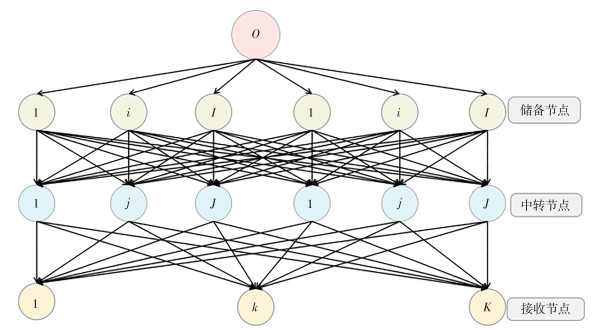
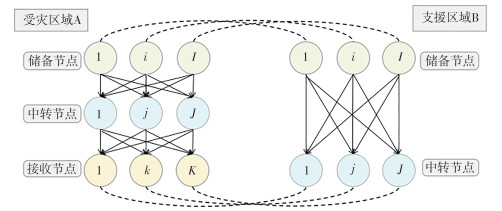
图 1 极端天气下低空应急物资调度采用的改进型超网络
Figure 1. Improved supernetwork adopted for low-altitude emergency supply scheduling under extreme weather

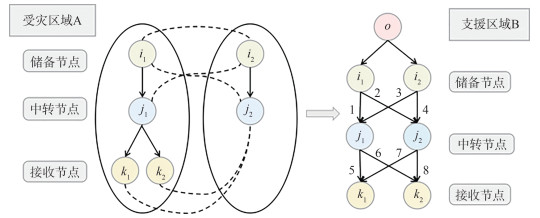
图 2 低空应急调度超网络物资流动建模形式
Figure 2. Supply flow modeling form of low-altitude emergency scheduling supernetwork

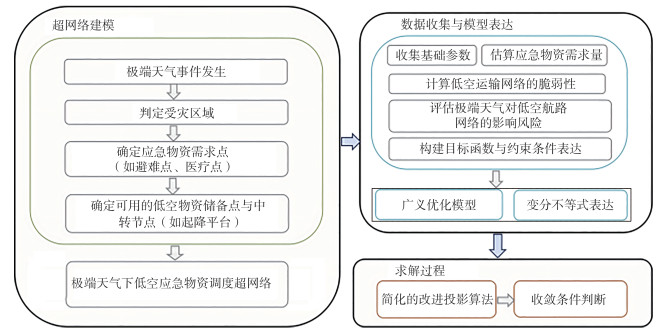
图 4 低空应急物资调度超网络框架
Figure 4. Framework for low-altitude emergency supply scheduling supernetwork
表 1 固定翼电动飞机电池在不同温度下的容量保持率
Table 1. Capacity retention rates of batteries for fixed-wing electric aircraft at different temperatures
温度/℃ 容量保持率/% $ \eta \left(T\right) $ -40 78.14 0.781 4 -20 83.30 0.833 0 -10 84.10 0.841 0 0 88.10 0.881 0 25 100.00 1.000 0 35 102.00 1.020 0 45 103.90 1.039 0 55 104.60 1.046 0  下载: 导出CSV
表 2 链路参数设置
Table 2. Setting of link parameters
链路编号 $ {\varphi }_{a}^{m, n} $ $ {w}_{a}^{n} $ $ {v}_{a}^{n} $ $ {r}_{a}^{n} $ $ {G}_{a}^{m, n} $ $ B $ 1 0.10 5.0 0.050 0.020 15 000 3 000 2 0.20 8.0 0080 0.030 18 000 4 500 3 0.15 6.0 0.060 0.025 16 500 3 600 4 0.18 7.0 0.070 0.028 17 400 3 900 5 0.12 5.5 0.055 0.022 15 600 3 300 6 0.22 8.5 0.085 0.035 18 600 4 800 7 0.16 6.5 0.065 0.026 16 800 3 750 8 0.25 9.0 0.090 0.040 19 500 5 100
下载: 导出CSV
表 3 应急物资与运输方式参数设置(按运输组织模式分类)
Table 3. Setting of parameters for emergency supplies and transportation modes (classified by transportation organization mode)
m n $ {y}^{m, n} $ $ {Y}^{m, n} $ $ {l}^{m, n} $ $ {Q}^{m} $ $ {z}^{m, n} $ $ {u}^{n} $ $ {\psi }_{a}^{m, 2} $ 1 1 0.3 25 8.0 45 0.40 2 0.2 50 20.0 85 0.30 5 3 3.0 200 60.0 190 0.12 4 2.0 65 80.0 130 0.35 2 1 0.4 30 6.0 40 0.50 2 0.3 55 18.0 80 0.35 5 3 3.5 250 55.0 180 0.15 4 2.3 75 75.0 120 0.40 3 1 0.8 40 4.0 35 0.60 3 4.5 300 50.0 160 0.20 4 3.0 85 70.0 100 0.50
下载: 导出CSV
表 4 各链路运输结果
Table 4. Transportation results of each link
m n 链路1 链路2 链路3 链路4 链路5 链路6 链路7 链路8 1 1 65.96 29.61 44.66 36.89 74.54 36.52 58.37 32.41 2 67.12 30.27 45.68 37.86 75.69 37.18 59.66 33.06 3 245.62 158.95 190.30 169.70 255.61 166.40 219.39 148.38 4 162.76 103.83 125.88 112.68 174.30 111.63 148.16 101.31 2 1 151.89 77.37 106.62 89.38 147.03 76.94 119.45 64.02 2 157.28 81.55 111.16 93.58 152.34 81.12 124.19 67.85 3 344.81 222.06 266.22 235.90 334.98 219.50 284.84 194.23 4 238.14 141.87 178.45 155.21 230.11 139.23 192.65 121.38 3 1 193.87 116.34 140.58 122.45 231.77 139.11 186.22 123.63 3 555.79 388.88 440.20 397.62 592.83 406.60 511.09 362.17 4 521.98 367.15 415.67 376.14 560.11 387.14 485.28 346.47
下载: 导出CSV
表 5 算法可扩展性验证结果
Table 5. Verification results of algorithm scalability
案例规模 基准案例 中等规模 大规模 链路数 8 35 86 路径数 8 24 48 接收点数 2 6 12 决策变量 96 420 1 032 规模增长/% 100.00 337.50 975.00 满足率/% > 98.00 99.88 99.52
下载: 导出CSV
表 6 多权重组合对比
Table 6. Comparison of multi-weight combinations
组合 权重{α1,α2,α3} 总成本 平均时间 总风险 综合目标 帕累托最优 W1 {0.33,0.34,0.33} 358 434 245.2 788.8 118 627.0 是 W2 {0.70,0.15,0.15} 268 668 282.1 738.1 188 221.0 是 W3 {0.20,0.60,0.20} 397 068 186.3 769.5 79 679.4 是 W4 {0.15,0.15,0.70} 491 305 194.6 827.2 74 304.0 否 W5 {0.45,0.45,0.10} 321 271 270.7 772.6 144 771.0 是 W6 {0.10,0.45,0.45} 670 915 224.9 957.8 67 623.8 否 W7 {0.45,0.10,0.45} 321 173 270.9 772.6 144 902.0 是
下载: 导出CSV
表 7 不同权重组合下的平台利用率对比
Table 7. Comparison of platform utilization rates under different weight combinations
% 权重组合 W2 W3 W4 垂直起降无人机 82.3 76.8 68.4 固定翼无人机 78.5 71.2 62.7 大型载人旋翼飞行器 43.2 68.9 59.3 其他低空方式 65.1 72.3 58.6 高风险链路流量占比 34.6 28.4 18.7
下载: 导出CSV
表 8 权重扰动下的目标函数统计特征
Table 8. Statistical characteristics of objective functions under weight perturbation
指标 均值 标准差 变异系数/% 最小值 最大值 极差 综合目标 79 870.40 2 407.81 3.01 76 183.90 84 531.50 8 347.56 成本 399 035 10 862 2.72 383 882 421 629 37 747 时间 186.93 2.19 1.17 184.46 191.91 7.44 风险 771.20 2.51 0.33 769.20 778.60 9.30
下载: 导出CSV
-
[1] 侯宗昊, 李钢. 考虑动态接收效率的机场枢纽震后物资接收性能评估[J/OL]. 交通运输工程学报, 2025, https://doi.org/10.19818/j.cnki.1671-1637.2026.028 .HOU Zong-hao, LI Gang. Performance evaluation of post-earthquake material reception in airport hubs considering dynamic receiving efficiency[J/OL]. Journal of Traffic and Transportation Engineering, 2025,https://doi.org/10.19818/j.cnki.1671-1637.2026.028 .[2] 梁军, 戴雨辛, 王文飒, 等. 智能飞行汽车: 驱动未来城市空中交通[J]. 交通运输工程学报, 2026, 26(3): 25-44. doi: 10.19818/j.cnki.1671-1637.2026.150 LIANG Jun, DAI Yu-xin, WANG Wen-sa, et al. Intelligent flying cars: Driving future of urban air mobility[J]. Journal of Traffic and Transportation Engineering, 2026, 26(3): 25-44. doi: 10.19818/j.cnki.1671-1637.2026.150 [3] HUANG X, LIU Q Q. Strategy of establishing the super network emergency plan system in coastal cities of China[J]. Environment, Development and Sustainability, 2021, 23(9): 13062-13086. doi: 10.1007/s10668-020-01199-7 [4] MA N, LIU Y J, LI L L. Link prediction in supernetwork: Risk perception of emergencies[J]. Journal of Information Science, 2022, 48(3): 374-392. doi: 10.1177/0165551520967303 [5] LV T, NIE Y, WANG C L, et al. Cross-regional emergency scheduling planning for petroleum based on the supernetwork model[J]. Petroleum Science, 2018, 15(3): 666-679. doi: 10.1007/s12182-018-0236-z [6] NAGURNEY A, DONG J N. Supernetworks: Decision-making for the information age[J]. Journal of Regional Science, 2003, 43(3): 615-617. [7] 王志平, 王众托. 超网络理论及其应用[M]. 北京: 科学出版社, 2008.WANG Zhi-ping, WANG Zhong-tuo. Supernetwork theory and its application[M]. Beijing: Science Press, 2008. [8] YUCESOY E, BALCIK B, COBAN E. The role of drones in disaster response: A literature review of operations research applications[J]. International Transactions in Operational Research, 2025, 32(2): 545-589. doi: 10.1111/itor.13484 [9] SANZ-MARTOS S, LÓPEZ-FRANCO M D, ÁLVAREZ-GARCÍA C, et al. Drone applications for emergency and urgent care: A systematic review[J]. Prehospital and Disaster Medicine, 2022, 37(4): 502-508. doi: 10.1017/S1049023X22000887 [10] FLEMONS K, BAYLIS B, KHAN A Z, et al. The use of drones for the delivery of diagnostic test kits and medical supplies to remote First Nations communities during COVID-19[J]. American Journal of Infection Control, 2022, 50(8): 849-856. doi: 10.1016/j.ajic.2022.03.004 [11] VORACEK D F. NASA's Armstrong flight research center: Research, technology, and engineering report 2021[R]. Washington DC: NASA, 2022. [12] KARPSTEIN R, HOLZAPFEL F, BIBERTHALER P, et al. Potential of advanced air mobility in German and Austrian organ transplantation[C]//AIAA. AIAA Aviation Forum and Ascend 2024. Reston: AIAA, 2024: AIAA2024-3556. [13] ZHANG D L, LI D, SUN H L, et al. A vehicle routing problem with distribution uncertainty in deadlines[J]. European Journal of Operational Research, 2021, 292(1): 311-326. doi: 10.1016/j.ejor.2020.10.026 [14] JALLER M, OTERO-PALENCIA C, PAHWA A. Automation, electrification, and shared mobility in urban freight: Opportunities and challenges[J]. Transportation Research Procedia, 2020, 46: 13-20. doi: 10.1016/j.trpro.2020.03.158 [15] CHOWDHURY S, EMELOGU A, MARUFUZZAMAN M, et al. Drones for disaster response and relief operations: A continuous approximation model[J]. International Journal of Production Economics, 2017, 188: 167-184. doi: 10.1016/j.ijpe.2017.03.024 [16] MURRAY C C, CHU A G. The flying sidekick traveling salesman problem: Optimization of drone-assisted parcel delivery[J]. Transportation Research Part C: Emerging Technologies, 2015, 54: 86-109. doi: 10.1016/j.trc.2015.03.005 [17] ROUSHAN A, DAS A, DUTTA A, et al. A multi-objective supply chain model for disaster relief optimization using neutrosophic programming and blockchain-based smart contracts[J]. Supply Chain Analytics, 2025, 10: 100107. doi: 10.1016/j.sca.2025.100107 [18] ZAHEDI A, KARGARI M, HUSSEINZADEH KASHAN A. Multi-objective decision-making model for distribution planning of goods and routing of vehicles in emergency multi-objective decision-making model for distribution planning of goods and routing of vehicles in emergency[J]. International Journal of Disaster Risk Reduction, 2020, 48: 101587. doi: 10.1016/j.ijdrr.2020.101587 [19] WANG J Y, WANG N Y, OUYANG M. Regional-scale dynamic planning for distributing emergency supplies under evolving tropical cyclones [J]. Reliability Engineering & System Safety, 2024, 245: 110024. [20] LI Y C, ZHANG J H, YU G D. A scenario-based hybrid robust and stochastic approach for joint planning of relief logistics and casualty distribution considering secondary disasters[J]. Transportation Research Part E: Logistics and Transportation Review, 2020, 141: 102029. doi: 10.1016/j.tre.2020.102029 [21] LEVIÄKANGAS P, MOLARIUS R, KÖNÖNEN V, et al. Devising and demonstrating an extreme weather risk indicator for use in transportation systems[J]. Transportation Research Record, 2013(2329): 45-53. [22] MOLARIUS R, KÖNÖNEN V, LEVIÄKANGAS P, et al. The extreme weather risk indicators (EWRI) for the European transport system[J]. Natural Hazards, 2014, 72(1): 189-210. doi: 10.1007/s11069-013-0650-x [23] 袁毓杰, 李嘉帅, 赵昕颐, 等. 面向动态需求与可变间隔的eVTOL联合调度方法[J]. 航空学报, 2026, 47(1): 22-41.YUAN Yu-jie, LI Jia-shuai, ZHAO Xin-yi, et al. eVTOL scheduling schemes for dynamic demand and variable intervals[J]. Acta Aeronautica et Astronautica Sinica, 2026, 47(1): 22-41. [24] WANG W, LIU S F, LI B. A hypernetwork based model for emergency response system[J]. Chinese Journal of Electronics, 2022, 31(1): 129-136. [25] SABERI S, CRUZ J M, SARKIS J, et al. A competitive multiperiod supply chain network model with freight carriers and green technology investment option[J]. European Journal of Operational Research, 2018, 266(3): 934-949. doi: 10.1016/j.ejor.2017.10.043 [26] MA X, DING S T, PAN Y L. Predicting the impact of temperature on eVTOL battery systems using experimental data from airworthiness-certified fixed-wing electric aircraft [J]. SAE Technical Paper Series, 2024, 1: 2024-1-7021. [27] KÄBITZ S, GERSCHIER J B, ECKER M, et al. Cycle and calendar life study of a graphite| LiNi1/3Mn1/3Co1/3O2 Li-ion high energy system. Part A: Full cell characterization[J]. Journal of Power Sources, 2013, 239: 572-583. doi: 10.1016/j.jpowsour.2013.03.045 [28] ZENG L T, HU Y L, LU C Y, et al. Arrhenius equation-based model to predict lithium-ions batteries'performance [J]. Journal of Marine Science and Engineering, 2022, 10(10): 1553. doi: 10.3390/jmse10101553 [29] NAGURNEY A. On the relationship between supply chain and transportation network equilibria: A supernetwork equivalence with computations[J]. Transportation Research Part E: Logistics and Transportation Review, 2006, 42(4): 293-316. doi: 10.1016/j.tre.2005.02.001 [30] KORPELEVICH G M. The extragradient method for finding saddle points and other problems[J]. Matecon, 1976, 12: 747-756. [31] NAGURNEY A. Network economics: A variational inequality approach [M]. Dordrecht: Springer Netherlands, 1993. [32] NAGURNEY A. Supply chain networks, wages, and labor productivity: Insights from Lagrange. Analysis and computations[J]. Journal of Global Optimization, 2022, 83(2): 615-638. [33] PERERA A T D, NIK V M, CHEN D L, et al. Quantifying the impacts of climate change and extreme climate events on energy systems[J]. Nature Energy, 2020, 5(5): 150-159. [34] THORNTON H E, SCAIFE A A, HOSKINS B J, et al. Skilful seasonal prediction of winter gas demand[J]. Environmental Research Letters, 2019, 14(2): 024009. doi: 10.1088/1748-9326/aaf338 [35] HOLGUÍN-VERAS J, PÉREZ N, JALLER M, et al. On the appropriate objective function for post-disaster humanitarian logistics models[J]. Journal of Operations Management, 2013, 31(5): 262-280. doi: 10.1016/j.jom.2013.06.002 [36] YANG H W, ZHANG P, ZHANG P W, et al. Optimization of a two-stage emergency logistics system considering public psychological risk perception under earthquake disaster[J]. Scientific Reports, 2024, 14: 31983. doi: 10.1038/s41598-024-83670-3 [37] WANG D J, PENG J, YANG H F, et al. Distributionally robust location-allocation with demand and facility disruption uncertainties in emergency logistics [J]. Computers & Industrial Engineering, 2023, 184: 109617. [38] CHEN M, ZHOU S L, GONG Y H, et al. Medical emergency supplies dispatching vehicle path optimization based on demand urgency [J]. Applied Mathematics and Nonlinear Sciences, 2024, 9: 20230270. [39] SCHNEIDER M, STENGER A, GOEKE D. The electric vehicle-routing problem with time windows and recharging stations [J]. Transportation Science, 2014, 48(4): 500-520. doi: 10.1287/trsc.2013.0490 -

计量
- 文章访问数: 154
- HTML全文浏览量: 91
- PDF下载量: 68
- 被引次数: 0
