


Calculation model for vertical stress of shallowly buried pipe-roofing tunnels and its engineering application
-
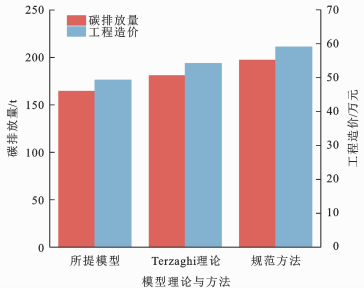
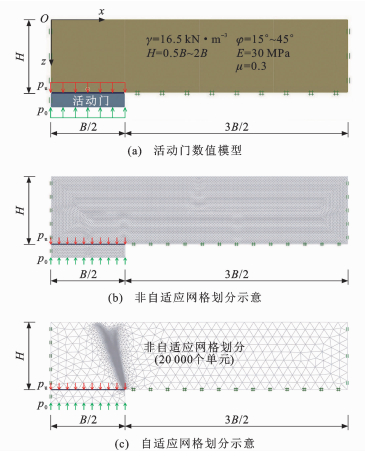
摘要: 传统水平微分单元法表征土拱效应时,忽略了单元层间剪切力对竖向应力传递的贡献,从而导致计算结果偏于保守。鉴于此,首先将管幕法隧道简化为活动门(Trapdoor)模型,采用有限元极限分析(FELA)方法,系统探究了不同深宽比及土体内摩擦角条件下浅埋活动门滑裂角的变化规律;据此,基于大主应力轨迹线,建立了拱形微分单元竖向应力计算模型,推导了浅埋活动门竖向应力解;进一步阐明了土体内摩擦角、剪胀角及地面超载对活动门归一化竖向应力的影响规律;最后将所提模型应用于某管幕法隧道工程,探究其工程适用性。研究结果表明:所提模型计算结果与既有解、FELA解及室内模型试验结果吻合良好;相较于经典Terzaghi理论及规范方法,归一化竖向应力分别降低30.7%与45.3%,碳排放量分别减少9.1%与16.6%。Abstract: The traditional horizontal differential element method used to characterize the soil arching effect neglects the contribution of inter-layer shear forces to vertical stress transfer, leading to conservative calculation results. In view of this, the pipe-roofing tunnel was first simplified into a "trapdoor" model. A finite element limit analysis (FELA) method was adopted to systematically investigate the variation of the slip angle of the shallow trapdoor under different depth-to-width ratios and soil internal friction angles. Accordingly, based on the trajectory of the major principal stress, a vertical stress calculation model of an arched differential element was established, and the vertical stress solution for the shallow trapdoor was derived. Furthermore, the influences of soil internal friction angle, dilation angle, and surface surcharge on the normalized vertical stress of the trapdoor were clarified. Finally, the proposed model was applied to a pipe-roofing tunnel project to explore its engineering applicability. Research results indicate that the calculation results of the proposed model show good agreement with existing solutions, FELA solutions, and laboratory model test results; compared with the classical Terzaghi theory and code methods, the proposed model reduces the normalized vertical stress by 30.7% and 45.3%, respectively, and it reduces carbon emissions by 9.1% and 16.6%, respectively.
-

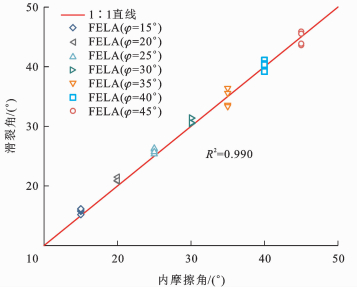
图 3 滑裂角和内摩擦角拟合结果
Figure 3. Fitting result of slip surface angle and internal friction angle

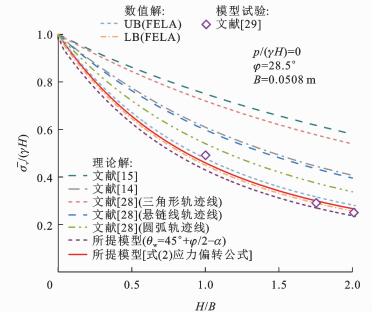
图 7 不同深宽比下归一化竖向应力计算结果对比
Figure 7. Comparison chart of normalized vertical stress calculation results under different aspect ratios

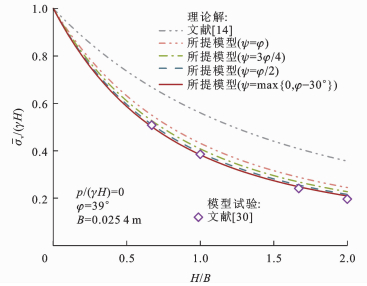
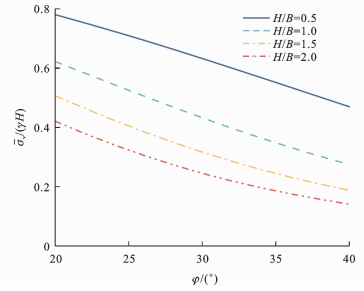
图 8 不同理论下归一化竖向应力计算结果对比
Figure 8. Comparison of normalized vertical stress calculation results by different theories

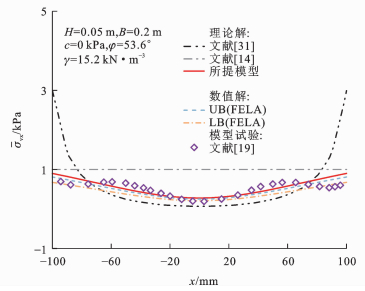
图 9 竖向应力分布计算结果对比
Figure 9. Comparison of the calculation results of vertical stress distribution

图 10 不同深宽比下内摩擦角对归一化竖向应力的影响规律
Figure 10. Influence law of internal friction angle on normalized vertical stress under different depth-to-width ratios

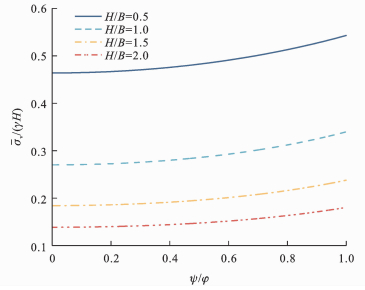
图 11 不同深宽比下归一化剪胀角对归一化竖向应力的影响规律
Figure 11. Influence law of normalized dilatancy angle on normalized vertical stress under different depth-to-width ratios

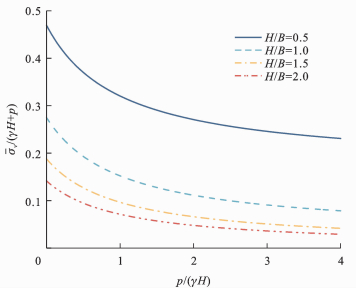
图 12 不同深宽比下归一化地面超载对归一化竖向应力的影响规律
Figure 12. Influence law of normalized ground surcharge on normalized vertical stress under different depth-to-width ratios

图 15 竖向应力分布计算结果对比
Figure 15. Comparison of calculation results of vertical stress distribution

图 16 归一化竖向应力随深度变化对比
Figure 16. Comparison of normalized vertical stress varying with depth
表 1 不同深宽比及内摩擦角的活动门上方滑裂角的变化
Table 1. Variation of slip surface angle above the trapdoors under different depth-to-width ratios and internal friction angles

 下载: 导出CSV
表 2 不同深宽比及内摩擦角的活动门上方滑裂角的大小
Table 2. Slip surface angle above the trapdoors under different depth-to-width ratios and internal friction angles
φ/(°) H/B α/(°) φ/(°) H/B α/(°) 15 0.5 15.20 30 1.5 31.38 15 1.0 15.74 30 2.0 30.60 15 1.5 15.96 35 0.5 35.56 15 2.0 16.16 35 1.0 36.39 20 0.5 20.90 35 1.5 33.58 20 1.0 20.82 35 2.0 33.33 20 1.5 21.48 40 0.5 39.19 20 2.0 20.91 40 1.0 41.09 25 0.5 26.16 40 1.5 39.49 25 1.0 26.30 40 2.0 39.32 25 1.5 25.34 45 0.5 45.90 25 2.0 25.72 45 1.0 45.54 30 0.5 30.48 45 1.5 43.62 30 1.0 30.61 45 2.0 43.88
下载: 导出CSV
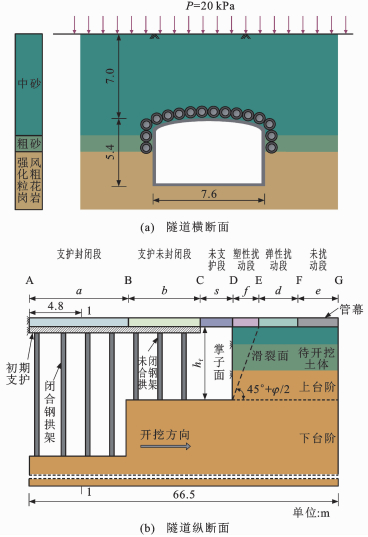
表 3 现场地质情况
Table 3. The on-site geological conditions
参数 土体 中砂 粗砂 花岗岩 层顶深度 0 8.1 9.7 黏聚力c/kPa 0 0 27.5 内摩擦角φ/(°) 33.0 26.0 25.5 土体重度γ/(kN·m-3) 19.2 19.8 18.3 弹性模量E/MPa 30 42 205
下载: 导出CSV
-
[1] 陈湘生, 付艳斌, 陈曦, 等. 地下空间施工技术进展及数智化技术现状[J]. 中国公路学报, 2022, 35(1): 1-12.CHEN Xiang-sheng, FU Yan-bin, CHEN Xi, et al. Progress in underground space construction technology and technical challenges of digital intelligence[J]. China Journal of Highway and Transport, 2022, 35(1): 1-12. [2] 陈丽俊, 陈建勋, 高剑峰, 等. 软岩隧道初期支护主动补强加固原理与工程实践[J]. 交通运输工程学报, 2025, 25(4): 80-93. doi: 10.19818/j.cnki.1671-1637.2025.04.006CHEN Li-jun, CHEN Jian-xun, GAO Jian-feng, et al. Principle and engineering practice of active reinforcement for initial support of soft rock tunnels[J]. Journal of Traffic and Transportation Engineering, 2025, 25(4): 80-93. doi: 10.19818/j.cnki.1671-1637.2025.04.006 [3] 刘小锋, 李晓龙, 段盛龙, 等. 隧道结构对其联络通道顶管施工破洞过程的力学响应[J]. 交通运输工程学报, 2025, 25(4): 94-108. doi: 10.19818/j.cnki.1671-1637.2025.04.007LIU Xiao-feng, LI Xiao-long, DUAN Sheng-long, et al. Mechanical response of tunnel structure to hole-breaking process of cross passage pipe jacking construction[J]. Journal of Traffic and Transportation Engineering, 2025, 25(4): 94-108. doi: 10.19818/j.cnki.1671-1637.2025.04.007 [4] 来弘鹏, 姚毅, 高强, 等. 浅埋隧道开挖引起地层位移的双极坐标求解法[J]. 交通运输工程学报, 2023, 23(4): 178-189. doi: 10.19818/j.cnki.1671-1637.2023.04.013LAI Hong-peng, YAO Yi, GAO Qiang, et al. Bipolar coordinate solving method of ground displacement caused by shallow tunnel excavation[J]. Journal of Traffic and Transportation Engineering, 2023, 23(4): 178-189. doi: 10.19818/j.cnki.1671-1637.2023.04.013 [5] 徐敬民, 徐成华, 施烨辉, 等. 隧道施工引起的松砂土层与地表结构响应[J]. 交通运输工程学报, 2023, 23(4): 190-204. doi: 10.19818/j.cnki.1671-1637.2023.04.014XU Jing-min, XU Cheng-hua, SHI Ye-hui, et al. Responses of loose sand ground and surface structure caused by tunnel construction[J]. Journal of Traffic and Transportation Engineering, 2023, 23(4): 190-204. doi: 10.19818/j.cnki.1671-1637.2023.04.014 [6] 宋伟涛, 张佩, 杜修力, 等. 土性对浅埋盾构隧道施工地层响应影响研究[J]. 岩土力学, 2025, 46(7): 2179-2188.SONG Wei-tao, ZHANG Pei, DU Xiu-li, et al. Influence of soil property on ground response during construction of shallow shield tunnel[J]. Rock and Soil Mechanics, 2025, 46(7): 2179-2188. [7] 刘德仁, 安政山, 徐硕昌, 等. 靖远地区大厚度黄土地基浸水湿陷过程及土中竖向应力特征试验研究[J]. 岩土力学, 2023, 44(1): 268-278.LIU De-ren, AN Zheng-shan, XU Shuo-chang, et al. Experimental study on immersion collapsibility process and vertical stress characteristics of large thickness loess foundation in Jingyuan area[J]. Rock and Soil Mechanics, 2023, 44(1): 268-278. [8] 芮瑞, 杨宇, 杨海青, 等. 地层塌陷引起土体变形的阵列式三维活动门试验研究[J]. 岩石力学与工程学报, 2023, 42(12): 2898-2907.RUI Rui, YANG Yu, YANG Hai-qing, et al. Array three-dimensional trapdoor experimental study on soil deformation due to ground collapse[J]. Chinese Journal of Rock Mechanics and Engineering, 2023, 42(12): 2898-2907. [9] 徐海岩, 王志杰, 陈昌健, 等. 土砂互层隧道塌方及演变规律的模型试验研究[J]. 岩土工程学报, 2021, 43(6): 1050-1058.XU Hai-yan, WANG Zhi-jie, CHEN Chang-jian, et al. Model tests on characteristics and evolution of tunnel collapse in soil-sand interbedded strata[J]. Chinese Journal of Geotechnical Engineering, 2021, 43(6): 1050-1058. [10] WANG G S, LU D C, JI G G, et al. A lifecycle carbon emission evaluation model for urban underground highway tunnel facilities[J]. Underground Space, 2025, 24: 352-370. doi: 10.1016/j.undsp.2025.04.005 [11] 陈福全, 赖丰文, 李大勇. 受空洞坍塌影响的加筋路基研究综述[J]. 岩土力学, 2018, 39(9): 3362-3376.CHEN Fu-quan, LAI Feng-wen, LI Da-yong. State of the art in research of geosynthetic-reinforced embankment overlying voids[J]. Rock and Soil Mechanics, 2018, 39(9): 3362-3376. [12] 张程程, 刘观仕, 杨景胜, 等. 板间距对风积沙金属装配式基础上拔承载力影响研究[J]. 岩石力学与工程学报, 2022, 41(10): 2149-2160.ZHANG Cheng-cheng, LIU Guan-shi, YANG Jing-sheng, et al. Influence of slab spacing on uplift bearing capacity of metal grillage foundations in aeolian sand[J]. Chinese Journal of Rock Mechanics and Engineering, 2022, 41(10): 2149-2160. [13] 吴楷, 陈仁朋, 孟凡衍, 等. 基坑开挖坑底土拱效应离心模型试验及数值分析[J]. 岩土工程学报, 2024, 46(9): 1936-1944.WU Kai, CHEN Ren-peng, MENG Fan-yan, et al. Centrifuge modeling of excavation and numerical analyses of soil arching below excavation base[J]. Chinese Journal of Geotechnical Engineering, 2024, 46(9): 1936-1944. [14] TERZAGHI K. Theoretical soil mechanics[M]. New York: John Wiley & Sons, 1943. [15] HANDY R L. The arch in soil arching[J]. Journal of Geotechnical Engineering, 1985, 111(3): 302-318. doi: 10.1061/(ASCE)0733-9410(1985)111:3(302) [16] 陈若曦, 朱斌, 陈云敏, 等. 基于主应力轴旋转理论的修正Terzaghi松动土压力[J]. 岩土力学, 2010, 31(5): 1402-1406.CHEN Ruo-xi, ZHU Bin, CHEN Yun-min, et al. Modified Terzaghi loozening earth pressure based on theory of main stress axes rotation[J]. Rock and Soil Mechanics, 2010, 31(5): 1402-1406. [17] PAPAMICHOS E, VARDOULAKIS I, HEIL L K. Overburden modeling above a compacting reservoir using a trap door apparatus[J]. Physics and Chemistry of the Earth, Part A: Solid Earth and Geodesy, 2001, 26(1/2): 69-74. [18] SANTICHAIANANT K. Centrifuge modeling and analysis of active trapdoor in sand[D]. Boulder: University of Colorado at Boulder, 2002: 92-96. [19] HASSOUN M, VILLARD P, AL HEIB M, et al. Soil reinforcement with geosynthetic for localized subsidence problems: Experimental and analytical analysis[J]. International Journal of Geomechanics, 2018, 18(10): 04018133. doi: 10.1061/(ASCE)GM.1943-5622.0001265 [20] 赖丰文, 陈福全, 万梁龙. 考虑不完全土拱效应的浅层地基竖向应力计算[J]. 岩土力学, 2018, 39(7): 2546-2554.LAI Feng-wen, CHEN Fu-quan, WAN Liang-long. Vertical stress calculation of shallow foundations based on partially developed soil arching effect[J]. Rock and Soil Mechanics, 2018, 39(7): 2546-2554. [21] EVANS C H. An examination of arching in granular soils[D]. Cambridge: Massachusetts Institute of Technology, 1983: 60-63. [22] RUI R, VAN TOL F, XIA Y Y, et al. Evolution of soil arching: 2D analytical models[J]. International Journal of Geomechanics, 2018, 18(6): 04018056. doi: 10.1061/(ASCE)GM.1943-5622.0001169 [23] LAI F W, CHEN S X, XUE J F, et al. New analytical solutions for shallow cohesive soils overlying trench voids under various slip surfaces[J]. Transportation Geotechnics, 2020, 25: 100411. doi: 10.1016/j.trgeo.2020.100411 [24] LAI F W, YANG D Y, LIU S Y, et al. Towards an improved analytical framework to estimate active earth pressure in narrow c-ϕ soils behind rotating walls about the base[J]. Computers and Geotechnics, 2022, 141: 104544. doi: 10.1016/j.compgeo.2021.104544 [25] LAI F W, ZHANG N N, LIU S Y, et al. A generalised analytical framework for active earth pressure on retaining walls with narrow soil[J]. Géotechnique, 2024, 74(11): 1127-1142. [26] CHEN F Q, LUO S C, LAI F W. New analytical solutions for cohesive-frictional soils above deep active trapdoors[J]. International Journal of Geomechanics, 2022, 22(12): 04022235. doi: 10.1061/(ASCE)GM.1943-5622.0002592 [27] FU C Z, HUANG M S, SHI Z H, et al. Upper bound stability analysis of soil-nailed slopes with a discretized technique in layered ground[J]. International Journal of Geomechanics, 2024, 24(11): 04024243. doi: 10.1061/IJGNAI.GMENG-9907 [28] DA SILVA BURKE T S, ELSHAFIE M Z E B. Arching in granular soils: Limit state equilibrium[J]. Géotechnique, 2021, 71(8): 700-713. [29] IGLESIA G R, EINSTEIN HH, WHITMAN R V. Investigation of soil arching with centrifuge tests[J]. Journal of Geotechnical and Geoenvironmental Engineering, 2014, 140(2): 04013005. doi: 10.1061/(ASCE)GT.1943-5606.0000998 [30] IGLESIA G R. Trapdoor experiments on the centrifuge: A study of arching in geomaterials and similitude in geotechnical models[D]. Cambridge: Massachusetts Institute of Technology, 1991: 112-118. [31] LIANG L J, XU C J. Numerical and theoretical research on stress distribution in the loosening zone of the trapdoor problem[J]. International Journal for Numerical and Analytical Methods in Geomechanics, 2019, 43(7): 1426-1447. doi: 10.1002/nag.2906 [32] 陈铖, 来弘鹏, 刘禹阳, 等. 密实细砂层地铁暗挖隧道新型超前加固材料性能及注浆参数研究[J]. 岩土工程学报, 2025, 47(7): 1432-1442.CHEN Cheng, LAI Hong-peng, LIU Yu-yang, et al. Performance and grouting parameters of new advanced reinforcement materials for underground tunnels with dense fine sand layers[J]. Chinese Journal of Geotechnical Engineering, 2025, 47(7): 1432-1442. [33] PECK B B. Deep excavation and tunnelling in soft ground, State of the art volume[C]//ICSMFE. Proceedings of the 7th International Conference on Soil Mechanics and Foundation Engineering. Mexico City: ICSMFE, 1969: 225-290. [34] 朱才辉, 李宁. 隧道施工诱发地表沉降估算方法及其规律分析[J]. 岩土力学, 2016, 37(增2): 533-542.ZHU Cai-hui, LI Ning. Estimation method and law analysis of surface settlement due to tunneling[J]. Rock and Soil Mechanics, 2016, 37(S2): 533-542. [35] 李然, 王圣涛, 王静峰, 等. 考虑微拱效应的隧道管棚受力机制分析与支护效果评价[J]. 岩土工程学报, 2023, 45(3): 561-570.LI Ran, WANG Sheng-tao, WANG Jing-feng, et al. Mechanical behaviors and supporting effect evaluation of pipe roof in tunneling engineering considering micro-arch effects[J]. Chinese Journal of Geotechnical Engineering, 2023, 45(3): 561-570. [36] CHEN R P, TANG L J, YIN X S, et al. An improved 3D wedge-prism model for the face stability analysis of the shield tunnel in cohesionless soils[J]. Acta Geotechnica, 2015, 10(5): 683-692. doi: 10.1007/s11440-014-0304-5 [37] 黎春林. 盾构开挖面三维曲面体破坏模型及支护力计算方法研究[J]. 岩土力学, 2022, 43(8): 2092-2102.LI Chun-lin. Curved solid failure model and calculation method of supporting pressure for shield tunnel excavation face[J]. Rock and Soil Mechanics, 2022, 43(8): 2092-2102. -

计量
- 文章访问数: 52
- HTML全文浏览量: 40
- PDF下载量: 16
- 被引次数: 0
